Patricia Johann – författare
Visar alla böcker från författaren . Handla med fri frakt och snabb leverans.
4 produkter
4 produkter
E-bok
PDF, Engelska, 2012686 kr
Läs direkt efter köp
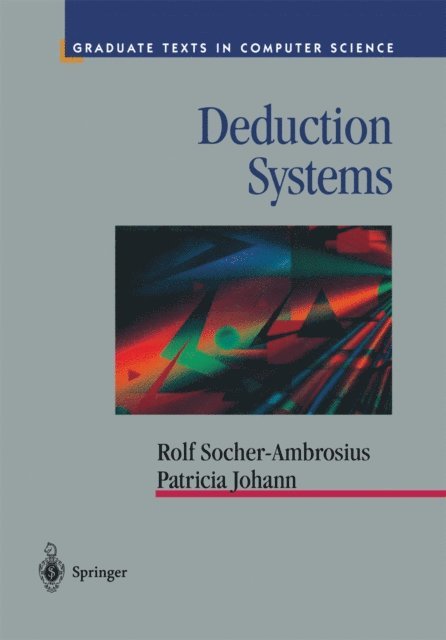
The idea of mechanizing deductive reasoning can be traced all the way back to Leibniz, who proposed the development of a rational calculus for this purpose. But it was not until the appearance of Frege''s 1879 Begriffsschrift-"not only the direct ancestor of contemporary systems of mathematical logic, but also the ancestor of all formal languages, including computer programming languages" ([Dav83])-that the fundamental concepts of modern mathematical logic were developed. Whitehead and Russell showed in their Principia Mathematica that the entirety of classical mathematics can be developed within the framework of a formal calculus, and in 1930, Skolem, Herbrand, and Godel demonstrated that the first-order predicate calculus (which is such a calculus) is complete, i. e. , that every valid formula in the language of the predicate calculus is derivable from its axioms. Skolem, Herbrand, and GOdel further proved that in order to mechanize reasoning within the predicate calculus, it suffices to Herbrand consider only interpretations of formulae over their associated universes. We will see that the upshot of this discovery is that the validity of a formula in the predicate calculus can be deduced from the structure of its constituents, so that a machine might perform the logical inferences required to determine its validity. With the advent of computers in the 1950s there developed an interest in automatic theorem proving.
Häftad, Engelska, 2011
559 kr
Skickas inom 10-15 vardagar
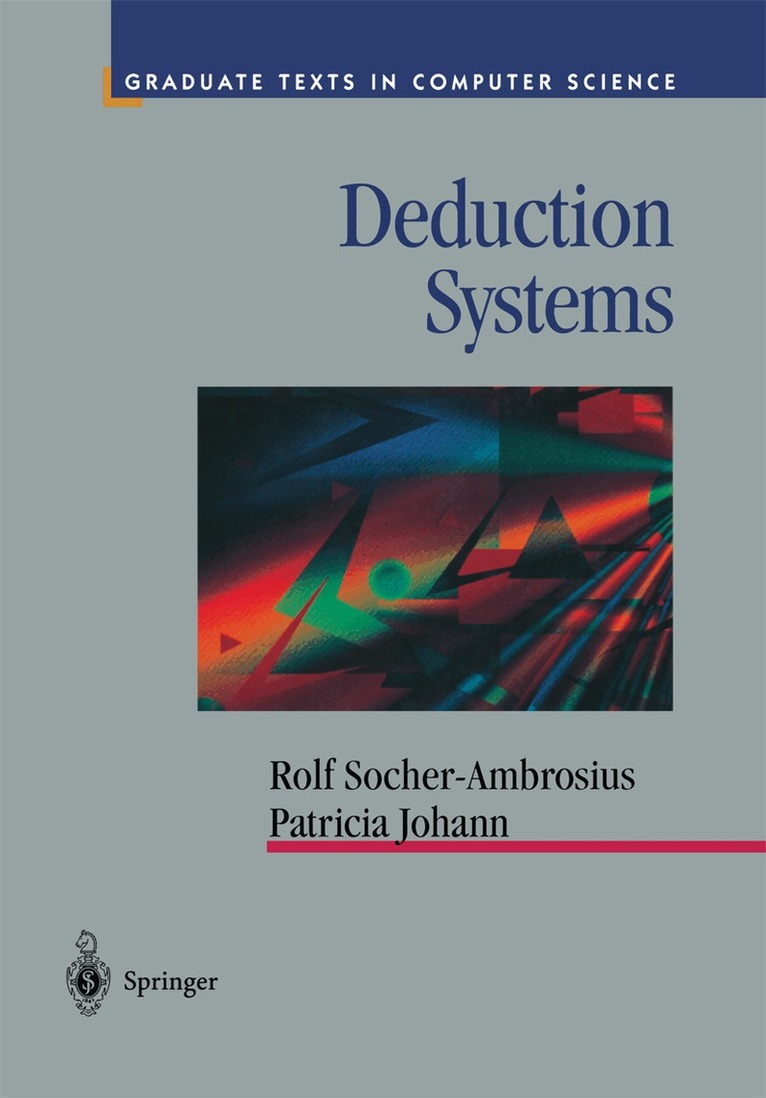
The idea of mechanizing deductive reasoning can be traced all the way back to Leibniz, who proposed the development of a rational calculus for this purpose. But it was not until the appearance of Frege's 1879 Begriffsschrift-"not only the direct ancestor of contemporary systems of mathematical logic, but also the ancestor of all formal languages, including computer programming languages" ([Dav83])-that the fundamental concepts of modern mathematical logic were developed. Whitehead and Russell showed in their Principia Mathematica that the entirety of classical mathematics can be developed within the framework of a formal calculus, and in 1930, Skolem, Herbrand, and Godel demonstrated that the first-order predicate calculus (which is such a calculus) is complete, i. e. , that every valid formula in the language of the predicate calculus is derivable from its axioms. Skolem, Herbrand, and GOdel further proved that in order to mechanize reasoning within the predicate calculus, it suffices to Herbrand consider only interpretations of formulae over their associated universes. We will see that the upshot of this discovery is that the validity of a formula in the predicate calculus can be deduced from the structure of its constituents, so that a machine might perform the logical inferences required to determine its validity. With the advent of computers in the 1950s there developed an interest in automatic theorem proving.
Häftad, Engelska, 2026
714 kr
Skickas inom 10-15 vardagar
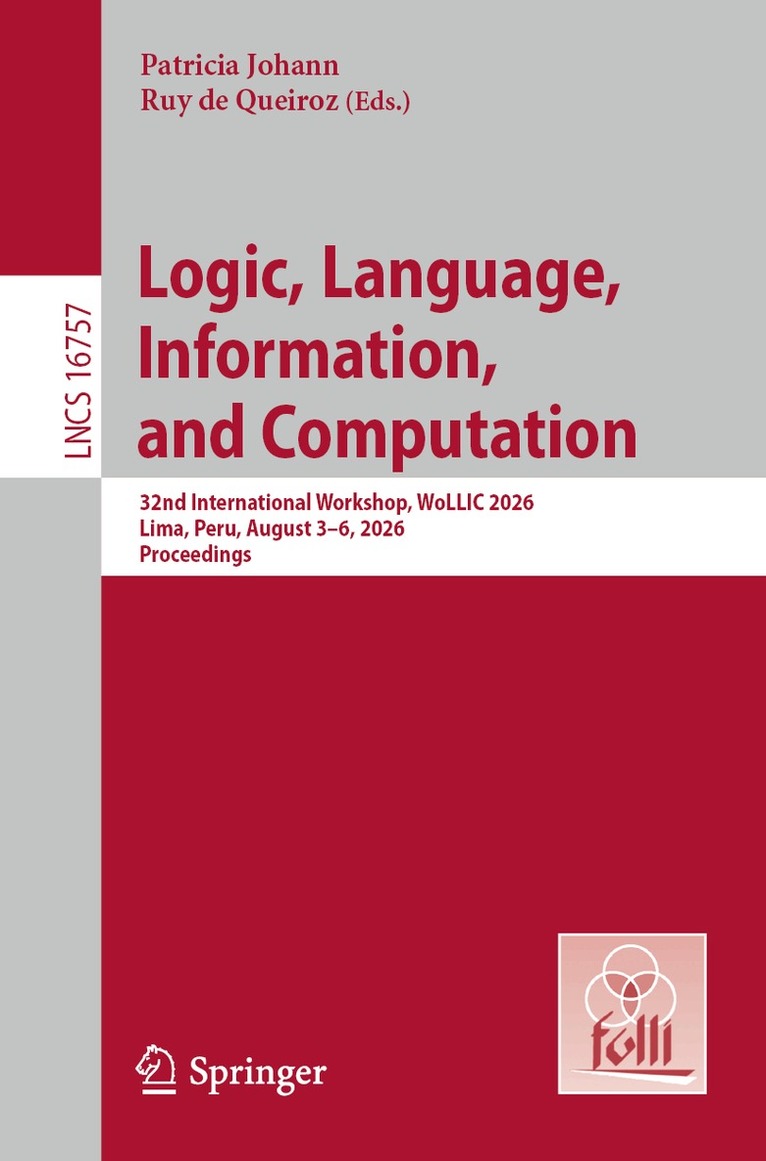
Edited in collaboration with FoLLI, the Association of Logic, Language and Information this book constitutes the refereed proceedings of the 32nd International Workshop on Logic, Language, Information, and Computation, WoLLIC 2026, in Lima, Peru, during August 3-6, 2026.The 9 full papers included in this book were carefully reviewed and selected from 17 submissions. The WoLLIC conference aim of fostering interdisciplinary research in pure and applied logic, information and computation.
E-bok
Engelska, 2026975 kr
Läs direkt efter köp
Edited in collaboration with FoLLI, the Association of Logic, Language and Information this book constitutes the refereed proceedings of the 32nd International Workshop on Logic, Language, Information, and Computation, WoLLIC 2026, in Lima, Peru, during August 3-6, 2026.The 9 full papers included in this book were carefully reviewed and selected from 17 submissions. The WoLLIC conference aim of fostering interdisciplinary research in pure and applied logic, information and computation.