• Fri frakt över 249 kr
  • •
  • Snabba leveranser
  • •
  • Billiga böcker
Kundservice

Du är på sajten för privatpersoner.

Företag, bibliotek eller offentlig verksamhet?

Du handlar på classic.bokus.com, där alla dina funktioner finns intakta.
Till classic.bokus.com
Bokus logotyp. Gå till startsidan.
  • Erbjudanden
  • Nyheter
  • Student
  • Topplistor
  • Barn & ungdom
  • Bokus Play
  • E-böcker
  • Pocketböcker
  • Spel & pussel

10% rabatt på allt med kod NYSTART10 →

Sidfot

Mina sidor

    Hjälp

    • Kundservice
    • Vanliga frågor och svar
    • Frakt och leverans
    • Retur vid ångerrätt
    • Reklamera vara
    • Betalning
    • Köpvillkor
    • Allmänna villkor
    • Information om webbplatsens tillgänglighet

    Om Bokus

    • Om oss
    • Pressrum
    • För studenter
    • För företag
    • För bibliotek och offentlig verksamhet
    • För leverantörer
    • Hållbarhet

    Populärt

    • Aktuella erbjudanden
    • Presentkort
    • Studentlitteratur
    • Nya böcker
    • Topplistor
    • Signerade böcker
    • Engelska böcker

    Inspiration

    • Boktips
    • BookTok
    • Populära bokserier
    • Barnbokskaraktärer
    • Populära författare
    Logotyp för Bokus
    Följ oss på Facebook (extern länk)Följ oss på Instagram (extern länk)Följ oss på YouTube (extern länk)Följ oss på TikTok (extern länk)
    bokus @ CookiesAnpassa cookiesIntegritetspolicyKöpvillkor
    Till Citymail hemsida (extern länk)Till Budbee hemsida (extern länk)Till Postnord hemsida (extern länk)Till Schenker hemsida (extern länk)Till Early Bird hemsida (extern länk)Till Walleys hemsida (extern länk)
    1. Data och IT
    2. Systemvetenskap och AI

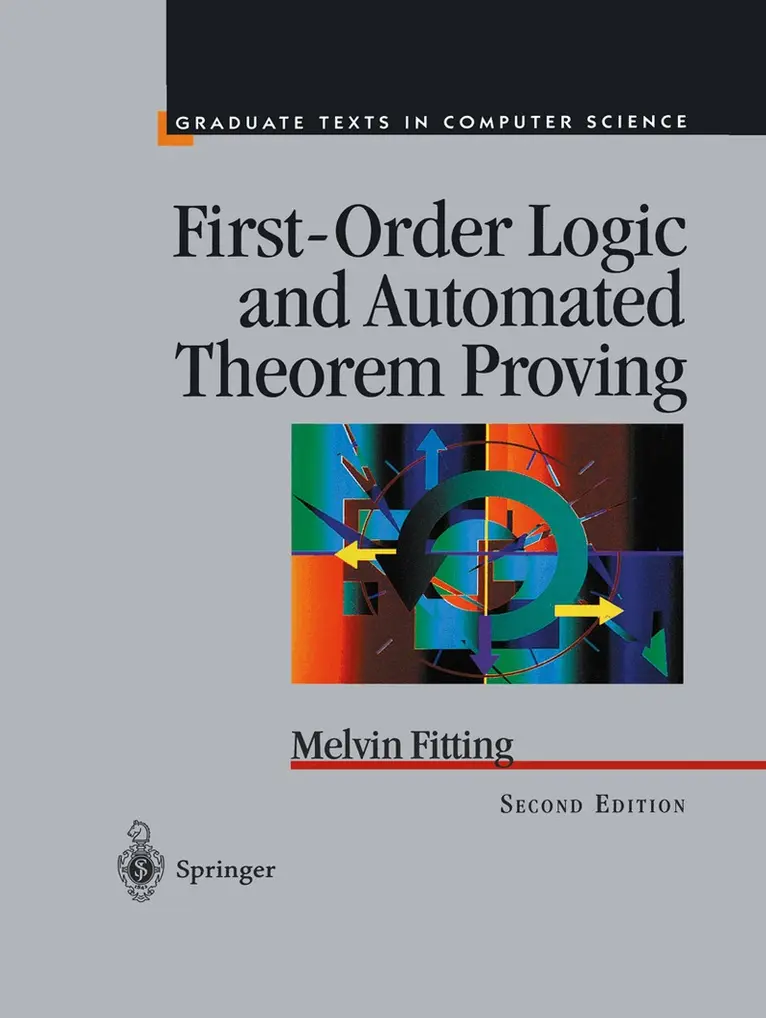
    First-Order Logic and Automated Theorem Proving

    AvMelvin Fitting

    Häftad, Engelska, 2013

    Del i serien Texts in Computer Science

    977 kr

    Beställningsvara. Skickas inom 10-15 vardagar. Fri frakt över 249 kr.

    Fler format och utgåvor

    E-bok

    1 176 kr

    E-bok

    1 174 kr

    Beskrivning

    There are many kinds of books on formal logic. Some have philosophers as their intended audience, some mathematicians, some computer scien­ tists. Although there is a common core to all such books, they will be very different in emphasis, methods, and even appearance. This book is intended for computer scientists. But even this is not precise. Within computer science formal logic turns up in a number of areas, from pro­ gram verification to logic programming to artificial intelligence. This book is intended for computer scientists interested in automated theo­ rem proving in classical logic. To be more precise yet, it is essentially a theoretical treatment, not a how-to book, although how-to issues are not neglected. This does not mean, of course, that the book will be of no interest to philosophers or mathematicians. It does contain a thorough presentation of formal logic and many proof techniques, and as such it contains all the material one would expect to find in a course in formal logic covering completeness but, not incompleteness issues. The first item to be addressed is, What are we talking about and why are we interested in it? We are primarily talking about truth as used in mathematical discourse, and our interest in it is, or should be, self­ evident. Truth is a semantic concept, so we begin with models and their properties. These are used to define our subject.

    Produktinformation

    • Utgivningsdatum:2013-06-26
    • Mått:170 x 244 x 19 mm
    • Vikt:601 g
    • Format:Häftad
    • Språk:Engelska
    • Serie:Texts in Computer Science
    • Antal sidor:326
    • Upplaga:2
    • Förlag:Springer-Verlag New York Inc.
    • ISBN:9781461275152

    Utforska kategorier

    • Systemvetenskap och AI inom Data och IT
    • Matematikens grunder inom Naturvetenskap och teknik

    Innehållsförteckning

    • 1 Background.- 2 Propositional Logic.- 2.1 Introduction.- 2.2 Propositional Logic—Syntax.- 2.3 Propositional Logic—Semantics.- 2.4 Boolean Valuations.- 2.5 The Replacement Theorem.- 2.6 Uniform Notation.- 2.7 König’s Lemma.- 2.8 Normal Forms.- 2.9 Normal Form Implementations.- 3 Semantic Tableaux and Resolution.- 3.1 Propositional Semantic Tableaux.- 3.2 Propositional Tableaux Implementations.- 3.3 Propositional Resolution.- 3.4 Soundness.- 3.5 Hintikka’s Lemma.- 3.6 The Model Existence Theorem.- 3.7 Tableau and Resolution Completeness.- 3.8 Completeness With Restrictions.- 3.9 Propositional Consequence.- 4 Other Propositional Proof Procedures.- 4.1 Hilbert Systems.- 4.2 Natural Deduction.- 4.3 The Sequent Calculus.- 4.4 The Davis-Putnam Procedure.- 4.5 Computational Complexity.- 5 First-Order Logic.- 5.1 First-Order Logic—Syntax.- 5.2 Substitutions.- 5.3 First-Order Semantics.- 5.4 Herbrand Models.- 5.5 First-Order Uniform Notation.- 5.6 Hintikka’s Lemma.- 5.7 Parameters.- 5.8 The Model Existence Theorem.- 5.9 Applications.- 5.10 Logical Consequence.- 6 First-Order Proof Procedures.- 6.1 First-Order Semantic Tableaux.- 6.2 First-Order Resolution.- 6.3 Soundness.- 6.4 Completeness.- 6.5 Hilbert Systems.- 6.6 Natural Deduction and Gentzen Sequents.- 7 Implementing Tableaux and Resolution.- 7.1 What Next.- 7.2 Unification.- 7.3 Unification Implemented.- 7.4 Free-Variable Semantic Tableaux.- 7.5 A Tableau Implementation.- 7.6 Free-Variable Resolution.- 7.7 Soundness.- 7.8 Free-Variable Tableau Completeness.- 7.9 Free-Variable Resolution Completeness.- 8 Further First-Order Features.- 8.1 Introduction.- 8.2 The Replacement Theorem.- 8.3 Skolemization.- 8.4 Prenex Form.- 8.5 The AE-Calculus.- 8.6 Herbrand’s Theorem.- 8.7 Herbrand’s Theorem, Constructively.-8.8 Gentzen’s Theorem.- 8.9 Cut Elimination.- 8.10 Do Cuts Shorten Proofs?.- 8.11 Craig’s Interpolation Theorem.- 8.12 Craig’s Interpolation Theorem—Constructively.- 8.13 Beth’s Definability Theorem.- 8.14 Lyndon’s Homomorphism Theorem.- 9 Equality.- 9.1 Introduction.- 9.2 Syntax and Semantics.- 9.3 The Equality Axioms.- 9.4 Hintikka’s Lemma.- 9.5 The Model Existence Theorem.- 9.6 Consequences.- 9.7 Tableau and Resolution Systems.- 9.8 Alternate Tableau and Resolution Systems.- 9.9 A Free-Variable Tableau System With Equality.- 9.10 A Tableau Implementation With Equality.- 9.11 Paramodulation.- References.