• Fri frakt över 249 kr
  • •
  • Snabba leveranser
  • •
  • Billiga böcker
Kundservice

Du är på sajten för privatpersoner.

Företag, bibliotek eller offentlig verksamhet?

Du handlar på classic.bokus.com, där alla dina funktioner finns intakta.
Till classic.bokus.com
Bokus logotyp. Gå till startsidan.
  • Erbjudanden
  • Student
  • Topplistor
  • Barn & ungdom
  • Bokus Play
  • E-böcker
  • Ljudböcker
  • Pocketböcker
  • Spel och pussel

5% studentrabatt – använd koden KURSBOK27 →

Sidfot

Mina sidor

    Hjälp

    • Kundservice
    • Vanliga frågor och svar
    • Frakt och leverans
    • Retur vid ångerrätt
    • Reklamera vara
    • Betalning
    • Köpvillkor
    • Allmänna villkor
    • Information om webbplatsens tillgänglighet

    Om Bokus

    • Om oss
    • Pressrum
    • För studenter
    • För företag
    • För bibliotek och offentlig verksamhet
    • För leverantörer
    • Hållbarhet

    Populärt

    • Aktuella erbjudanden
    • Presentkort
    • Studentlitteratur
    • Nya böcker
    • Topplistor
    • Signerade böcker
    • Engelska böcker

    Inspiration

    • Boktips
    • BookTok
    • Barnbokskaraktärer
    • Populära författare
    Logotyp för Bokus
    Följ oss på Facebook (extern länk)Följ oss på Instagram (extern länk)Följ oss på YouTube (extern länk)Följ oss på TikTok (extern länk)
    bokus @ CookiesAnpassa cookiesIntegritetspolicyKöpvillkor
    Till Citymail hemsida (extern länk)Till Budbee hemsida (extern länk)Till Postnord hemsida (extern länk)Till Schenker hemsida (extern länk)Till Early Bird hemsida (extern länk)Till Walleys hemsida (extern länk)
    1. Naturvetenskap och teknik
    2. Teknik och industri
    3. Teknik: allmänt

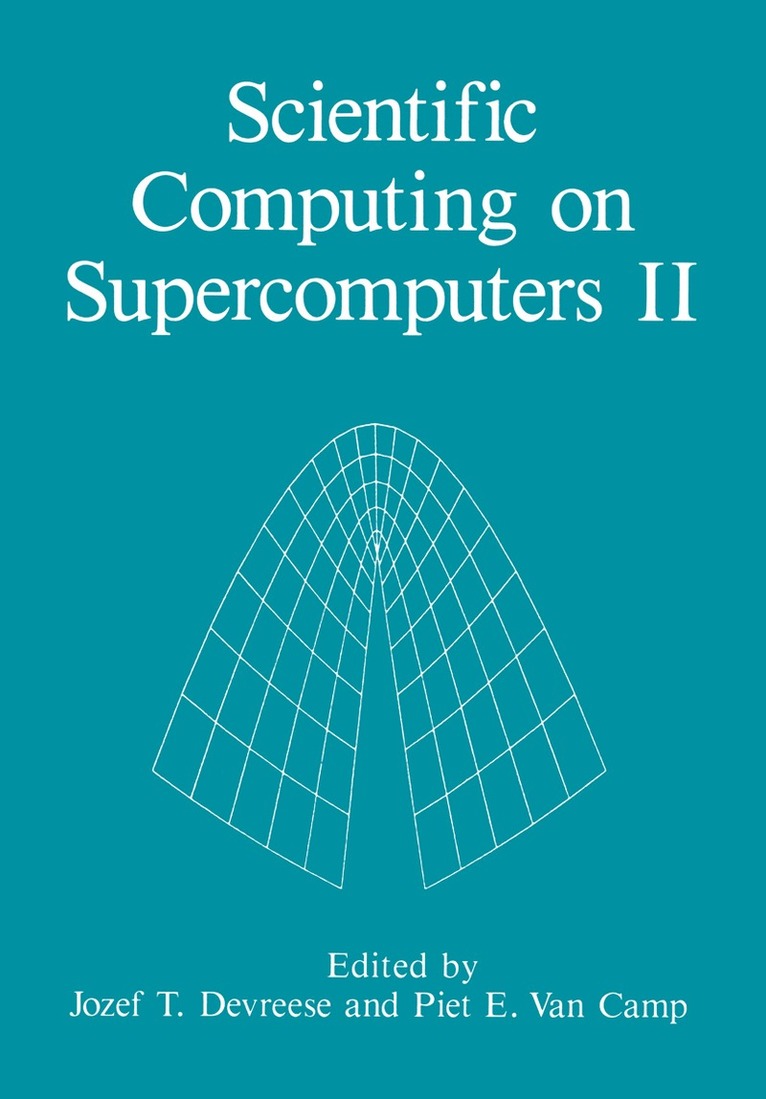
    Scientific Computing on Supercomputers II

    AvJ.T. Devreese

    Häftad, Engelska, 2011

    544 kr

    Beställningsvara. Skickas inom 10-15 vardagar. Fri frakt över 249 kr.

    Beskrivning

    The International Workshop on "The Use of Supercomputers in Theoretical Science" took place on November 29 and 30, 1989 at the University of Antwerp (UIA), Antwerpen, Belgium. It was the fifth in a series of workshops, the first of which took place in 1984. The principal aim of these workshops is to present the state-of-the-art in scientific large scale and high speed computation. Computational science has developed into a third methodology equally important now as its theoretical and experimental companions. Gradually academic researchers acquired access to a variety of supercomputers and as a consequence computational science has become a major tool for their work. It is a pleasure to thank the Belgian National Science Foundation (NFWO-FNRS) and the Ministry of Scientific Affairs for sponsoring the workshop. It was organized both in the framework of the Third Cycle "Vectorization, Parallel Processing and Supercomputers" and the "Governemental Program in Information Technology"~ We also very much would like to thank the University of Antwerp (Universitaire Instelling Antwerpen - UIA) for financial and material support. Special thanks are due to Mrs. H. Evans for the typing and editing of the manuscripts and for the preparation of the author and subject index.

    Produktinformation

    • Utgivningsdatum:2011-10-04
    • Mått:170 x 244 x 15 mm
    • Vikt:462 g
    • Format:Häftad
    • Språk:Engelska
    • Antal sidor:260
    • Förlag:Springer-Verlag New York Inc.
    • ISBN:9781461279143

    Utforska kategorier

    • Teknik: allmänt inom Naturvetenskap och teknik
    • Matematisk fysik inom Naturvetenskap och teknik

    Innehållsförteckning

    • Vectorization, Optimization and Supercomputer Architecture.- Abstract.- 1. The architecture of vector computers.- 2. Arithmetic operations, memory bandwidth and memory access.- 3. Data structures and the design of algorithms.- 4. Matrix multiplication and related problems.- 5. Red-black SOR and diagonal storing of matrices.- 6. The linear first order recurrence.- 7. Generation of random numbers.- 8. Supercomputer software independent of a special architecture.- 9. Concluding remarks.- 10. References.- Vectorization of Some General Purpose Algorithms.- Abstract.- I. Introduction.- II. The vector concept in Fortran-200.- III. Main vector extensions in Fortran-200.- IV. Intrinsic functions.- Conclusion.- References.- ASTRID: a Programming Environment for Scientific Applications on Parallel Vector Computers.- Abstract.- 1. Introduction.- 2. Organization of ASTRID.- 3. ASTRID command language.- 4. MiniM: mini-modeller to define the geometry.- 5. CASE: interface to define physical quantities.- 6. Mesh: numerical mesh.- 7. Solve: solves the problem.- 8. BASPL: graphics system.- 9. Application: distribution of electrical contacts.- Acknowledgments.- References.- Large Scale Computations in Solid State Physics.- I. Introduction.- II. Numerical procedures.- III. Summary of the results.- IV. Acknowledgment.- Appendix A: the density functional theory.- Appendix B: the pseudopotential theory and plane wave expansion.- References.- Could User-friendly Supercomputers be Designed?.- Abstract.- 1. Introduction.- 2. The requirements for a supercomputer in engineering sciences.- 3. Parallel architectures.- 4. The continuous pipe vector computer (CPVC).- 5. Concluding remarks.- 6. Weak points of present supercomputer architectures.- 7. References.- The Use of Transputers in Quantum Chemistry.- Quantum chemistry and computer.- Parallel computer architectures or why we use transputers.- Programming environment for transputer systems.- Developing programs for transputer systems.- A direct SCF-program.- Testing the direct SCF-program.- Improving the performance.- First experience with Helios.- Conclusion.- References.- Domain Decomposition Methods for Partial Differential Equations and Parallel Computing.- Abstract.- 1. Introduction.- 2. The Schwarz alternative principle.- 3. The Schur complement method.- 4. The hybrid element method.- 5. Implementation of the hybrid method for solving a three-dimensional structural analysis problem.- 6. Conclusions.- References.- TERPSICHORE: A Three-Dimensional Ideal Magnetohydrodynamic Stability Program.- Abstract.- 1. Introduction.- 2. The physics problem.- 3. The organization of TERPSICHORE.- 4. The test case.- 5. Performance measurements.- Acknowledgments.- References.- The Bridge from Present (Sequential) Systems to Future (Parallel) Systems: the Parallel Programming Environments Express and CSTools.- Abstract.- Requirements of a good parallel programming environment.- An overview of parallel programming environments and languages.- The CSTools cross-development toolset.- The Express portable parallel programming environment.- Some features of Express.- An example: transputer implementation of the Kohonen feature map.- A comparison of Express and CSTools.- Conclusion.- Monte Carlo Methods in Classical Statistical Mechanics.- I. Introduction.- II. Monte Carlo calculations.- III. The scheme in practice: Monte Carlo in the canonical ensemble.- IV. Monte Carlo calculations in the grand canonical ensemble.- V. Final remarks.- Acknowledgement.- References.- The Usefulness of Vector Computers for Performing Simultaneous Experiments.- 1. Basic principles.- 2. Example: throwing a dice.- 3. Example: path integrals.- Conclusions.- Acknowledgments.- References.