• Fri frakt över 249 kr
  • •
  • Snabba leveranser
  • •
  • Billiga böcker
Kundservice

Du är på sajten för privatpersoner.

Företag, bibliotek eller offentlig verksamhet?

Du handlar på classic.bokus.com, där alla dina funktioner finns intakta.
Till classic.bokus.com
Bokus logotyp. Gå till startsidan.
  • Erbjudanden
  • Nyheter
  • Student
  • Topplistor
  • Barn & ungdom
  • Bokus Play
  • E-böcker
  • Pocketböcker
  • Spel & pussel

10% studentrabatt med kod TERM26

Sidfot

Mina sidor

    Hjälp

    • Kundservice
    • Vanliga frågor och svar
    • Frakt och leverans
    • Retur vid ångerrätt
    • Reklamera vara
    • Betalning
    • Köpvillkor
    • Allmänna villkor
    • Information om webbplatsens tillgänglighet

    Om Bokus

    • Om oss
    • Pressrum
    • För studenter
    • För företag
    • För bibliotek och offentlig verksamhet
    • För leverantörer
    • Hållbarhet

    Populärt

    • Aktuella erbjudanden
    • Presentkort
    • Studentlitteratur
    • Nya böcker
    • Topplistor
    • Signerade böcker
    • Engelska böcker

    Inspiration

    • Boktips
    • BookTok
    • Populära bokserier
    • Barnbokskaraktärer
    • Populära författare
    Logotyp för Bokus
    Följ oss på Facebook (extern länk)Följ oss på Instagram (extern länk)Följ oss på YouTube (extern länk)Följ oss på TikTok (extern länk)
    bokus @ CookiesAnpassa cookiesIntegritetspolicyKöpvillkor
    Till Citymail hemsida (extern länk)Till Budbee hemsida (extern länk)Till Postnord hemsida (extern länk)Till Schenker hemsida (extern länk)Till Early Bird hemsida (extern länk)Till Walleys hemsida (extern länk)
    1. Medicin
    2. Andra medicinska specialiteter
    3. Farmakologi

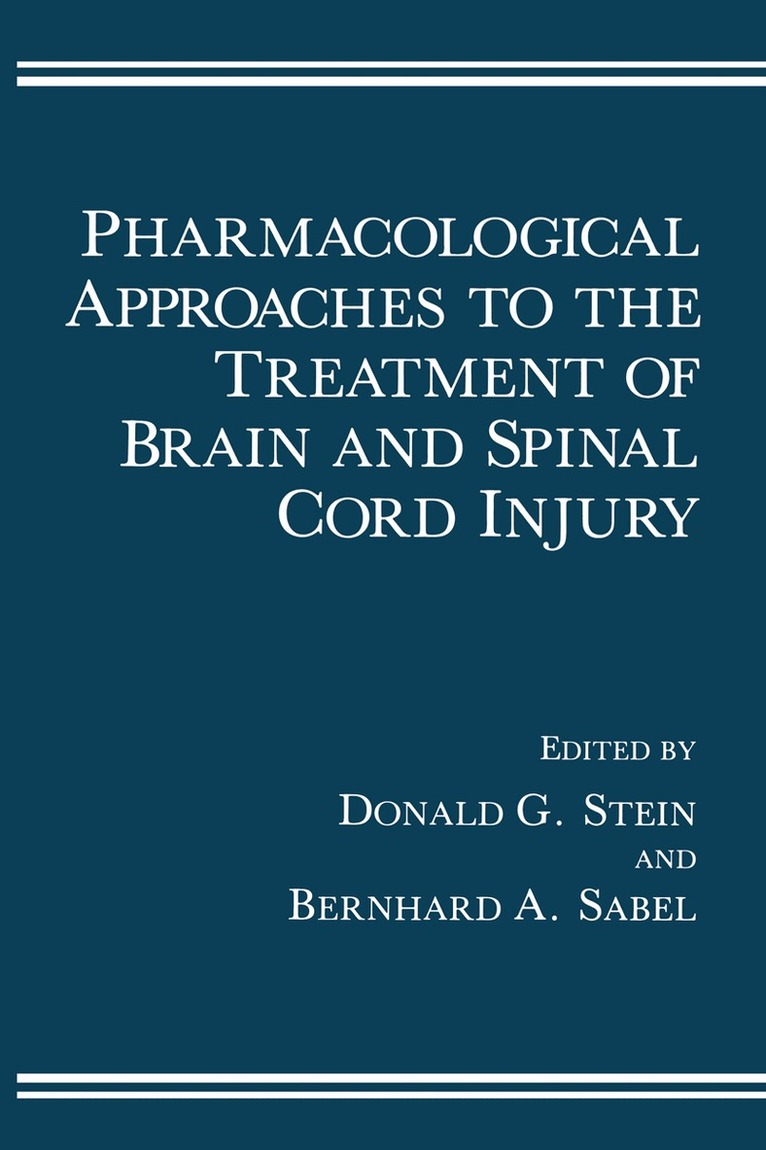
    Pharmacological Approaches to the Treatment of Brain and Spinal Cord Injury

    AvDonald G. Stein,Bernhard A. Sabel

    Häftad, Engelska, 2011

    566 kr

    Beställningsvara. Skickas inom 10-15 vardagar. Fri frakt över 249 kr.

    Beskrivning

    Although there are over 400,000 people each year in the United States alone who suffer from traumatic injury to the central nervous system (CNS), no phar­ macological treatment is currently available. Considering the enormity of the problem in terms of human tragedy as well as the economic burden to families and societies alike, it is surprising that so little effort is being made to develop treatments for these disorders. Although no one can become inured to the victims of brain or spinal cord injuries, one reason that insufficient time and effort have been devoted to research on recovery is that it is a generally held medical belief that nervous system injuries are simply not amenable to treatment. At best, current therapies are aimed at providing symptomatic relief or focus on re­ habilitative measures and the teaching of alternative behavioral strategies to help patients cope with their impairments, with only marginal results in many cases. Only within the last decade have neuroscientists begun to make serious inroads into understanding and examining the inherent "plasticity" found in the adult CNS. Ten years or so ago, very few researchers or clinicians would have thought that damaged central neurons could sprout new terminals or that intact nerve fibers in a damaged pathway could proliferate to replace inputs from neurons that died as a result of injury.

    Produktinformation

    • Utgivningsdatum:2011-09-17
    • Mått:152 x 229 x 23 mm
    • Vikt:594 g
    • Format:Häftad
    • Språk:Engelska
    • Antal sidor:386
    • Förlag:Springer-Verlag New York Inc.
    • ISBN:9781461282495

    Utforska kategorier

    • Farmakologi inom Medicin
    • Neurologi och klinisk neurofysiologi inom Medicin

    Innehållsförteckning

    • 1. Therapeutic Approaches in Subjects with Brain Lesions.- 2. Arachidonic Acid Metabolites and Membrane Lipid Changes in Central Nervous System Injury.- 3. Experimental Spinal Cord Injury: Strategies for Acute and Chronic Intervention Based on Anatomic, Physiological, and Behavioral Studies.- 4. Serotonin Antagonists Reduce Central Nervous System Ischemic Damage.- 5. Opiate Antagonists in CNS Injury.- 6. Adaptive Changes in Central Dopaminergic Neurons after Injury: Effects of Drugs.- 7. Catecholamines and Recovery of Function after Brain Damage.- 8. Ganglioside Involvement in Membrane-Mediated Transfer of Trophic Information: Relationship to GM1 Effects following CNS Injury.- 9. Anatomic Mechanisms whereby Ganglioside Treatment Induces Brain Repair: What Do We Really Know?.- 10. Gangliosides and Functional Recovery from Brain Injury.- 11. Acute Ganglioside Effects Limit CNS Injury: Functional and Biochemical Consequences.- 12. A Rationale for the Use of Melanocortins in Neural Injury.- 13. Developmental Neurobiology and Physiopathology of Brain Injury.- 14. Growth-Associated Triggering Factors and Central Nervous System Response to Injury.- 15. Growth Factor Induction and Order of Events in CNS Repair.- 16. Nerve Growth Factor: Effects on CNS Neurons and on Behavioral Recovery from Brain Damage.- 17. Recovery from Stroke.