• Fri frakt över 249 kr
  • •
  • Snabba leveranser
  • •
  • Billiga böcker
Kundservice

Du är på sajten för privatpersoner.

Företag, bibliotek eller offentlig verksamhet?

Du handlar på classic.bokus.com, där alla dina funktioner finns intakta.
Till classic.bokus.com
Bokus logotyp. Gå till startsidan.
  • Erbjudanden
  • Nyheter
  • Student
  • Topplistor
  • Barn & ungdom
  • Bokus Play
  • E-böcker
  • Pocketböcker
  • Spel & pussel

10% rabatt på allt med kod: NYSTART10 →

Sidfot

Mina sidor

    Hjälp

    • Kundservice
    • Vanliga frågor och svar
    • Frakt och leverans
    • Retur vid ångerrätt
    • Reklamera vara
    • Betalning
    • Köpvillkor
    • Allmänna villkor
    • Information om webbplatsens tillgänglighet

    Om Bokus

    • Om oss
    • Pressrum
    • För studenter
    • För företag
    • För bibliotek och offentlig verksamhet
    • För leverantörer
    • Hållbarhet

    Populärt

    • Aktuella erbjudanden
    • Presentkort
    • Studentlitteratur
    • Nya böcker
    • Topplistor
    • Signerade böcker
    • Engelska böcker

    Inspiration

    • Boktips
    • BookTok
    • Populära bokserier
    • Barnbokskaraktärer
    • Populära författare
    Logotyp för Bokus
    Följ oss på Facebook (extern länk)Följ oss på Instagram (extern länk)Följ oss på YouTube (extern länk)Följ oss på TikTok (extern länk)
    bokus @ CookiesAnpassa cookiesIntegritetspolicyKöpvillkor
    Till Citymail hemsida (extern länk)Till Budbee hemsida (extern länk)Till Postnord hemsida (extern länk)Till Schenker hemsida (extern länk)Till Early Bird hemsida (extern länk)Till Walleys hemsida (extern länk)
    1. Naturvetenskap och teknik
    2. Matematik och naturvetenskap
    3. Biologi
    4. Cellbiologi

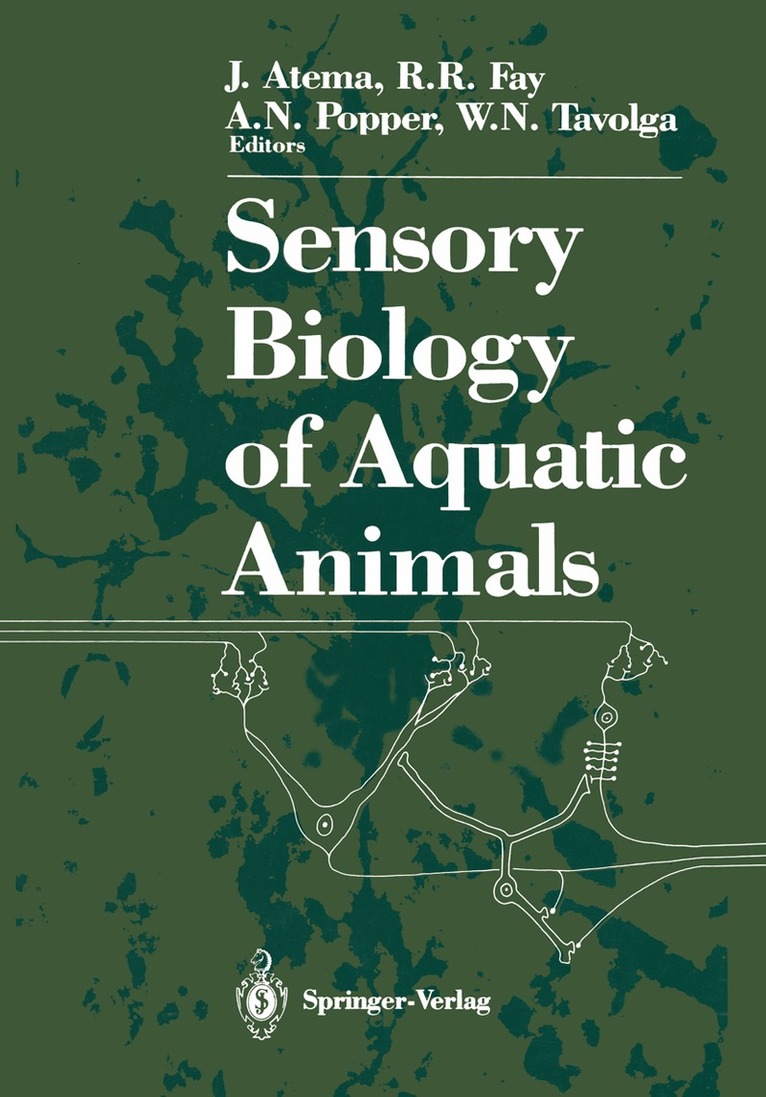
    Sensory Biology of Aquatic Animals

    AvJelle 1987,Richard R. Fay

    Häftad, Engelska, 2011

    1 626 kr

    Beställningsvara. Skickas inom 10-15 vardagar. Fri frakt över 249 kr.

    Beskrivning

    This volume constitutes a series of invited chapters based on presentations given at an International Conference on the Sensory Biology of Aquatic Animals held June 24-28, 1985 at the Mote Marine Laboratory in Sarasota, Florida. The immediate purpose of the conference was to spark an exchange of ideas, concepts, and techniques among investigators concerned with the different sensory modalities employed by a wide variety of animal species in extracting information from the aquatic environment. By necessity, most investigators of sensory biology are specialists in one sensory system: different stimulus modalities require different methods of stimulus control and, generally, different animal models. Yet, it is clear that all sensory systems have principles in common, such as stimulus filtering by peripheral structures, tuning of receptor cells, signal-to-noise ratios, adaption and disadaptation, and effective dynamic range. Other features, such as hormonal and efferent neural control, circadian reorganization, and receptor recycling are known in some and not in other senses. The conference afforded an increased awareness of new discoveries in other sensory systems that has effectively inspired a fresh look by the various participants at their own area of specialization to see whether or not similar principles apply. This inspiration was found not only in theoretical issues, but equally in techniques and methods of approach. The myopy of sensory specialization was broken in one unexpected way by showing limitations of individual sense organs and their integration within each organism. For instance, studying vision, one generally chooses a visual animal as a model.

    Produktinformation

    • Utgivningsdatum:2011-12-27
    • Mått:170 x 244 x 53 mm
    • Vikt:1 666 g
    • Format:Häftad
    • Språk:Engelska
    • Antal sidor:936
    • Förlag:Springer-Verlag New York Inc.
    • ISBN:9781461283171

    Utforska kategorier

    • Cellbiologi inom Naturvetenskap och teknik
    • Biovetenskap inom Naturvetenskap och teknik

    Innehållsförteckning

    • Detailed Chapter Contents.- I. Physical and Chemical Characteristics of Signals in the Aquatic Environment.- 1 The Molecular Nature of Chemical Stimuli in the Aquatic Environment.- 2 Distribution of Chemical Stimuli.- 3 Light and Vision in the Aquatic Environment.- 4 Hydrodynamic and Acoustic Field Detection.- 5 Underwater Sound as a Biological Stimulus.- 6 Detection of Weak Electric Fields.- II. Behavior: Survival Functions and Stimulus Acquisition.- 7 Behavioral Ecology and Sensory Biology.- 8 Sensory Performance, Behavior, and Ecology of Fish.- 9 Social Communication in the Aquatic Environment.- 10 The Comparative Neurology of Expectation: Stimulus Acquisition and Neurobiology of Anticipated and Unanticipated Input.- III. Signal Extraction: Receptor Cells and Sensory Systems.- III. A. Chemoreception.- 11 The Diversity of Chemoreceptors.- 12 Peripheral Filters and Chemoreceptor Cells in Fishes.- 13 Organization of Chemosensory Systems Within the Brains of Bony Fishes.- 14 Chemoreceptor Cells in Aquatic Invertebrates: Peripheral Mechanisms of Chemical Signal Processing in Decapod Crustaceans.- 15 Integration of Chemosensory Information in Aquatic Invertebrates.- III. B. Vision.- 16 Vision in Marine Invertebrates.- 17 Vision and Mating Behavior in Limulus.- 18 Aquatic Adaptations in Fish Eyes.- 19 Optics of Amphibious Eyes in Vertebrates.- 20 How to Be Unseen: An Essay in Obscurity.- 21 The Visual System in Teleost Fishes: Morphological Patterns and Trends.- III. C. Mechanoreception.- III. C. 1. Hydrodynamic Reception.- 22 Diversity of Lateral Line Systems: Evolutionary and Functional Considerations.- 23 Mechanical Factors in the Excitation of the Lateral Lines of Fishes.- 24 Prey Identification and Prey Localization in Surface-Feeding Fish and Fishing Spiders.- 25 Surface Wave Reception in Invertebrates and Vertebrates.- 26 The Representation of Hydrodynamic Parameters in the CNS of the Crayfish Procambarus.- III. C. 2. Hearing.- 27 Role of the Fish Ear in Sound Processing.- 28 Peripheral Adaptations for Spatial Hearing in Fish.- 29 Central Connections of the Octavolateralis System: Evolutionary Considerations.- III. C. 3. Equilibrium.- 30 Morphological Diversity of Equilibrium Receptor Systems in Aquatic Invertebrates.- 31 Equilibrium in the Vertebrates: Signals, Senses, and Steering Underwater.- III. D. Electroreception.- 32 The Electroreceptors: Diversity in Structure and Function.- 33 The Neuronal Basis of Electrosensory Perception and Its Control of a Behavioral Response in a Weakly Electric Fish.- IV. Adaptation and Sensory Systems.- 34 Sensory and Other Neural Traits and the Adaptationist Program: Mackerels of San Marco?.- Author Index.- Animal Index.