• Fri frakt över 249 kr
  • •
  • Snabba leveranser
  • •
  • Billiga böcker
Kundservice

Du är på sajten för privatpersoner.

Företag, bibliotek eller offentlig verksamhet?

Du handlar på classic.bokus.com, där alla dina funktioner finns intakta.
Till classic.bokus.com
Bokus logotyp. Gå till startsidan.
  • Erbjudanden
  • Nyheter
  • Student
  • Topplistor
  • Barn & ungdom
  • Bokus Play
  • E-böcker
  • Pocketböcker
  • Spel & pussel

10% rabatt på allt med kod: NYSTART10 →

Sidfot

Mina sidor

    Hjälp

    • Kundservice
    • Vanliga frågor och svar
    • Frakt och leverans
    • Retur vid ångerrätt
    • Reklamera vara
    • Betalning
    • Köpvillkor
    • Allmänna villkor
    • Information om webbplatsens tillgänglighet

    Om Bokus

    • Om oss
    • Pressrum
    • För studenter
    • För företag
    • För bibliotek och offentlig verksamhet
    • För leverantörer
    • Hållbarhet

    Populärt

    • Aktuella erbjudanden
    • Presentkort
    • Studentlitteratur
    • Nya böcker
    • Topplistor
    • Signerade böcker
    • Engelska böcker

    Inspiration

    • Boktips
    • BookTok
    • Populära bokserier
    • Barnbokskaraktärer
    • Populära författare
    Logotyp för Bokus
    Följ oss på Facebook (extern länk)Följ oss på Instagram (extern länk)Följ oss på YouTube (extern länk)Följ oss på TikTok (extern länk)
    bokus @ CookiesAnpassa cookiesIntegritetspolicyKöpvillkor
    Till Citymail hemsida (extern länk)Till Budbee hemsida (extern länk)Till Postnord hemsida (extern länk)Till Schenker hemsida (extern länk)Till Early Bird hemsida (extern länk)Till Walleys hemsida (extern länk)
    1. Data och IT
    2. Programmeringsböcker
    3. Programvaruutveckling

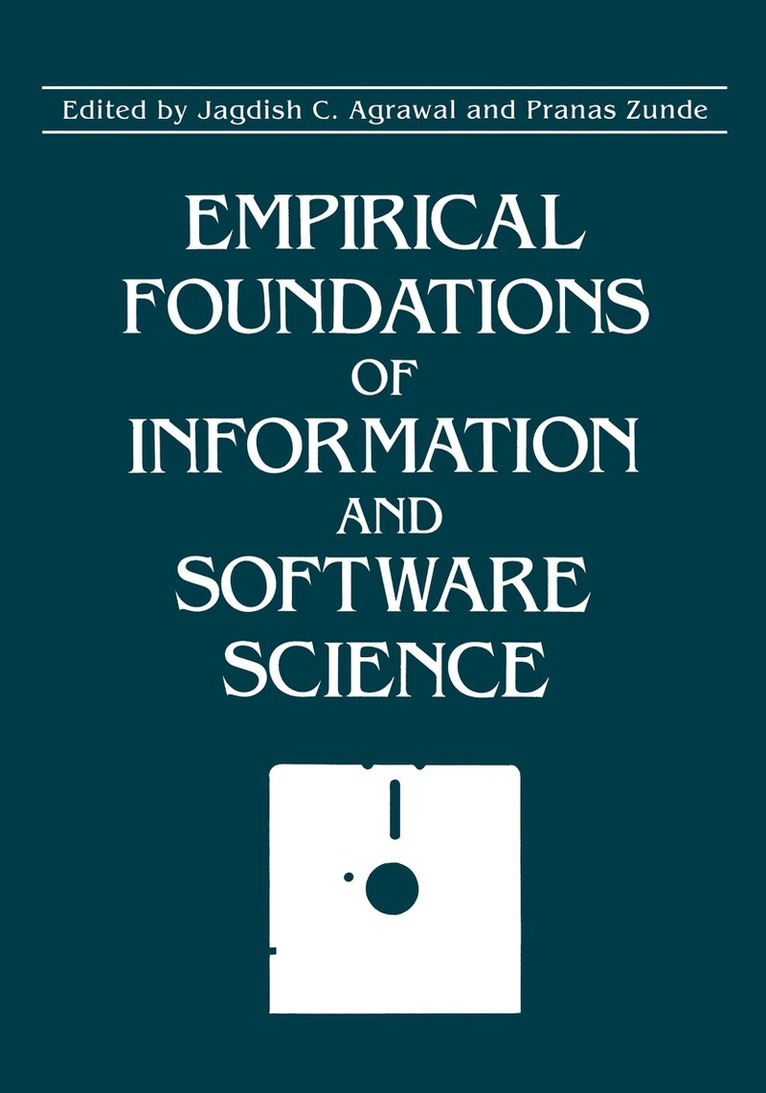
    Impirical Foundations of Information and Software Science

    AvJagdish C. Agrawal

    Häftad, Engelska, 2011

    563 kr

    Beställningsvara. Skickas inom 10-15 vardagar. Fri frakt över 249 kr.

    Beskrivning

    The purpose of the Second Symposium on Empirical Foundations of Informa­ tion and Software Science (EFISS) was, in essence, the same as that of the First Symposium in this series, i. e. to explore subjects and methods of sci­ entific inquiry which are of fundamental and common interest to information and software sciences, and to map directions of research that will benefit from the mutual interaction of these two fields. In fact, one of the most important results of the First EFISS Symposium was the conclusion that the commonality of these two sciences is much more than just the commonality of their objects of study, namely, the study of informative and prescriptive properties of texts in all kinds of sign sys­ tems (such as natural or artificial languages). Rather, the most challeng­ ing problems appear to be in the areas in which both these sciences overlap, such as, for instance, the problem of trade-offs between informative and prescriptive uses of texts. This problem can be formulated in generic terms as follows: given a certain kind of action or activity which has been pre­ scribed to some agent, i. e. which is required to be implemented or carried out, what kind of information should be provided to the agent, in what form, and how should it be distributed over the contextual structure of the pre­ scriptive text to enable the agent to carry out the action or activity most effectively and efficiently.

    Produktinformation

    • Utgivningsdatum:2011-10-03
    • Mått:178 x 254 x 24 mm
    • Vikt:800 g
    • Format:Häftad
    • Språk:Engelska
    • Antal sidor:415
    • Förlag:Springer-Verlag New York Inc.
    • ISBN:9781461295235

    Utforska kategorier

    • Programvaruutveckling inom Data och IT

    Innehållsförteckning

    • Symposium Opening Addresses.- 1. Information Value.- Information About How to Retrieve Information: Its Relation to the Information Retrieved.- Implication of User’s Value Perception for the Design of a Bibliographic Retrieval System.- Value of Information in Supervisory Control.- On the Value of Information in Systems Design: A Framework for Understanding and Aiding Designers.- 2. Information in Interactive Context.- Experiences with Changeable Informative Texts in Guiding Users of the On-Line Interactive ABC-System.- Computer-Aided Searching of Bibliographic Data Bases: Online Estimation of the Value of Information.- A System for Imbedding Data Displays in Graphical Contexts.- Human Factors Issues of Manuals, Online Help, and Tutorials.- 3. Aids for Man-Machine Interaction.- Computer Graphics and a Revised Concept of Dependence and Independence.- Designing a Human-Computer Interface with Software Specification Techniques.- Empirical Methods in the BTU-Project.- The Use of Multi-Level Adaptable User Interfaces in Improving User-Computer Interaction.- 4. Assessment of Information Effects.- Empirical Investigation of Aids for Non-Programming Users in Developing Cost-Effective Requirements Specifications.- The Effect of Comments, Mnemonic Names, and Modularity: Some University Experiment Results.- Rationale for Comments: The Effect on Programming Languages and Implementation.- 5. Software Metrics.- A Measure of Program Clarity for Modular Programming Systems.- Measuring Software Complexity: The Syntactic Dimension.- An Experimental Study of the Logical Complexity of Data Structures.- PARTIAL: A Software Tool for the Development of Ada Programs.- 6. Information Mapping and Retrieval.- Document Ranking Methodology for Conventional Boolean Retrieval Systems.- On GeneratingSemantic Dispositions in a Given Subject Domain.- 7. Methodological Issues.- The Impact on “Informational Entropy” of Disproof of the Boltzmann Relation.- Information Measurement in Natural and Artificial Systems.- On the Validation of Computer Science Theories.- Software Science — A Heuristic Approach.- 8. Software and System Models.- Flexible Software Models for Quality Assessments of Interactive Information Systems.- Value of Formal Information Systems Models for a Flexible Reorganization in an Insurance Company.- 9. Software Tools and Techniques.- A Spelling Checker Based on Affix Classes.- On Penetrance and Branching Factor for Search Trees.- Automatic Program Description: A Compiler Based Approach.- 10. Workshops.- Workshop on Research Directions and Opportunities I: Current Programs.- Workshop on Research Directions and Opportunities II: Prospects and Open Problems. Synopsis by E. C Weiss, the Workshop Chairman.