• Fri frakt över 249 kr
  • •
  • Snabba leveranser
  • •
  • Billiga böcker
Kundservice

Du är på sajten för privatpersoner.

Företag, bibliotek eller offentlig verksamhet?

Du handlar på classic.bokus.com, där alla dina funktioner finns intakta.
Till classic.bokus.com
Bokus logotyp. Gå till startsidan.
  • Erbjudanden
  • Nyheter
  • Student
  • Topplistor
  • Barn & ungdom
  • Bokus Play
  • E-böcker
  • Pocketböcker
  • Spel & pussel

10% rabatt på allt med kod NYSTART10 →

Sidfot

Mina sidor

    Hjälp

    • Kundservice
    • Vanliga frågor och svar
    • Frakt och leverans
    • Retur vid ångerrätt
    • Reklamera vara
    • Betalning
    • Köpvillkor
    • Allmänna villkor
    • Information om webbplatsens tillgänglighet

    Om Bokus

    • Om oss
    • Pressrum
    • För studenter
    • För företag
    • För bibliotek och offentlig verksamhet
    • För leverantörer
    • Hållbarhet

    Populärt

    • Aktuella erbjudanden
    • Presentkort
    • Studentlitteratur
    • Nya böcker
    • Topplistor
    • Signerade böcker
    • Engelska böcker

    Inspiration

    • Boktips
    • BookTok
    • Populära bokserier
    • Barnbokskaraktärer
    • Populära författare
    Logotyp för Bokus
    Följ oss på Facebook (extern länk)Följ oss på Instagram (extern länk)Följ oss på YouTube (extern länk)Följ oss på TikTok (extern länk)
    bokus @ CookiesAnpassa cookiesIntegritetspolicyKöpvillkor
    Till Citymail hemsida (extern länk)Till Budbee hemsida (extern länk)Till Postnord hemsida (extern länk)Till Schenker hemsida (extern länk)Till Early Bird hemsida (extern länk)Till Walleys hemsida (extern länk)
    1. Naturvetenskap och teknik
    2. Teknik och industri
    3. Elektronik och kommunikationer

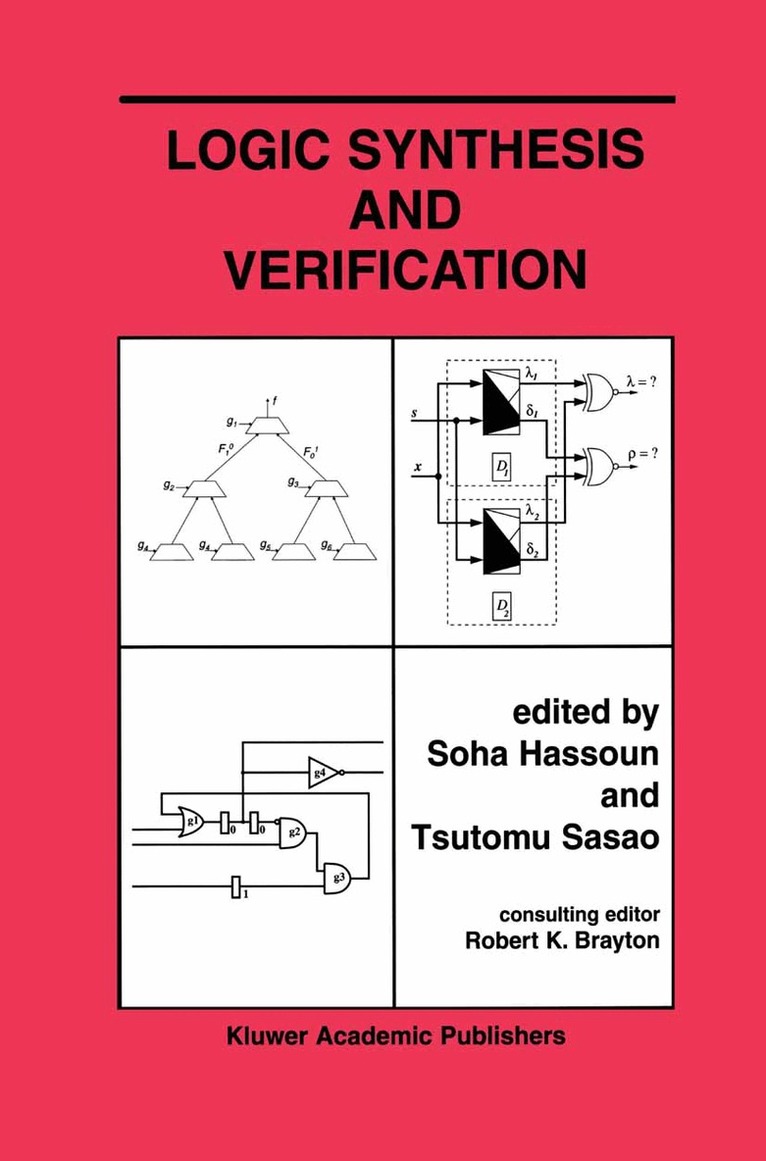
    Logic Synthesis and Verification

    AvSoha Hassoun,Tsutomu Sasao

    Häftad, Engelska, 2013

    Del 654 i serien Springer International Series in Engineering and Computer Science

    1 731 kr

    Beställningsvara. Skickas inom 10-15 vardagar. Fri frakt över 249 kr.

    Beskrivning

    Research and development of logic synthesis and verification have matured considerably over the past two decades. Many commercial products are available, and they have been critical in harnessing advances in fabrication technology to produce today's plethora of electronic components. While this maturity is assuring, the advances in fabrication continue to seemingly present unwieldy challenges. Logic Synthesis and Verification provides a state-of-the-art view of logic synthesis and verification. It consists of fifteen chapters, each focusing on a distinct aspect. Each chapter presents key developments, outlines future challenges, and lists essential references. Two unique features of this book are technical strength and comprehensiveness. The book chapters are written by twenty-eight recognized leaders in the field and reviewed by equally qualified experts. The topics collectively span the field. Logic Synthesis and Verification fills a current gap in the existing CAD literature. Each chapter contains essential information to study a topic at a great depth, and to understand further developments in the field. The book is intended for seniors, graduate students, researchers, and developers of related Computer-Aided Design (CAD) tools. From the foreword: "The commercial success of logic synthesis and verification is due in large part to the ideas of many of the authors of this book. Their innovative work contributed to design automation tools that permanently changed the course of electronic design." by Aart J. de Geus, Chairman and CEO, Synopsys, Inc.

    Produktinformation

    • Utgivningsdatum:2013-07-01
    • Mått:155 x 235 x 26 mm
    • Vikt:709 g
    • Format:Häftad
    • Språk:Engelska
    • Serie:Springer International Series in Engineering and Computer Science
    • Antal sidor:454
    • Förlag:Springer-Verlag New York Inc.
    • ISBN:9781461352532

    Utforska kategorier

    • Elektronik och kommunikationer inom Naturvetenskap och teknik
    • CAD-program inom Data och IT
    • Energiteknik inom Naturvetenskap och teknik

    Innehållsförteckning

    • 1 Two-Level Logic Minimization.- 1.1 Introduction.- 1.2 Exact Logic Minimization.- 1.3 Heuristic Logic Minimization.- 1.4 Conclusion.- 2 Multi-Level Logic Optimization.- 2.1 Introduction.- 2.2 Algebraic Methods.- 2.3 Boolean Methods.- 2.4 Functional Decomposition.- 2.5 Conclusions and Perspectives.- 2.6 Acknowledgments.- 3 Flexibility in Logic.- 3.1 Introduction.- 3.2 Environment.- 3.3 Types of Flexibility.- 3.4 Historical Perspective.- 4 Multiple-Valued Logic Synthesis and Optimization.- 4.1 Introduction.- 4.2 Multiple-Valued Functions.- 4.3 Functional Completeness.- 4.4 Chain-Based Post Algebra.- 4.5 Representations of Multiple-Valued Functions.- 4.6 Two-level Logic Optimization.- 4.7 Multi-Level Logic Optimization.- 4.8 Summary.- 4.9 Historical Perspectives.- 5 Technology Mapping.- 5.1 Introduction.- 5.2 Decomposition.- 5.3 Pattern Matching.- 5.4 Covering.- 5.5 Other Costs.- 5.6 Conclusions and Perspectives.- 6 Technology-based Transformations.- 6.1 Introduction.- 6.2 Gate Delay Models.- 6.3 Logic Transformations.- 6.4 Trends.- 7 Logical and Physical Design: A flow Perspective.- 7.1 Introduction.- 7.2 Logical and Physical Design Challenges.- 7.3 Survey of Current Design Flows.- 7.4 Refinement-based Flow.- 7.5 Conclusion & Perspective.- 8 Logic Synthesis for Low Power.- 8.1 Introduction.- 8.2 Gate-Level Techniques.- 8.3 Register-Transfer Level Techniques.- 8.4 The Evolution of Low-Power Synthesis.- 8.5 Conclusions.- 9 Optimization of Synchronous Circuits.- 9.1 Introduction.- 9.2 State-Based Techniques.- 9.3 Structural Techniques.- 9.4 Future Challenges.- 10 Asynchronous Control Circuits.- 10.1 Introduction.- 10.2 Burst-Mode Circuits.- 10.3 Speed-Independent Circuits.- 10.4 Conclusions.- 11 Ordered Binary Decision Diagrams.- 11.1 Introduction.- 11.2 Data Structures forSwitching Functions.- 11.3 OBDDs — Ordered Binary Decision Diagrams.- 11.4 Paradigmatic Applications of OBDDs.- 11.5 Optimization of Variable Ordering.- 11.6 Various Improvements of the BDD Data Structure.- 11.7 WWW-Portal for BDD Research.- 12 SAT and ATPG: Algorithms for Boolean Decision Problems.- 12.1 Introduction.- 12.2 SAT and ATPG Problem Formulations.- 12.3 Combinational Deterministic ATPG.- 12.4 SAT Algorithms: A Taxonomy.- 12.5 Search Acceleration Techniques.- 12.6 Implementation Issues.- 12.7 Historical Perspectives and Open Problems.- 13 Combinational and Sequential Equivalence Checking.- 13.1 Introduction.- 13.2 Problem Definition.- 13.3 General Approach to Formal Equivalence Checking.- 13.4 Deriving the Invariant ?.- 13.5 Combinational Equivalence Checking.- 13.6 Sequential Equivalence Checking.- 13.7 Implementation and Application Issues.- 13.8 Summary and Future Problems.- 14 Static Timing Analysis.- 14.1 Introduction.- 14.2 Basics.- 14.3 Path Exceptions.- 14.4 Transparent Latches.- 14.5 Incremental Timing Analysis.- 14.6 Statistical Timing Analysis.- 14.7 Summary and Future Challenges.- 14.8 Historical Perspective.- 15 The Future of Logic Synthesis and Verification.- 15.1 Logic Synthesis – Introduction.- 15.2 Techniques On The Edge.- 15.3 Physical/Logical Design.- 15.4 DSM Issues.- 15.5 Design For Low Power.- 15.6 Use In Software Compilers.- 15.7 Sequential Issues.- 15.8 Implementation Issues.- 15.9 Additional Challenges.- 15.10 Verification: Introduction.- 15.11 Static Timing.- 15.12 ATPG and SAT.- 15.13 BDDs.- 15.14 Equivalence Checking.- Appendices.- Appendix A: About the Authors.- Appendix B: Author Contact Information.