• Fri frakt över 249 kr
  • •
  • Snabba leveranser
  • •
  • Billiga böcker
Kundservice

Du är på sajten för privatpersoner.

Företag, bibliotek eller offentlig verksamhet?

Du handlar på classic.bokus.com, där alla dina funktioner finns intakta.
Till classic.bokus.com
Bokus logotyp. Gå till startsidan.
  • Erbjudanden
  • Nyheter
  • Student
  • Topplistor
  • Barn & ungdom
  • Bokus Play
  • E-böcker
  • Pocketböcker
  • Spel & pussel

10% rabatt på allt med kod: NYSTART10 →

Sidfot

Mina sidor

    Hjälp

    • Kundservice
    • Vanliga frågor och svar
    • Frakt och leverans
    • Retur vid ångerrätt
    • Reklamera vara
    • Betalning
    • Köpvillkor
    • Allmänna villkor
    • Information om webbplatsens tillgänglighet

    Om Bokus

    • Om oss
    • Pressrum
    • För studenter
    • För företag
    • För bibliotek och offentlig verksamhet
    • För leverantörer
    • Hållbarhet

    Populärt

    • Aktuella erbjudanden
    • Presentkort
    • Studentlitteratur
    • Nya böcker
    • Topplistor
    • Signerade böcker
    • Engelska böcker

    Inspiration

    • Boktips
    • BookTok
    • Populära bokserier
    • Barnbokskaraktärer
    • Populära författare
    Logotyp för Bokus
    Följ oss på Facebook (extern länk)Följ oss på Instagram (extern länk)Följ oss på YouTube (extern länk)Följ oss på TikTok (extern länk)
    bokus @ CookiesAnpassa cookiesIntegritetspolicyKöpvillkor
    Till Citymail hemsida (extern länk)Till Budbee hemsida (extern länk)Till Postnord hemsida (extern länk)Till Schenker hemsida (extern länk)Till Early Bird hemsida (extern länk)Till Walleys hemsida (extern länk)
    1. Medicin
    2. Klinisk medicin och internmedicin
    3. Sjukdomar och rubbningar
    4. Onkologi

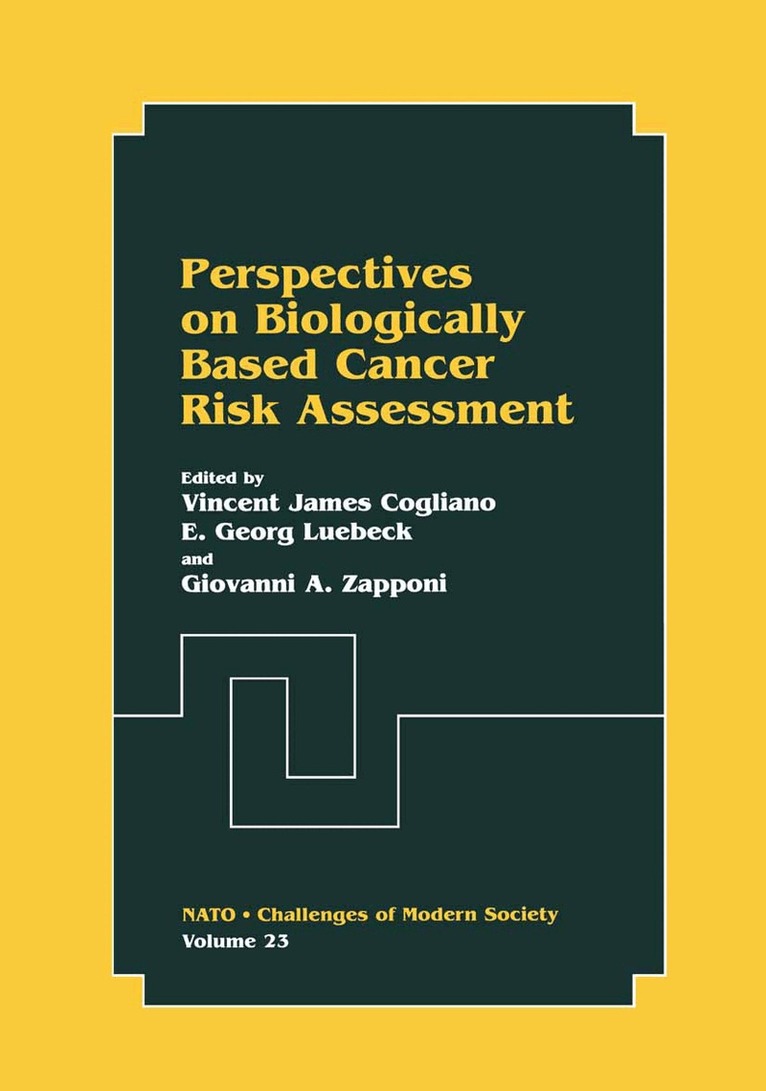
    Perspectives on Biologically Based Cancer Risk Assessment

    AvVincent James Cogliano,E. Georg Luebeck

    Häftad, Engelska, 2012

    Del i serien Nato Challenges of Modern Society

    1 674 kr

    Beställningsvara. Skickas inom 10-15 vardagar. Fri frakt över 249 kr.

    Beskrivning

    The first meeting of the NATO/CCMS Pilot Study "Dose-Response Analysis and Biologically-Based Risk assessment for Initiator and Promoter Carcinogens" was held in Rome, Italy, in the spring of 1991, and was followed by annual or bi-annual meetings held in Germany, Greece, Netherlands, Portugal, USA, up to the end of 1995; in large part supported by NATO/CCMS grants or fellowships, and organized by Pilot Study participants. The Pilot Study activity has been characterized by a higly collaborative atmosphere, which was essential for a deep and detailed analysis of a problem on which different points of view, methodological approaches and regulations exist in the various member countries. The Pilot Study was aimed at proposing a carcinogenic risk assessment procedure which is based on a detailed analysis of the relevant biological processes, and may also consent the verification of hypotheses. The specific form of theoretical and mathe­ matical models is identified by considering and using the whole set of objective data available. The multidisciplinary approach of the pilot study is reflected by the struc­ ture of this book. Each chapter is the result of the cooperation of several authors from to produce a comprehensive manual that includes different countries; its objective was both theoretical and practical information.

    Produktinformation

    • Utgivningsdatum:2012-09-25
    • Mått:178 x 254 x 19 mm
    • Vikt:634 g
    • Format:Häftad
    • Språk:Engelska
    • Serie:Nato Challenges of Modern Society
    • Antal sidor:319
    • Förlag:Springer-Verlag New York Inc.
    • ISBN:9781461371496

    Utforska kategorier

    • Onkologi inom Medicin
    • Miljövetenskap och miljöpolitik inom Naturvetenskap och teknik
    • Farmakologi inom Medicin

    Innehållsförteckning

    • 1. Introduction.- 1.1. Dose-Response Assessment in Nato Countries.- 1.2. Future Directions in Dose-Response Assessment.- 1.3. Brief Considerations on Some Commonly Used Parameters.- 1.4. Structure of this Report.- 1.5. References.- 2. The Biological Basis of Cancer.- 2.1. Introduction.- 2.2. Cell Proliferation.- 2.3. Cell Proliferation and Mutation.- 2.4. Differences in Susceptibility.- 2.5. Mechanisms of Inhibition in Mutagenesis and Carcinogenesis.- 2.6. References.- 3. Sources of Data For Cancer Risk Assessment.- 3.1. Introduction.- 3.2. In Vitro and Short Term Testing.- 3.3. Trends in Animal Toxicology Testing.- 3.4. Cell Proliferation.- 3.5. Sources of Toxicokinetic Data.- 3.6. Inter- and Intra-Species Variability.- 3.7. References.- 4. Use of Biochemical and Molecular Biomarkers For Cancer Risk Assessment in Humans.- 4.1. Introduction.- 4.2. The Initiatory Complex and its Modulators.- 4.3. The Determinants of the Clonal Expansion of the Initiated Cells.- 4.4. Adjuvant Determinants of the Clonal Expansion.- 4.5. Conclusion.- 4.6. Acknowledgments.- 4.7. References.- 5. The Multistage Model of Carcinogenesis: A Critical Review of its Use.- 5.1. Introduction.- 5.2. Historical Antecedents of the Multistage Model.- 5.3. The Armitage-Doll Multistage Model.- 5.4. Derivation, Rationale and Mathematical Form of the Model.- 5.5. The “Linearized Multistage Model”.- 5.6. Time-Dependent Non-Constant Exposure Patterns: Their Influence on Multistage-Derived Risk Estimates.- 5.7. Consideration of Pharmakokinetics in Multistage Modeling.- 5.8. The Problem of Multiple Exposure: Multistage Carcinogenesis Theory and Additive and Multiplicative Models.- 5.9. Critical Review of the Model.- 5.10. Discussion.- 5.11. References.- 6. Biologically Based Models of Carcinogenesis.- 6.1.Introduction.- 6.2. A Brief History of Biologically-Based Cancer Models.- 6.3. Two-Mutation Clonal Expansion Model.- 6.4. Modes of Action of Carcinogens.- 6.5. Quantitative Formulation of the Model.- 6.6. Likelihood Construction and Estimation.- 6.7. Quantitative Analysis of Intermediate Lesions.- 6.8. Toxicokinetics in Biologically Based Risk Assessment.- 6.9. Interspecies Extrapolation.- 6.10. Implications for Low-Dose Extrapolation.- 6.11. References.- 7. Statistical Issues in the Application of Multistage and Biologically Based Models.- 7.1. Introduction.- 7.2. Characterization Of Models.- 7.3. Statistical Inference.- 7.4. Design Considerations for Low-Dose Problems.- 7.5. Sensitivity Analysis and Physiologically Based Toxicokinetic Modeling.- 7.6. Discussion.- 7.7. References.- 8. Informative Case Studies.- 8.1. Radon, Cigarette Smoke, and Lung Cancer: The Colorado Plateau Uranium Miners’ Cohort.- 8.2. Modeling Colon Cancer.- 8.3. Quantitative Analysis of Enzyme Altered Foci (EAF).- 8.4. The Role of Cell Proliferation in Urinary Bladder Carcinogenesis.- 8.5. N-Nitrosomorpholine: Comparison of Multistage Model and Two-Event Clonal Expansion Model.- 8.6. Calculation of Tetrachloroethylene Risk Estimates.- 8.7. Considerations for Benzene Toxicokinetic Extrapolation.- 8.8. References.- 8.9. Appendix A.- 9. Conclusions and Recommendations.- 9.1. Introduction.- 9.2. What does Each Source of Experimental Data Contribute to our Knowledge and Ability to Model?.- 9.3. What Kinds of Information are Needed to Develop a Biologically Based Model?.- 9.4. How does Linearity Enter into Empirical Models and Biologically Based Models?.- 9.5. How does a Biologically Based Model Help Us Understand Intraspecies Variability?.- 9.6. How Ddoes a Biologically Based Model Help UsUnderstand Interspecies Variability?.- 9.7. What are the Uncertainties Associated with a Biologically Based Model?.- Contributors.