• Fri frakt över 249 kr
  • •
  • Snabba leveranser
  • •
  • Billiga böcker
Kundservice

Du är på sajten för privatpersoner.

Företag, bibliotek eller offentlig verksamhet?

Du handlar på classic.bokus.com, där alla dina funktioner finns intakta.
Till classic.bokus.com
Bokus logotyp. Gå till startsidan.
  • Erbjudanden
  • Nyheter
  • Student
  • Topplistor
  • Barn & ungdom
  • Bokus Play
  • E-böcker
  • Pocketböcker
  • Spel & pussel

10% studentrabatt med kod TERM26

Sidfot

Mina sidor

    Hjälp

    • Kundservice
    • Vanliga frågor och svar
    • Frakt och leverans
    • Retur vid ångerrätt
    • Reklamera vara
    • Betalning
    • Köpvillkor
    • Allmänna villkor
    • Information om webbplatsens tillgänglighet

    Om Bokus

    • Om oss
    • Pressrum
    • För studenter
    • För företag
    • För bibliotek och offentlig verksamhet
    • För leverantörer
    • Hållbarhet

    Populärt

    • Aktuella erbjudanden
    • Presentkort
    • Studentlitteratur
    • Nya böcker
    • Topplistor
    • Signerade böcker
    • Engelska böcker

    Inspiration

    • Boktips
    • BookTok
    • Populära bokserier
    • Barnbokskaraktärer
    • Populära författare
    Logotyp för Bokus
    Följ oss på Facebook (extern länk)Följ oss på Instagram (extern länk)Följ oss på YouTube (extern länk)Följ oss på TikTok (extern länk)
    bokus @ CookiesAnpassa cookiesIntegritetspolicyKöpvillkor
    Till Citymail hemsida (extern länk)Till Budbee hemsida (extern länk)Till Postnord hemsida (extern länk)Till Schenker hemsida (extern länk)Till Early Bird hemsida (extern länk)Till Walleys hemsida (extern länk)
    1. Naturvetenskap och teknik
    2. Matematik och naturvetenskap
    3. Kemi
    4. Fysikalisk kemi

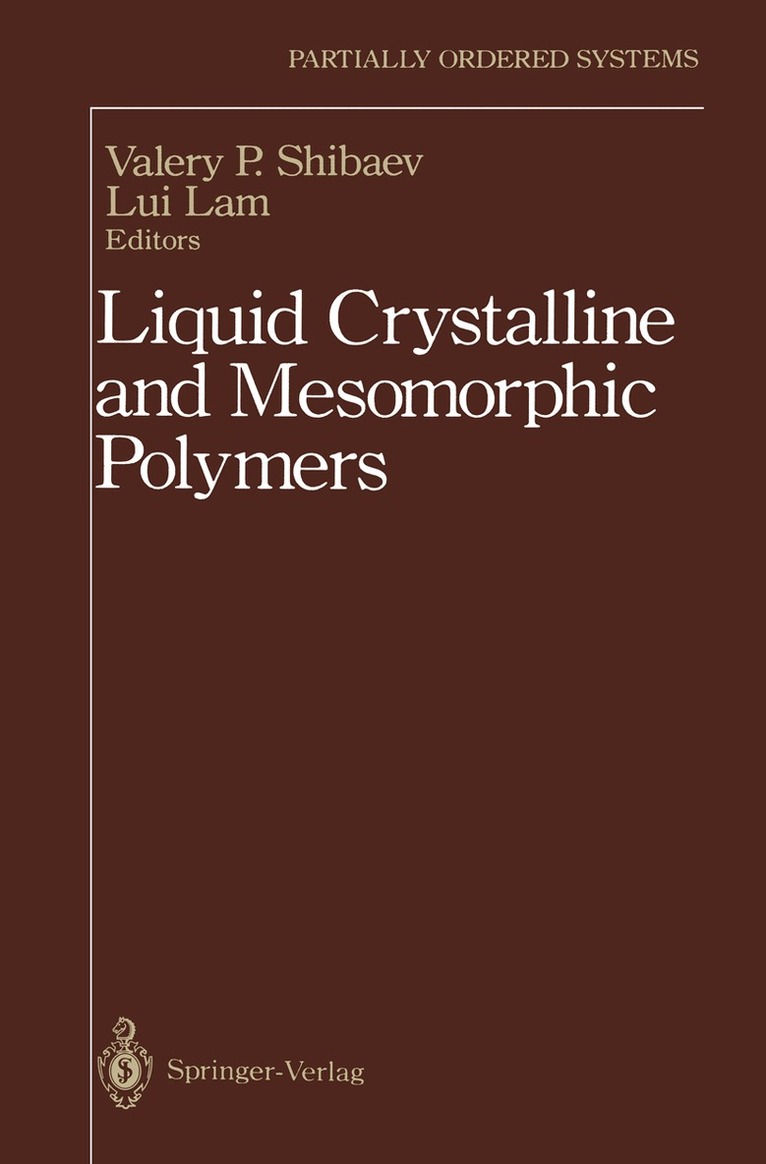
    Liquid Crystalline and Mesomorphic Polymers

    AvValery P. Shibaev,Lui Lam

    Häftad, Engelska, 2011

    Del i serien Partially Ordered Systems

    1 092 kr

    Beställningsvara. Skickas inom 10-15 vardagar. Fri frakt över 249 kr.

    Beskrivning

    Among the various new directions in modern polymer science, the design and investigation of liquid crystal (LC) polymers have been the ones growing most actively and fruitfully. In spite of that, the possible formation of an anisotropic LC phase was only demonstrated theoretically for the first time in the 1950s by Onsager [1] and Flory [2], and then experimentally verified in the studies with polypeptides solutions. In essence, the studies of these LC lyotropic systems did not deviate from the theme of purely academic interest. It was at the beginning of the 1970s that the experimental "explosion" occurred, when aromatic polyamides were synthesized and their ability to form LC solutions in certain very aggressive solvents was discovered. The search for practical applications of such LC systems was crowned with the successful creation of the new generation of ultrastrong high-modulus ther­ mostable fibers, such as the Kevlar, due to the high degree of order of the macromolecules in the anisotropic LC state. In fact, these investigations coincided with the swift emergence on the practical "scene" of thermotropic low-molar-mass liquid crystals, with the use of these materials in microelectronics and electro optics (figures and let­ ters indicators, displays in personal computers, and flat TV, etc.). Polymer scientists also began to develop methods of synthesizing thermotropic LC polymers by incorporating mesogenic fragments in the main (main-chain LC polymers) or side branchings of the macromolecules (side-chain or comb­ shaped polymers).

    Produktinformation

    • Utgivningsdatum:2011-11-06
    • Mått:155 x 235 x 21 mm
    • Vikt:575 g
    • Format:Häftad
    • Språk:Engelska
    • Serie:Partially Ordered Systems
    • Antal sidor:361
    • Förlag:Springer-Verlag New York Inc.
    • ISBN:9781461383352

    Utforska kategorier

    • Fysikalisk kemi inom Naturvetenskap och teknik
    • Organisk kemi inom Naturvetenskap och teknik
    • Maskinteknik och material inom Naturvetenskap och teknik

    Innehållsförteckning

    • 1 Molecular Theory of Cholesteric Polymers.- 1.1 Introduction.- 1.2 Elementary Models for Chiral Molecules.- 1.3 Chiral Anisotropic Interaction Between Macromolecules in the Solvent.- 1.4 Statistical Theory of Cholesteric Ordering.- 1.5 Influence of Molecular Flexibility on the Cholesteric Ordering in Polymer Solutions.- References.- 2 Structure of Thermotropic Main-Chain Polymers.- 2.1 Introduction.- 2.2 Molecular Architecture.- 2.3 Levels of Order in Mesophases of Main-Chain Liquid Polymers.- References.- 3 Molecular Architecture and Structure of Thermotropic Liquid Crystal Polymers with Mesogenic Side Groups.- 3.1 Introduction.- 3.2 Molecular Architecture of Liquid Crystal Polymers.- 3.3 Specific Features of Comb-Shaped Polymers Associated with Their Macromolecular Nature.- 3.4 Mesophase Types of Comb-Shaped Liquid Crystal Polymers. Problems of Classification.- 3.5 Effect of Mesophase Type on the Structure of Polymers Oriented by Uniaxial Drawing.- 3.6 Placement of the Main-Chain in Smectic and Nematic Phases of Comb-Shaped Liquid Crystal Polymers.- 3.7 Structure of Cholesteric Polymers.- References.- 4 Phase Behavior of High- and Low-Molar-Mass Liquid Crystal Mixtures.- 4.1 Introduction.- 4.2 Binary Mixtures of Low-Molar-Mass Mesogens.- 4.3 Mixtures of a Liquid Crystalline Polymer with a Low-Molar-Mass Liquid Crystal.- 4.4 Conclusions.- References.- 5 Polymer-Dispersed Liquid Crystal Films.- 5.1 Introduction.- 5.2 Film Structure and Operation.- 5.3 Film Formation: General Aspects.- 5.4 Polymer-Dispersed Liquid Crystal Formation: Polymer-Induced Phase Separation Systems.- 5.5 Materials Selection.- 5.6 Film Fabrication and Morphology.- 5.7 Electrooptic Properties.- 5.8 Light Scattering.- 5.9 Final Comments.- References.- 6 Nuclear Magnetic Resonance Spectroscopy of Thermotropic Liquid Crystalline Polymers.- 6.1 Introduction.- 6.2 Thermotropic Liquid Crystalline Polymers with Mesogenic Groups in the Main Chain.- 6.3 Liquid Crystalline Polymers with Mesogenic Groups in the Side Chains.- References.- 7 Mesophase of Graphitizable Carbons.- 7.1 Introduction.- 7.2 Discotic Nematic Liquid Crystals.- 7.3 Formation of the Mesophase.- 7.4 Structure in the Mesophase.- 7.5 Growth and Coalescence.- 7.6 Formation of Anisotropic Carbons.- 7.7 Factors Influencing the Formation of Anisotropic Carbons.- 7.8 Graphitization.- 7.9 Industrial Relevance of Mesophase: Discotic, Aromatic, and Nematic Liquid Crystals.- References.- 8 Mesophase State of Polyorganophosphazenes.- 8.1 Introduction.- 8.2 Thermodynamics and Structure of Polyorganophosphazenes.- 8.3 Relaxation Transitions of Poly-bis-Trifluoroethoxyphosphazenes.- 8.4 Properties of Diluted Solutions of Poly-bis-Fluoroalkoxyphosphazenes.- 8.5 Rheological Properties of Concentrated Poly-bis-Trifluoroethoxyphosphazene Solutions.- 8.6 Rheological Properties of Poly-bis-Fluoroalkoxyphosphazenes in the Mesophase State.- 8.7 Polymer Blends on a Base of Poly-bis-Trifluoroethoxyphosphazene.- 8.8 Conclusions.- References.- 9 Chiral Nematic Mesophases of Lyotropic and Thermotropic Cellulose Derivatives.- 9.1 Mesophase Formation.- 9.2 Mesophases of Cellulose Derivatives.- 9.3 Chiral Nematic Properties.- 9.4 Circular Dichroism and Induced Circular Dichroism.- 9.5 Chiroptical Properties of Specifically Substituted Cellulose Derivatives.- 9.6 Concluding Remarks.- References.- 10 Bowlics.- 10.1 Introduction.- 10.2 The First Paper.- 10.3 Bowlic Monomers.- 10.4 Bowlic Polymers.- 10.5 Conclusions.- References.