• Fri frakt över 249 kr
  • •
  • Snabba leveranser
  • •
  • Billiga böcker
Kundservice

Du är på sajten för privatpersoner.

Företag, bibliotek eller offentlig verksamhet?

Du handlar på classic.bokus.com, där alla dina funktioner finns intakta.
Till classic.bokus.com
Bokus logotyp. Gå till startsidan.
  • Erbjudanden
  • Nyheter
  • Student
  • Topplistor
  • Barn & ungdom
  • Bokus Play
  • E-böcker
  • Pocketböcker
  • Spel & pussel

10% rabatt på allt med kod: NYSTART10 →

Sidfot

Mina sidor

    Hjälp

    • Kundservice
    • Vanliga frågor och svar
    • Frakt och leverans
    • Retur vid ångerrätt
    • Reklamera vara
    • Betalning
    • Köpvillkor
    • Allmänna villkor
    • Information om webbplatsens tillgänglighet

    Om Bokus

    • Om oss
    • Pressrum
    • För studenter
    • För företag
    • För bibliotek och offentlig verksamhet
    • För leverantörer
    • Hållbarhet

    Populärt

    • Aktuella erbjudanden
    • Presentkort
    • Studentlitteratur
    • Nya böcker
    • Topplistor
    • Signerade böcker
    • Engelska böcker

    Inspiration

    • Boktips
    • BookTok
    • Populära bokserier
    • Barnbokskaraktärer
    • Populära författare
    Logotyp för Bokus
    Följ oss på Facebook (extern länk)Följ oss på Instagram (extern länk)Följ oss på YouTube (extern länk)Följ oss på TikTok (extern länk)
    bokus @ CookiesAnpassa cookiesIntegritetspolicyKöpvillkor
    Till Citymail hemsida (extern länk)Till Budbee hemsida (extern länk)Till Postnord hemsida (extern länk)Till Schenker hemsida (extern länk)Till Early Bird hemsida (extern länk)Till Walleys hemsida (extern länk)
    1. Naturvetenskap och teknik
    2. Matematik och naturvetenskap
    3. Matematik
    4. Talteori

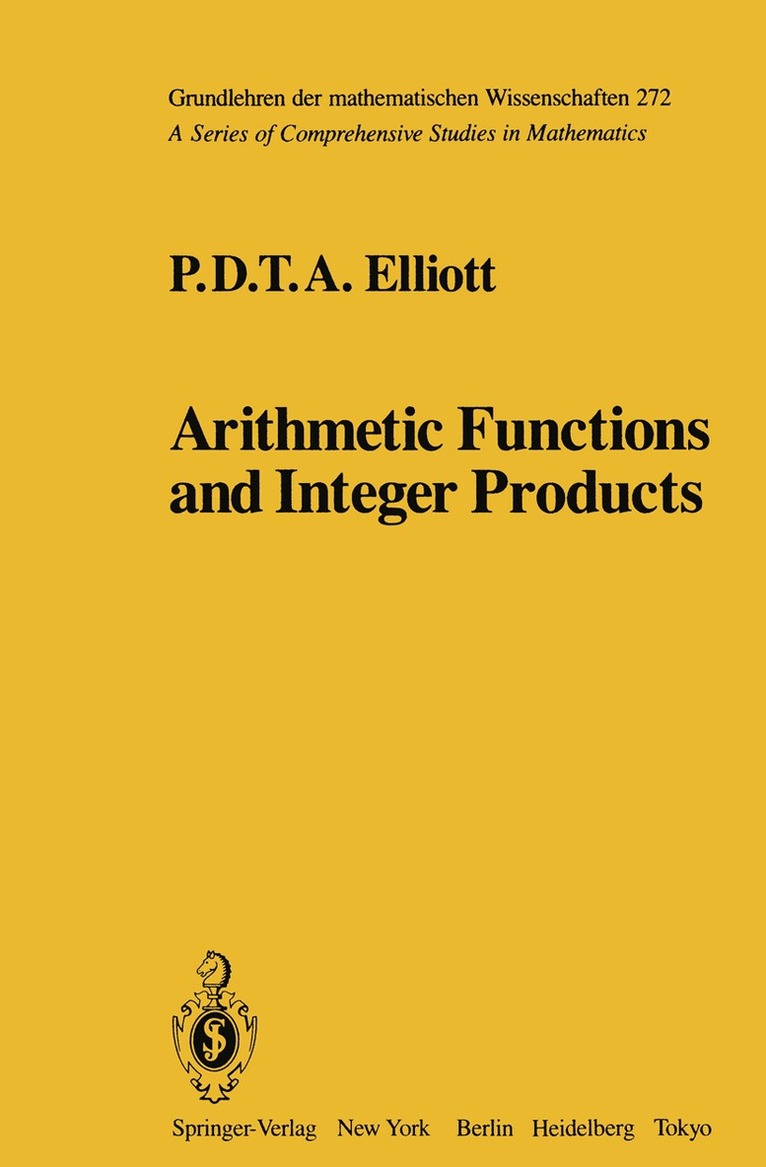
    Arithmetic Functions and Integer Products

    AvP.D.T.A. Elliott

    Häftad, Engelska, 2011

    Del 272 i serien Grundlehren der mathematischen Wissenschaften

    547 kr

    Beställningsvara. Skickas inom 10-15 vardagar. Fri frakt över 249 kr.

    Fler format och utgåvor

    E-bok

    710 kr

    Beskrivning

    Every positive integer m has a product representation of the form where v, k and the ni are positive integers, and each Ei = ± I. A value can be given for v which is uniform in the m. A representation can be computed so that no ni exceeds a certain fixed power of 2m, and the number k of terms needed does not exceed a fixed power of log 2m. Consider next the collection of finite probability spaces whose associated measures assume only rational values. Let hex) be a real-valued function which measures the information in an event, depending only upon the probability x with which that event occurs. Assuming hex) to be non­ negative, and to satisfy certain standard properties, it must have the form -A(x log x + (I - x) 10g(I -x». Except for a renormalization this is the well-known function of Shannon. What do these results have in common? They both apply the theory of arithmetic functions. The two widest classes of arithmetic functions are the real-valued additive and the complex-valued multiplicative functions. Beginning in the thirties of this century, the work of Erdos, Kac, Kubilius, Turan and others gave a discipline to the study of the general value distribution of arithmetic func­ tions by the introduction of ideas, methods and results from the theory of Probability. I gave an account of the resulting extensive and still developing branch of Number Theory in volumes 239/240 of this series, under the title Probabilistic Number Theory.

    Produktinformation

    • Utgivningsdatum:2011-10-18
    • Mått:155 x 235 x 27 mm
    • Vikt:727 g
    • Format:Häftad
    • Språk:Engelska
    • Serie:Grundlehren der mathematischen Wissenschaften
    • Antal sidor:461
    • Förlag:Springer-Verlag New York Inc.
    • ISBN:9781461385509

    Utforska kategorier

    • Talteori inom Naturvetenskap och teknik

    Innehållsförteckning

    • Duality and the Differences of Additive Functions.- First Motive.- 1 Variants of Well-Known Arithmetic Inequalities.- 2 A Diophantine Equation.- 3 A First Upper Bound.- 4 Intermezzo: The Group Q*/?.- 5 Some Duality.- Second Motive.- 6 Lemmas Involving Prime Numbers.- 7 Additive Functions on Arithmetic Progressions with Large Moduli.- 8 The Loop.- Third Motive.- 9 The Approximate Functional Equation.- 10 Additive Arithmetic Functions on Differences.- 11 Some Historical Remarks.- 12 From L2 to L?.- 13 A Problem of Kátai.- 14 Inequalities in L?.- 15 Integers as Products.- 16 The Second Intermezzo.- 17 Product Representations by Values of Rational Functions.- 18 Simultaneous Product Representations by Values of Rational Functions.- 19 Simultaneous Product Representations with aix + bi.- 20 Information and Arithmetic.- 21 Central Limit Theorem for Differences.- 22 Density Theorems.- 23 Problems.- Supplement Progress in Probabilistic Number Theory.- References.