• Fri frakt över 249 kr
  • •
  • Snabba leveranser
  • •
  • Billiga böcker
Kundservice

Du är på sajten för privatpersoner.

Företag, bibliotek eller offentlig verksamhet?

Du handlar på classic.bokus.com, där alla dina funktioner finns intakta.
Till classic.bokus.com
Bokus logotyp. Gå till startsidan.
  • Erbjudanden
  • Nyheter
  • Student
  • Topplistor
  • Barn & ungdom
  • Bokus Play
  • E-böcker
  • Pocketböcker
  • Spel & pussel

10% rabatt på allt med kod: NYSTART10 →

Sidfot

Mina sidor

    Hjälp

    • Kundservice
    • Vanliga frågor och svar
    • Frakt och leverans
    • Retur vid ångerrätt
    • Reklamera vara
    • Betalning
    • Köpvillkor
    • Allmänna villkor
    • Information om webbplatsens tillgänglighet

    Om Bokus

    • Om oss
    • Pressrum
    • För studenter
    • För företag
    • För bibliotek och offentlig verksamhet
    • För leverantörer
    • Hållbarhet

    Populärt

    • Aktuella erbjudanden
    • Presentkort
    • Studentlitteratur
    • Nya böcker
    • Topplistor
    • Signerade böcker
    • Engelska böcker

    Inspiration

    • Boktips
    • BookTok
    • Populära bokserier
    • Barnbokskaraktärer
    • Populära författare
    Logotyp för Bokus
    Följ oss på Facebook (extern länk)Följ oss på Instagram (extern länk)Följ oss på YouTube (extern länk)Följ oss på TikTok (extern länk)
    bokus @ CookiesAnpassa cookiesIntegritetspolicyKöpvillkor
    Till Citymail hemsida (extern länk)Till Budbee hemsida (extern länk)Till Postnord hemsida (extern länk)Till Schenker hemsida (extern länk)Till Early Bird hemsida (extern länk)Till Walleys hemsida (extern länk)
    1. Naturvetenskap och teknik
    2. Matematik och naturvetenskap
    3. Matematik

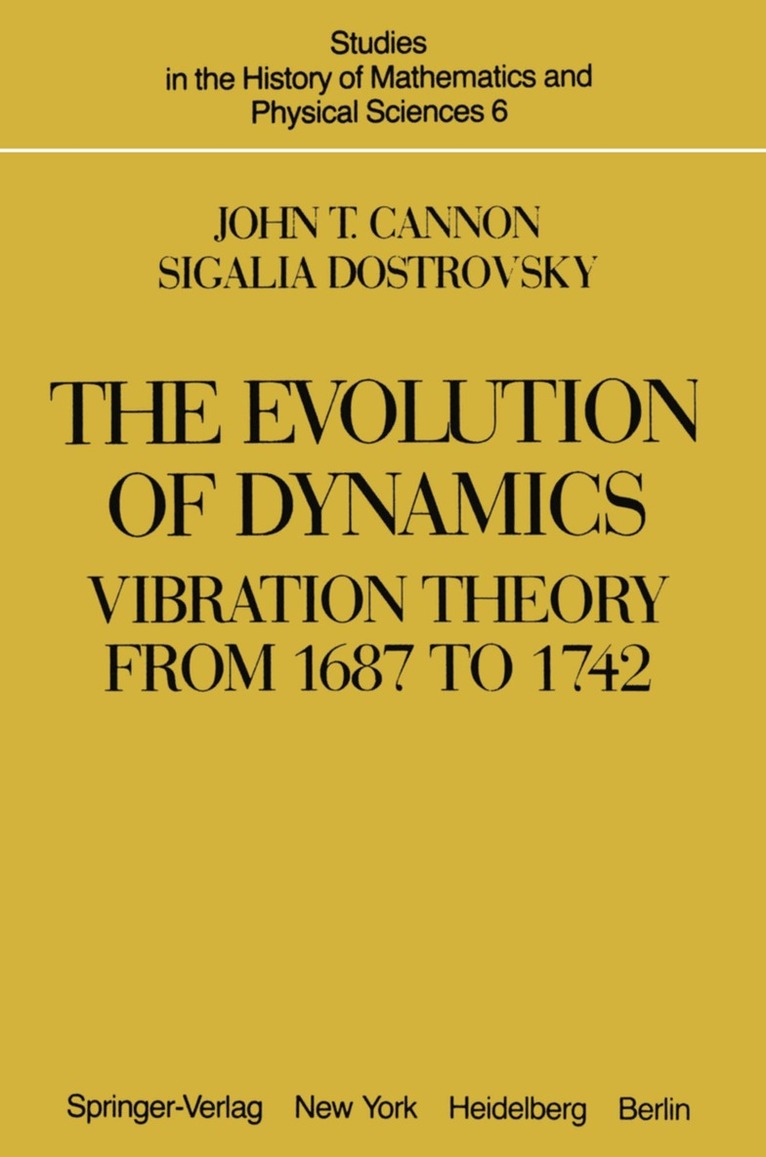
    Evolution of Dynamics: Vibration Theory from 1687 to 1742

    Vibration Theory from 1687 to 1742

    AvJ. T. Cannon,S. Dostrovsky

    Häftad, Engelska, 2011

    Del 6 i serien Studies in the History of Mathematics and Physical Sciences

    816 kr

    Beställningsvara. Skickas inom 10-15 vardagar. Fri frakt över 249 kr.

    Beskrivning

    In this study we are concerned with Vibration Theory and the Problem of Dynamics during the half century that followed the publication of Newton's Principia. The relationship that existed between these subject!! is obscured in retrospection for it is now almost impossible not to view (linear) Vibration Theory as linearized Dynamics. But during the half century in question a theory of Dynamics did not exist; while Vibration Theory comprised a good deal of acoustical information, posed definite problems and obtained specific results. In fact, it was through problems posed by Vibration Theory that a general theory of Dynamics was motivated and discovered. Believing that the emergence of Dynamics is a critically important link in the history of mathematical science, we present this study with the primary goal of providing a guide to the relevant works in the aforemen­ tioned period. We try above all to make the contents of the works readily accessible and we try to make clear the historical connections among many of the pertinent ideas, especially those pertaining to Dynamics in many degrees of freedom. But along the way we discuss other ideas on emerging subjects such as Calculus, Linear Analysis, Differential Equations, Special Functions, and Elasticity Theory, with which Vibration Theory is deeply interwound. Many of these ideas are elementary but they appear in a surprising context: For example the eigenvalue problem does not arise in the context of special solutions to linear problems-it appears as a condition for isochronous vibrations.

    Produktinformation

    • Utgivningsdatum:2011-12-06
    • Mått:155 x 235 x 11 mm
    • Vikt:306 g
    • Format:Häftad
    • Språk:Engelska
    • Serie:Studies in the History of Mathematics and Physical Sciences
    • Antal sidor:184
    • Förlag:Springer-Verlag New York Inc.
    • ISBN:9781461394631

    Utforska kategorier

    • Matematik inom Naturvetenskap och teknik
    • Matematisk fysik inom Naturvetenskap och teknik

    Innehållsförteckning

    • 1. Introduction.- 2. Newton (1687).- 2.1. Pressure Wave.- 2.2. Remarks.- 3. Taylor (1713).- 3.1. Vibrating String.- 3.2. Absolute Frequency.- 3.3. Remarks.- 4. Sauveur (1713).- 4.1. Vibrating String.- 4.2. Remarks.- 5. Hermann (1716).- 5.1. Pressure Wave.- 5.2. Vibrating String.- 5.3. Remarks.- 6. Cramer (1722).- 6.1. Sound.- 6.2. Remarks.- 7. Euler (1727).- 7.1. Vibrating Ring.- 7.2. Sound.- 8. Johann Bernoulli (1728).- 8.1. Vibrating String (Continuous and Discrete).- 8.2. Remark on the Energy Method.- 9. Daniel Bernoulli (1733; 1734); Euler (1736) …..- 9.1. Linked Pendulum and Hanging Chain.- 9.2. Laguerre Polynomials and J0.- 9.3. Double and Triple Pendula.- 9.4. Roots of Polynomials.- 9.5. Zeros of J0.- 9.6. Other Boundary Conditions.- 9.7. The Bessel Functions Jv.- 10. Euler (1735).- 10.1. Pendulum Condition.- 10.2. Vibrating Rod.- 10.3. Remarks.- 11. Johann II Bernoulli (1736).- 11.1. Pressure Wave.- 11.2. Remarks.- 12. Daniel Bernoulli (1739; 1740).- 12.1. Floating Body.- 12.2. Remarks.- 12.3. Dangling Rod.- 12.4. Remarks on Superposition.- 13. Daniel Bernoulli (1742).- 13.1. Vibrating Rod.- 13.2. Absolute Frequency and Experiments.- 13.3. Superposition.- 14. Euler (1742).- 14.1. Linked Compound Pendulum.- 14.2. Dangling Rod and Weighted Chain.- 15. Johann Bernoulli (1742) no.- 15.1. One Degree of Freedom.- 15.2. Dangling Rod.- 15.3. Linked Pendulum I.- 15.4. Linked Pendulum II.- Appendix: Daniel Bernoulli’s Papers on the Hanging Chain and the Linked Pendulum.- Theoremata de Oscillationibus Corporum.- De Oscillationibus Filo Flexili Connexorum.- Theorems on the Oscillations of Bodies.- On the Oscillations of Bodies Connected by a Flexible Thread.