• Fri frakt över 249 kr
  • •
  • Snabba leveranser
  • •
  • Billiga böcker
Kundservice

Du är på sajten för privatpersoner.

Företag, bibliotek eller offentlig verksamhet?

Du handlar på classic.bokus.com, där alla dina funktioner finns intakta.
Till classic.bokus.com
Bokus logotyp. Gå till startsidan.
  • Erbjudanden
  • Nyheter
  • Student
  • Topplistor
  • Barn & ungdom
  • Bokus Play
  • E-böcker
  • Pocketböcker
  • Spel & pussel

10% rabatt på allt med kod: NYSTART10 →

Sidfot

Mina sidor

    Hjälp

    • Kundservice
    • Vanliga frågor och svar
    • Frakt och leverans
    • Retur vid ångerrätt
    • Reklamera vara
    • Betalning
    • Köpvillkor
    • Allmänna villkor
    • Information om webbplatsens tillgänglighet

    Om Bokus

    • Om oss
    • Pressrum
    • För studenter
    • För företag
    • För bibliotek och offentlig verksamhet
    • För leverantörer
    • Hållbarhet

    Populärt

    • Aktuella erbjudanden
    • Presentkort
    • Studentlitteratur
    • Nya böcker
    • Topplistor
    • Signerade böcker
    • Engelska böcker

    Inspiration

    • Boktips
    • BookTok
    • Populära bokserier
    • Barnbokskaraktärer
    • Populära författare
    Logotyp för Bokus
    Följ oss på Facebook (extern länk)Följ oss på Instagram (extern länk)Följ oss på YouTube (extern länk)Följ oss på TikTok (extern länk)
    bokus @ CookiesAnpassa cookiesIntegritetspolicyKöpvillkor
    Till Citymail hemsida (extern länk)Till Budbee hemsida (extern länk)Till Postnord hemsida (extern länk)Till Schenker hemsida (extern länk)Till Early Bird hemsida (extern länk)Till Walleys hemsida (extern länk)
    1. Naturvetenskap och teknik
    2. Matematik och naturvetenskap
    3. Matematik
    4. Matematikens grunder

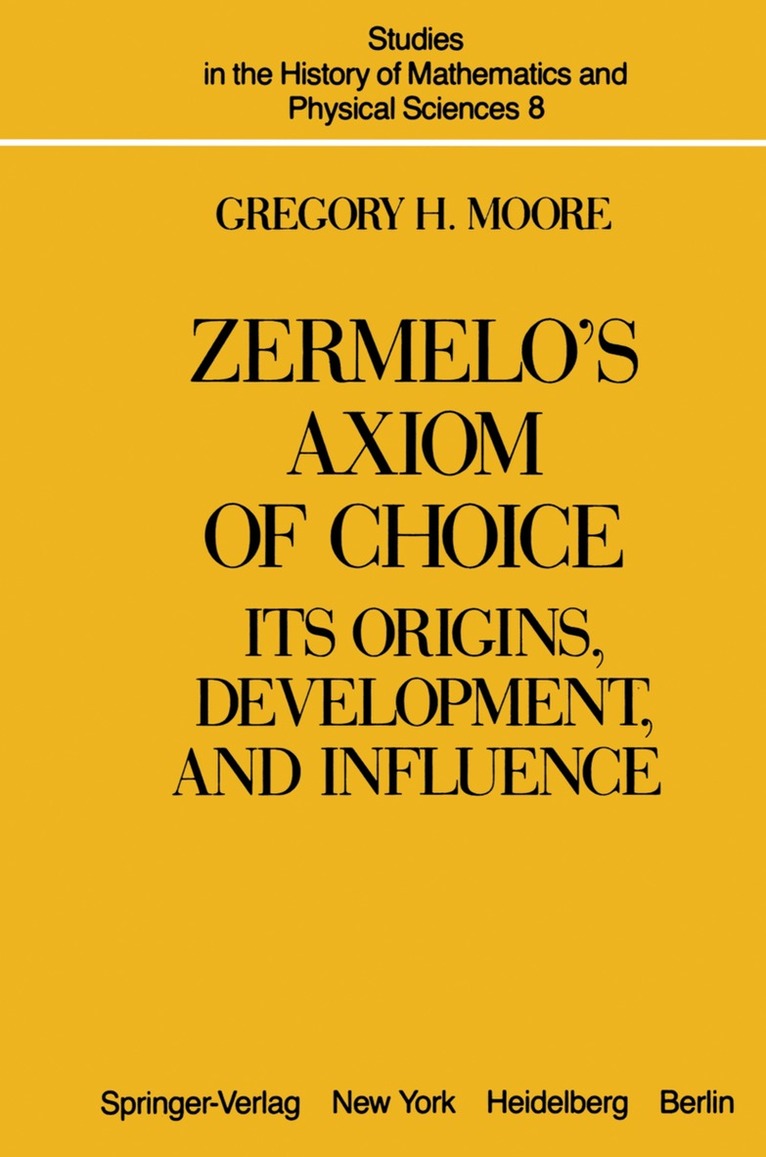
    Zermelo’s Axiom of Choice

    Its Origins, Development, and Influence

    AvG.H. Moore

    Häftad, Engelska, 2011

    Del 8 i serien Studies in the History of Mathematics and Physical Sciences

    547 kr

    Beställningsvara. Skickas inom 10-15 vardagar. Fri frakt över 249 kr.

    Fler format och utgåvor

    E-bok

    710 kr

    Beskrivning

    This book grew out of my interest in what is common to three disciplines: mathematics, philosophy, and history. The origins of Zermelo's Axiom of Choice, as well as the controversy that it engendered, certainly lie in that intersection. Since the time of Aristotle, mathematics has been concerned alternately with its assumptions and with the objects, such as number and space, about which those assumptions were made. In the historical context of Zermelo's Axiom, I have explored both the vagaries and the fertility of this alternating concern. Though Zermelo's research has provided the focus for this book, much of it is devoted to the problems from which his work originated and to the later developments which, directly or indirectly, he inspired. A few remarks about format are in order. In this book a publication is indicated by a date after a name; so Hilbert 1926, 178 refers to page 178 of an article written by Hilbert, published in 1926, and listed in the bibliography.

    Produktinformation

    • Utgivningsdatum:2011-12-01
    • Mått:152 x 229 x 24 mm
    • Vikt:616 g
    • Format:Häftad
    • Språk:Engelska
    • Serie:Studies in the History of Mathematics and Physical Sciences
    • Antal sidor:412
    • Förlag:Springer-Verlag New York Inc.
    • ISBN:9781461394808

    Utforska kategorier

    • Matematikens grunder inom Naturvetenskap och teknik

    Innehållsförteckning

    • Prologue.- 1 The Prehistory of the Axiom of Choice.- 1.1 Introduction.- 1.2 The Origins of the Assumption.- 1.3 The Boundary between the Finite and the Infinite.- 1.4 Cantor’s Legacy of Implicit Uses.- 1.5 The Well-Ordering Problem and the Continuum Hypothesis.- 1.6 The Reception of the Well-Ordering Problem.- 1.7 Implicit Uses by Future Critics.- 1.8 Italian Objections to Arbitrary Choices.- 1.9 Retrospect and Prospect.- 2 Zermelo and His Critics (1904–1908).- 2.1 König’s “Refutation” of the Continuum Hypothesis.- 2.2 Zermelo’s Proof of the Well-Ordering Theorem.- 2.3 French Constructivist Reaction.- 2.4 A Matter of Definitions: Richard, Poincaré, and Fréchet.- 2.5 The German Cantorians.- 2.6 Father and Son: Julius and Denes König.- 2.7 An English Debate.- 2.8 Peano: Logic vs. Zermelo’s Axiom.- 2.9 Brouwer: A Voice in the Wilderness.- 2.10 Enthusiasm and Mistrust in America.- 2.11 Retrospect and Prospect.- 3 Zermelo’s Axiom and Axiomatization in Transition (1908–1918).- 3.1 Zermelo’s Reply to His Critics.- 3.2 Zermelo’s Axiomatization of Set Theory.- 3.3 The Ambivalent Response to the Axiomatization.- 3.4 The Trichotomy of Cardinals and Other Equivalents.- 3.5 Steinitz and Algebraic Applications.- 3.6 A Smoldering Controversy.- 3.7 Hausdorff’s Paradox.- 3.8 An Abortive Attempt to Prove the Axiom of Choice.- 3.9 Retrospect and Prospect.- 4 The Warsaw School, Widening Applications, Models of Set Theory (1918–1940).- 4.1 A Survey by Sierpi?ski.- 4.2 Finite, Infinite, and Mediate.- 4.3 Cardinal Equivalents.- 4.4 Zorn’s Lemma and Related Principles.- 4.5 Widening Applications in Algebra.- 4.6 Convergence and Compactness in General Topology.- 4.7 Negations and Alternatives.- 4.8 The Axiom’s Contribution to Logic.- 4.9 ShiftingAxiomatizations for Set Theory.- 4.10 Consistency and Independence of the Axiom.- 4.11 Scepticism and Inquiry.- 4.12 Retrospect and Prospect.- Epilogue: After Gödel.- 5.1 A Period of Stability: 1940–1963.- 5.2 Cohen’s Legacy.- Conclusion.- Appendix 1 Five Letters on Set Theory.- Appendix 2 Deductive Relations Concerning the Axiom of Choice.- Journal Abbreviations Used in the Bibliography.- Index of Numbered Propositions.- General Index.