• Fri frakt över 249 kr
  • •
  • Snabba leveranser
  • •
  • Billiga böcker
Kundservice

Du är på sajten för privatpersoner.

Företag, bibliotek eller offentlig verksamhet?

Du handlar på classic.bokus.com, där alla dina funktioner finns intakta.
Till classic.bokus.com
Bokus logotyp. Gå till startsidan.
  • Erbjudanden
  • Student
  • Topplistor
  • Barn & ungdom
  • Bokus Play
  • E-böcker
  • Ljudböcker
  • Pocketböcker
  • Spel & pussel

10% rabatt på allt med kod NYSTART10 →

Sidfot

Mina sidor

    Hjälp

    • Kundservice
    • Vanliga frågor och svar
    • Frakt och leverans
    • Retur vid ångerrätt
    • Reklamera vara
    • Betalning
    • Köpvillkor
    • Allmänna villkor
    • Information om webbplatsens tillgänglighet

    Om Bokus

    • Om oss
    • Pressrum
    • För studenter
    • För företag
    • För bibliotek och offentlig verksamhet
    • För leverantörer
    • Hållbarhet

    Populärt

    • Aktuella erbjudanden
    • Presentkort
    • Studentlitteratur
    • Nya böcker
    • Topplistor
    • Signerade böcker
    • Engelska böcker

    Inspiration

    • Boktips
    • BookTok
    • Populära bokserier
    • Barnbokskaraktärer
    • Populära författare
    Logotyp för Bokus
    Följ oss på Facebook (extern länk)Följ oss på Instagram (extern länk)Följ oss på YouTube (extern länk)Följ oss på TikTok (extern länk)
    bokus @ CookiesAnpassa cookiesIntegritetspolicyKöpvillkor
    Till Citymail hemsida (extern länk)Till Budbee hemsida (extern länk)Till Postnord hemsida (extern länk)Till Schenker hemsida (extern länk)Till Early Bird hemsida (extern länk)Till Walleys hemsida (extern länk)
    1. Data och IT
    2. Programmeringsböcker
    3. Programvaruutveckling

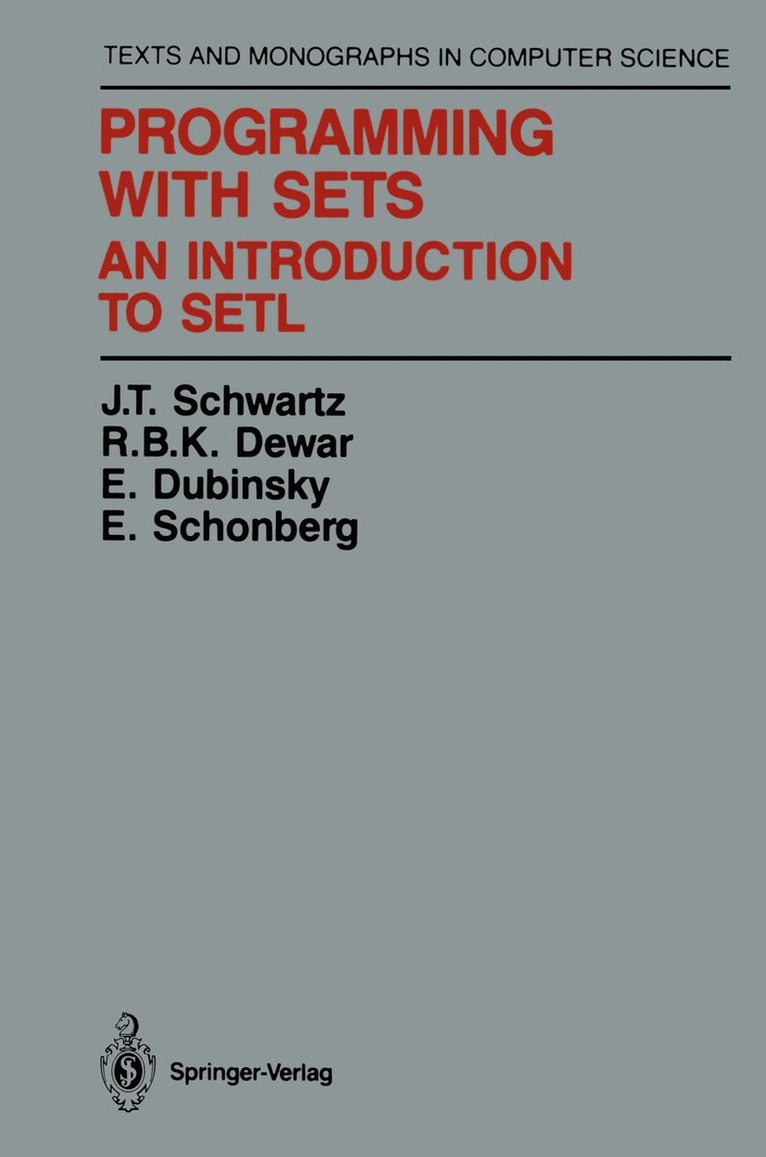
    Programming with Sets

    An Introduction to SETL

    AvJ.T. Schwartz,R.B.K. Dewar

    Häftad, Engelska, 2012

    Del i serien Monographs in Computer Science

    1 116 kr

    Beställningsvara. Skickas inom 10-15 vardagar. Fri frakt över 249 kr.

    Beskrivning

    The programming language SETL is a relatively new member of the so-called "very-high-level" class of languages, some of whose other well-known mem­ bers are LISP, APL, SNOBOL, and PROLOG. These languages all aim to reduce the cost of programming, recognized today as a main obstacle to future progress in the computer field, by allowing direct manipulation of large composite objects, considerably more complex than the integers, strings, etc., available in such well-known mainstream languages as PASCAL, PL/I, ALGOL, and Ada. For this purpose, LISP introduces structured lists as data objects, APL introduces vectors and matrices, and SETL introduces the objects characteristic for it, namely general finite sets and maps. The direct availability of these abstract, composite objects, and of powerful mathematical operations upon them, improves programmer speed and pro­ ductivity significantly, and also enhances program clarity and readability. The classroom consequence is that students, freed of some of the burden of petty programming detail, can advance their knowledge of significant algorithms and of broader strategic issues in program development more rapidly than with more conventional programming languages.

    Produktinformation

    • Utgivningsdatum:2012-01-04
    • Mått:155 x 235 x 28 mm
    • Vikt:768 g
    • Format:Häftad
    • Språk:Engelska
    • Serie:Monographs in Computer Science
    • Antal sidor:493
    • Förlag:Springer-Verlag New York Inc.
    • ISBN:9781461395775

    Utforska kategorier

    • Programvaruutveckling inom Data och IT
    • Programmeringsböcker inom Data och IT

    Innehållsförteckning

    • 1 Programming Concepts.- 1.1 An Informal Overview of SETL.- 1.2 Advice to the Would-Be Programmer.- 1.3 Programming Steps: How to Run Your Program and Read Its Results.- 1.4 How to Type a Program: Character Sets.- 1.5 Appendix: More on How to Read Your Output Listing.- 2 Simple Data Types, Expressions, and Operations.- 2.1 The Main Classes of Data Objects.- 2.2 Simple Types and Their Constants.- 2.3 Variable Identifiers.- 2.4 Expressions and Statements.- 2.5 Operations with Simple Data Types.- 3 Compound Data Types and Operators.- 3.1 Sets and Set Denotations.- 3.2 Tuples.- 3.3 Maps.- 3.4 The Size of Composite Objects: The # Operator.- 3.5 Set Operations and Set Formers.- 3.6 Tuple Operations and Tuple Formers.- 3.7 Tuple Formers; Simple Tuple and String Iterators.- 3.8 Map Operations.- 3.9 Compound Operators.- 3.10 Types and Type-Testing Operators.- 3.11 The? Operator.- 3.12 General Form of the SETL Assignment: The Operators from, frome, and fromb.- 3.13 Operator Precedence Rules.- 3.14 Om and Errors.- 4 Control Structures.- 4.1 The if Statement.- 4.2 The case Statement.- 4.3 Loops.- 4.4 The goto Statement.- 4.5 The stop Statement.- 4.6 The assert Statement.- 4.7 Programming Examples.- 4.8 Reading and Writing Data.- 5 Procedures.- 5.1 Writing and Using Procedures.- 5.2 Name Scopes; Local and Global Variable Names: The var Declaration.- 5.3 Programming Examples 177 5.3.1 The buckets and well problem: a simple artificial intelligence example.- 5.4 Recursive Procedures.- 5.5 Procedures that Modify Their Parameters.- 5.6 Other Procedure-Related Facilities.- 5.7 Rules of Style in the Use of Procedures.- 5.8 String Scanning Primitives.- 5.9 Use of Atoms.- 6 Program Development, Testing, and Debugging.- 6.1 Bugs: How to Minimize Them.- 6.2 Finding Bugs.- 6.3 A Checklist of Common Bugs.- 6.4 Program Testing.- 6.5 Analysis of Program Efficiency.- 6.6 Formal Verification of Programs.- 6.7 Formative Influences on Program Development.- 6.8 References to Material on Alternative Data Structures: References for Additional Material on Algorithms.- 7 Backtracking.- 7.1 Backtracking.- 8 Structuring Large SETL Programs.- 8.1 The const Declaration.- 8.2 Macros.- 8.3 Programming Examples.- 8.4 Programs, Modules, Libraries, and Directories: Structuring Constructs for Large SETL Programs.- 9 Input/Output and Communication with the Environment.- 9.1 Input-Output Facilities.- 9.2 Use of Inclusion Libraries.- 9.3 Listing-Control Commands.- 9.4 Environment Operators and SETL Command Parameters.- 10 The Data Representation Sublanguage.- 10.0 Implementation of the SETL Primitives.- 10.1 The Standard Representation for Tuples.- 10.2 The Standard Representation for Sets.- 10.3 Type Declarations.- 10.4 Basing Declarations.- 10.5 Base Sets Consisting of Atoms Only.- 10.6 Constant Bases.- 10.7 The Packed Representations.- 10.8 Guidelines for the Effective Use of the Data Representation Sublanguage.- 11 The Language in Action: A Gallery of Programming Examples.- 11.1 Eulerian Paths in a Graph.- 11.2 Topological Sorting.- 11.3 The Stable Assignment Problem.- 11.4 A Text Preparation Program.- 11.5 A Simplified Financial Record-Keeping System.- 11.6 A Turing-Machine Simulator.- 11.7 Huffman Coding of Text Files.- 11.8 A Game-Playing Program.- 11.9 Implementation of a Macroprocessor.- Appendix A SETL Reserved Words.- Appendix B Syntax Diagrams.- B.1 Lexical Structure.- B.2 Program Structure.- B.3 Declarative Forms.- B.4 Statement Forms.- B.5 Expressions.