• Fri frakt över 249 kr
  • •
  • Snabba leveranser
  • •
  • Billiga böcker
Kundservice

Du är på sajten för privatpersoner.

Företag, bibliotek eller offentlig verksamhet?

Du handlar på classic.bokus.com, där alla dina funktioner finns intakta.
Till classic.bokus.com
Bokus logotyp. Gå till startsidan.
  • Erbjudanden
  • Student
  • Topplistor
  • Barn & ungdom
  • Bokus Play
  • E-böcker
  • Ljudböcker
  • Pocketböcker
  • Spel och pussel

Pocketfynda! Hundratals böcker för 49 kr/st →

Sidfot

Mina sidor

    Hjälp

    • Kundservice
    • Vanliga frågor och svar
    • Frakt och leverans
    • Retur vid ångerrätt
    • Reklamera vara
    • Betalning
    • Köpvillkor
    • Allmänna villkor
    • Information om webbplatsens tillgänglighet

    Om Bokus

    • Om oss
    • Pressrum
    • För studenter
    • För företag
    • För bibliotek och offentlig verksamhet
    • För leverantörer
    • Hållbarhet

    Populärt

    • Aktuella erbjudanden
    • Presentkort
    • Studentlitteratur
    • Nya böcker
    • Topplistor
    • Signerade böcker
    • Engelska böcker

    Inspiration

    • Boktips
    • BookTok
    • Barnbokskaraktärer
    • Populära författare
    Logotyp för Bokus
    Följ oss på Facebook (extern länk)Följ oss på Instagram (extern länk)Följ oss på YouTube (extern länk)Följ oss på TikTok (extern länk)
    bokus @ CookiesAnpassa cookiesIntegritetspolicyKöpvillkor
    Till Citymail hemsida (extern länk)Till Budbee hemsida (extern länk)Till Postnord hemsida (extern länk)Till Schenker hemsida (extern länk)Till Early Bird hemsida (extern länk)Till Walleys hemsida (extern länk)
    1. Naturvetenskap och teknik
    2. Teknik och industri
    3. Elektronik och kommunikationer

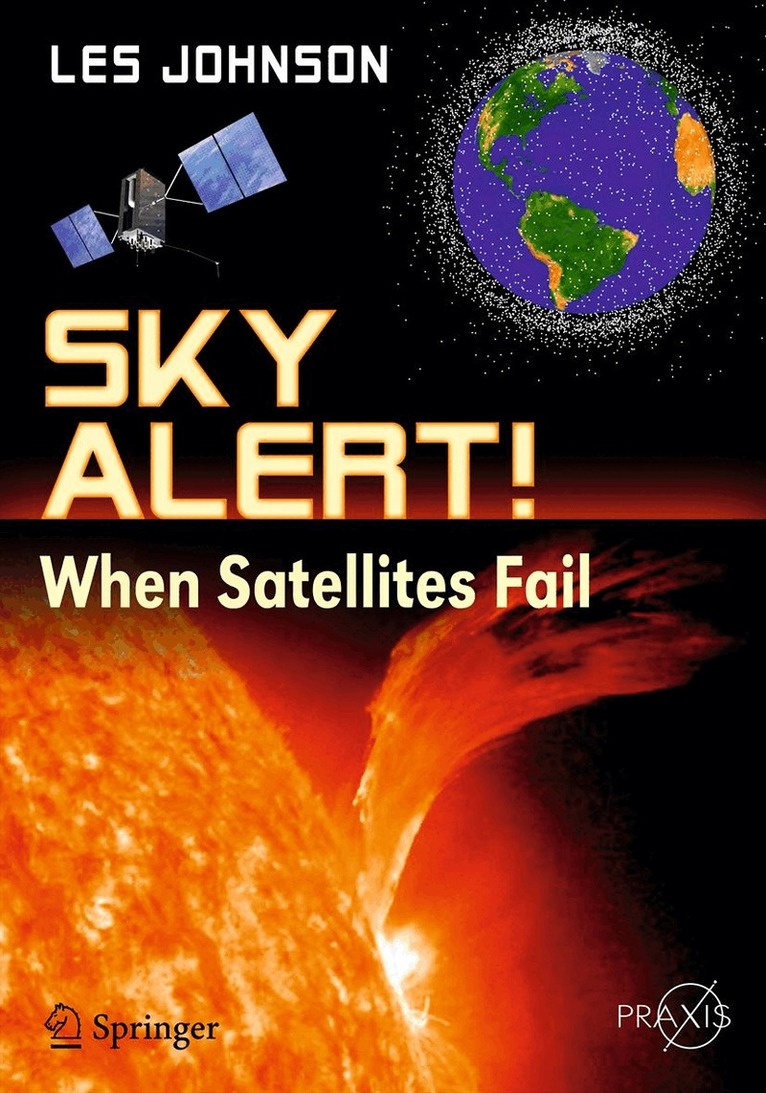
    Sky Alert!

    When Satellites Fail

    AvLes Johnson

    Häftad, Engelska, 2013

    Del i serien Springer Praxis Books

    328 kr

    Beställningsvara. Skickas inom 10-15 vardagar. Fri frakt över 249 kr.

    Fler format och utgåvor

    E-bok

    395 kr

    Beskrivning

    “Sky Alert! What Happens When Satellites Fail” explores for the first time what our modern world would be like if we were suddenly to lose most, if not all, of our space assets. The author demonstrates humankind’s dependence on space satellites and show what might happen to various aspects of our economy, defense, and daily lives if they were suddenly destroyed. The book opens with a consideration of how our space assets might be lost in the first place: through orbital debris, war, and solar storms. The author then looks at what would happen if our satellites were lost, including the effect on weather forecasting, and the Global Positioning System, explaining GPS in detail and its importance to the military, including spy satellites and military reconnaissance, commerce, civilians, communications and remote sensing – both resource monitoring and locating and environmental monitoring and science. The effects of losing such assets as the International Space Station as well as such research satellites as the Hubble Space Telescope or the Chandra X-Ray Observatory are also considered. Part III of the book looks at how we can protect our satellites, preparing for the worst, reducing the growth and amount of orbital debris, preventing acts of war in space and hardening against space radiation. The book ends on an optimistic note: most spacefaring nations are now working together to develop new technologies to reduce the threat posed by orbital debris and in-space nuclear detonations and treaties exist to limit the development and use of weapons in space. Finally, it is hoped that it will not be long before we will be able to better predict and take precautions against solar storms. The global economy has now become so dependent upon satellites that their loss would be devastating – to the economy, to national security, and potentially, to the day-to-day survival of those who live in the world’s most advancedeconomies.

    Produktinformation

    • Utgivningsdatum:2013-02-26
    • Mått:168 x 240 x 11 mm
    • Vikt:408 g
    • Format:Häftad
    • Språk:Engelska
    • Serie:Springer Praxis Books
    • Antal sidor:199
    • Upplaga:2013
    • Förlag:Springer-Verlag New York Inc.
    • ISBN:9781461418290

    Utforska kategorier

    • Elektronik och kommunikationer inom Naturvetenskap och teknik
    • Meteorologi och klimatologi inom Naturvetenskap och teknik
    • Geografi inom Naturvetenskap och teknik

    Mer om författaren

    Les Johnson is the Deputy Manager for NASA's Advanced Concepts Office at the George C. Marshall Space Flight Center in Huntsville, Alabama. He is also the co-author of three published popular science books, Living Off the Land in Space (Springer/Copernicus 2007), the 2008 PROSE Award finalist, Solar Sails - A Novel Approach to Interplanetary Travel (Springer/Copernicus 2008), and Paradise Regained - The Regreening of Earth (Springer/Copernicus 2009). He is also the co-author of the science fiction novel, Back to the Moon (Baen/2010). In the early 2000's, Les was NASA's Manager for Interstellar Propulsion Research and later managed the $100M In-Space Propulsion Technology Program. He has worked for NASA since 1990 and has served in various technical and management roles. Les is the NASA co-investigator on the Japanese space tether experiment "T-Rex" that flew in late 2010. He was the Chief Scientist for the ProSEDS space experiment, twice received NASA's Exceptional Achievement Medal, and holds 3 space technology patents. Les earned his Master's degree at Vanderbilt University in Nashville, TN and his Bachelor's Degree from Transylvania University in Lexington, KY. He has numerous peer-reviewed publications and was published in Analog. He is a frequent contributor to the Journal of the British Interplanetary Society and a member of the National Space Society, The World Future Society, and MENSA.

    Innehållsförteckning

    • From the Contents: Part I: How we might lose our Satellites.- Orbital Debris.- War.-Part II: If we were to lose our satellites.- The Global Positioning System (Military Uses).- Economic Fallout from the Losing the Global Positioning System.- GPS and the Average Person.- Spy Satellites and Military Reconnaissance.- Communications.- Weather Forecasting.- Remote Sensing - Resource Monitoring and Locating.- Remote Sensing - Environmental Monitoring and Science.- Part III: What Can We Do?.- Reduce the Growth of Orbital Debris.