• Fri frakt över 249 kr
  • •
  • Snabba leveranser
  • •
  • Billiga böcker
Kundservice

Du är på sajten för privatpersoner.

Företag, bibliotek eller offentlig verksamhet?

Du handlar på classic.bokus.com, där alla dina funktioner finns intakta.
Till classic.bokus.com
Bokus logotyp. Gå till startsidan.
  • Erbjudanden
  • Nyheter
  • Student
  • Topplistor
  • Barn & ungdom
  • Bokus Play
  • E-böcker
  • Pocketböcker
  • Spel & pussel

10% rabatt på allt med kod: NYSTART10 →

Sidfot

Mina sidor

    Hjälp

    • Kundservice
    • Vanliga frågor och svar
    • Frakt och leverans
    • Retur vid ångerrätt
    • Reklamera vara
    • Betalning
    • Köpvillkor
    • Allmänna villkor
    • Information om webbplatsens tillgänglighet

    Om Bokus

    • Om oss
    • Pressrum
    • För studenter
    • För företag
    • För bibliotek och offentlig verksamhet
    • För leverantörer
    • Hållbarhet

    Populärt

    • Aktuella erbjudanden
    • Presentkort
    • Studentlitteratur
    • Nya böcker
    • Topplistor
    • Signerade böcker
    • Engelska böcker

    Inspiration

    • Boktips
    • BookTok
    • Populära bokserier
    • Barnbokskaraktärer
    • Populära författare
    Logotyp för Bokus
    Följ oss på Facebook (extern länk)Följ oss på Instagram (extern länk)Följ oss på YouTube (extern länk)Följ oss på TikTok (extern länk)
    bokus @ CookiesAnpassa cookiesIntegritetspolicyKöpvillkor
    Till Citymail hemsida (extern länk)Till Budbee hemsida (extern länk)Till Postnord hemsida (extern länk)Till Schenker hemsida (extern länk)Till Early Bird hemsida (extern länk)Till Walleys hemsida (extern länk)
    1. Medicin
    2. Andra medicinska specialiteter
    3. Klinisk psykologi
    4. Psykoterapi som behandlingsmetod

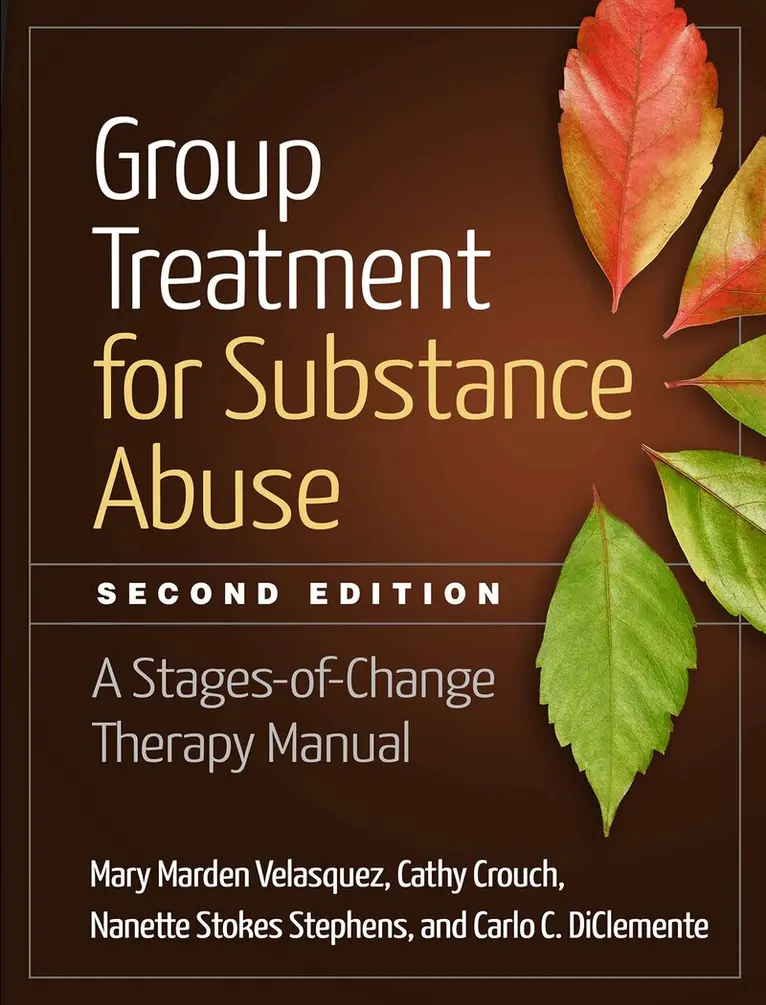
    Group Treatment for Substance Abuse, Second Edition

    A Stages-of-Change Therapy Manual

    AvMary Marden Velasquez,Cathy Crouch

    Häftad, Engelska, 2016

    600 kr

    Beställningsvara. Skickas inom 5-8 vardagar. Fri frakt över 249 kr.

    Beskrivning

    The leading manual on group-based treatment of substance use disorders, this highly practical book is grounded in the transtheoretical model and emphasizes the experiential and behavioral processes of change. The program helps clients move through the stages of change by building skills for acknowledging a problem, deciding to act, developing and executing a plan, and accomplishing other critical tasks. The expert authors provide step-by-step guidelines for implementing the 35 structured sessions, along with strategies for enhancing motivation. In a large-size format for easy photocopying, the volume includes 58 reproducible handouts. Purchasers get access to a webpage where they can download and print the reproducible materials.New to This EditionReflects significant developments in research and clinical practice. Eight new sessions focusing on the brain and substance use, gratitude, self-control, mindfulness, acceptance, and more. Updated discussions of motivational interviewing and the use of cognitive-behavioral techniques with groups. 41 of the 58 handouts are new or revised; all are now downloadable. See also Substance Abuse Treatment and the Stages of Change, Second Edition, by Gerard J. Connors et al., which explores how the transtheoretical model can inform treatment planning and intervention in diverse clinical contexts.

    Produktinformation

    • Utgivningsdatum:2016-01-04
    • Mått:203 x 267 x 20 mm
    • Vikt:694 g
    • Format:Häftad
    • Språk:Engelska
    • Antal sidor:308
    • Upplaga:2
    • Förlag:Guilford Publications
    • ISBN:9781462523405

    Utforska kategorier

    • Psykoterapi som behandlingsmetod inom Medicin
    • Missbruk inom Medicin

    Mer om författaren

    Mary Marden Velasquez, PhD, is the Director of the Health Behavior Research and Training (HBRT) Institute at the School of Social Work, University of Texas at Austin. For more than 20 years, Dr. Velasquez has developed and studied behavioral interventions in the areas of group therapy, integrated primary care, screening and brief interventions, fetal alcohol spectrum disorder, alcohol and other drug abuse, prenatal health, sexually transmitted disease and HIV prevention, and smoking cessation. With particular expertise in the use of evidence-based brief interventions in health care, substance abuse treatment, and criminal justice settings, she is the author of numerous publications on motivational interventions in high-risk settings. She is a member of the Motivational Interviewing Network of Trainers (MINT).Cathy Crouch, LCSW, is Executive Vice-President of SEARCH Homeless Services, a large multi-service organization in Houston, Texas, which works with persons who have substance use problems and other issues. She has 27 years of management experience in nonprofit, corporate, and academic settings, and a strong commitment to using evidence-based practices and conducting research and evaluation. Over her career she has served as coprincipal investigator or consultant on a number of large federally funded research grants, including several clinical trials. Ms. Crouch is a licensed clinical social worker, a state board-approved clinical supervisor, and a member of MINT.Nanette Stokes Stephens, PhD, is Director of Training and Research Scientist at the HBRT Institute at the University of Texas at Austin. Dr. Stephens has more than 20 years of experience working with the transtheoretical model and utilizing motivational interviewing as a trainer, clinician, consultant, coach, and supervisor, and she has published peer-reviewed journal articles and book chapters. She is a member of MINT and has worked in a wide range of settings and agencies, including those that provide substance abuse services for veterans, homeless people, military personnel, juvenile probationers, college students, and women at risk for alcohol- and tobacco-exposed pregnancies.Carlo C. DiClemente, PhD, ABPP, is Professor Emeritus of Psychology at the University of Maryland, Baltimore County (UMBC), and Director of the MDQuit tobacco resource center, the Center for Community Collaboration, and the Home Visitor Training Certificate Program at UMBC. He is codeveloper of the transtheoretical model of behavior change and author of numerous scientific publications on motivation and behavior change with a variety of health and addictive behaviors. His books include Addiction and Change, Second Edition; Substance Abuse Treatment and the Stages of Change, Second Edition; Group Treatment for Substance Abuse, Second Edition; and the self-help resource Changing for Good. Dr. DiClemente is a recipient of awards including the Lifetime Achievement Award from the Addictive Behaviors Special Interest Group of the Association for Behavioral and Cognitive Therapies, the John P. McGovern Award from the American Society of Addiction Medicine, the Innovators Combating Substance Abuse award from the Robert Wood Johnson Foundation, and a Presidential Citation from the American Psychological Association.

    Recensioner i media

    "There is a dizzying array of seemingly correct methods for helping people change, so what is a busy practitioner to do? Velasquez and her colleagues have supplied the answer: do the right thing at the right time. This book provides an orientation to the transtheoretical model from one of its originators and outlines group treatment sessions developed by savvy clinicians. The second edition retains the best-loved features of the first edition while adding new developments from motivational interviewing, cognitive-behavioral therapy, and positive psychology. Each session includes the processes engaged, the tasks to be accomplished, and the markers that help us know if clients are making progress--plus, most important, the step-by-step instructions to get the work done."--David B. Rosengren, PhD, President and CEO, Prevention Research Institute, Lexington, Kentucky"I love this book. The second edition distills the best strategies from motivational interviewing, cognitive-behavioral therapy, and other approaches. It’s exactly what I need: practical strategies, tips, and handouts that make it easy to conduct groups. The progression of session topics--from precontemplation, to contemplation, to action--works really well. I love the inclusion of new activities related to mindfulness, acceptance, and wellness. Hands down, my favorite book for running clinical groups!"--Scott T. Walters, PhD, Regents Professor, School of Public Health, University of North Texas Health Science Center"This reader-friendly second edition contains useful, sensible instructions for flexibly facilitating group treatment for people with substance use disorders--I can't say enough good things about it! It is well organized by sessions, and provides excellent clinical resource materials. This book can be used by practitioners in clinical settings; faculty who teach courses in group therapy, addictive behaviors, or evidence-based practice; and researchers who conduct clinical trials. A great resource for psychology students, it brings to life important concepts such as 'readiness to change,' while showing how to apply them in an empirically supported treatment."--Bruce S. Liese, PhD, ABPP, Professor of Family Medicine and Psychiatry, and Clinical Director, Cofrin Logan Center for Addiction Research and Treatment, University of Kansas"This second edition contains the latest research on the stages and processes of change, motivational interviewing, self-control, positive psychology, and mindfulness in relapse prevention, and applies this content in new group sessions. Included are objectives, step-by-step directions, tasks, and handouts that can be used by veteran and new group facilitators alike. Addiction studies, counseling, and social work students will find this text immensely useful for coursework and field internships."--Melinda Hohman, PhD, MSW, School of Social Work, San Diego State University"This second edition shows that even the best, most useful books can be improved. The manual is full of current scientific information, presented in digestible nuggets that inform group leaders about the 'why' and 'how' of effective, theory-based treatment for substance users. The first chapter presents one of the most concise and accessible available overviews of the transtheoretical model, and should be required reading for graduate courses on health behavior change. The rest of the book is equally impressive, with a number of completely new session outlines and handouts. While the content is immediately usable for beginning group leaders, there are enough sophisticated, evidence-based ideas throughout the manual to help even experienced group leaders maximize their productiveness."--Karen S. Ingersoll, PhD, Department of Psychiatry and Neurobehavioral Sciences, University of Virginia -Velasquez and colleagues have produced a book that is accessible and practical for clinicians. The intervention approaches in the therapy manual are well supported with accepted theoretical underpinnings….This manual is structured in such a way that it will be useful to both the novice and the experienced group work clinician and even offers a brief refresher on group work….This text would make a useful and user-friendly addition to the library of any clinician working with people who are undertaking to change their substance-related behavior, particularly in a group work center.--Drug and Alcohol Review, 3/1/2017ƒƒI would highly recommend this book to substance abuse counselors of all levels, from beginners to experienced counselors. It provides an understandable way to use the stages of change, which underlies most of the evidence-based practices at the time in the treatment field. (on the first edition)--Journal of Groups in Addiction and Recovery, 4/2/2015

    Innehållsförteckning

    • IntroductionI. How to Help People Change1. How People Change: The Transtheoretical Model2. Strategies for Facilitating Change3. Putting It All Together: Setting Up and Carrying Out the InterventionII. Thinking about Changing Substance UseP/C/P Sequence: Precontemplation–Contemplation–PreparationP/C/P Session 1: The Stages of ChangeChange Process Objective: Consciousness RaisingP/C/P Session 2: Myths and MisconceptionsChange Process Objectives: Consciousness Raising, Self-ReevaluationP/C/P Session 3: Alcohol’s Effects on the BodyChange Process Objectives: Consciousness Raising, Self-ReevaluationP/C/P Session 4: Drugs’ Effects on the BodyChange Process Objectives: Consciousness Raising, Self-ReevaluationP/C/P Session 5: The Brain and Substance UseChange Process Objective: Consciousness RaisingP/C/P Session 6: ExpectationsChange Process Objectives: Consciousness Raising, Self-ReevaluationP/C/P Session 7: Personal ValuesChange Process Objectives: Self-Reevaluation, Emotional ArousalP/C/P Session 8: Expressions of ConcernChange Process Objectives: Self-Reevaluation, Environmental Reevaluation, Emotional ArousalP/C/P Session 9: RelationshipsChange Process Objective: Environmental ReevaluationP/C/P Session 10: Tipping the Balance of ChangeChange Process Objectives: Decisional Balance, Self-Reevaluation, Environmental ReevaluationP/C/P Session 11: GratitudeChange Process Objective: Emotional ArousalP/C/P Session 12: RolesChange Process Objective: Environmental ReevaluationP/C/P Session 13: Self-ControlChange Process Objective: Self-LiberationP/C/P Session 14: Temptation and ConfidenceChange Process Objectives: Self-Efficacy, Self-Reevaluation, Environmental ReevaluationP/C/P Session 15: Problem SolvingChange Process Objectives: Self-Efficacy, Social LiberationP/C/P Session 16: Preparing for ChangeChange Process Objective: Self-LiberationP/C/P Session 17: Review and TerminationChange Process Objectives: Self-Reevaluation, Self-EfficacyIII. Making Changes in Substance UseA/M Sequence: Action–MaintenanceA/M Session 1: The Stages of ChangeChange Process Objective: Consciousness RaisingA/M Session 2: High-Risk SituationsChange Process Objective: Stimulus ControlA/M Session 3: MindfulnessChange Process Objective: CounterconditioningA/M Session 4: Disrupting HabitsChange Process Objectives: Stimulus Control, CounterconditioningA/M Session 5: Managing Cravings and UrgesChange Process Objectives: Stimulus Control, Counterconditioning, Reinforcement ManagementA/M Session 6: AcceptanceChange Process Objective: CounterconditioningA/M Session 7: Rewarding My SuccessesChange Process Objective: Reinforcement ManagementA/M Session 8: Assertive CommunicationChange Process Objectives: Counterconditioning, Reinforcement ManagementA/M Session 9: Effective RefusalsChange Process Objectives: Counterconditioning, Reinforcement ManagementA/M Session 10: Managing CriticismChange Process Objectives: Counterconditioning, Reinforcement ManagementA/M Session 11: Positive ThinkingChange Process Objectives: Stimulus Control, Counterconditioning, Reinforcement ManagementA/M Session 12: Managing AnxietyChange Process Objectives: Stimulus Control, CounterconditioningA/M Session 13: WellnessChange Process Objectives: Stimulus Control, Counterconditioning, Reinforcement ManagementA/M Session 14: Moving ForwardChange Process Objective: Self-LiberationA/M Session 15: Recommitting after a SlipChange Process Objective: Self-LiberationA/M Session 16: Social SupportChange Process Objective: Helping RelationshipsA/M Session 17: Building Your FutureChange Process Objective: Social LiberationA/M Session 18: Review and TerminationChange Process Objectives: Self-Efficacy, Reinforcement ManagementAppendix. Professional Contacts and Suggested ResourcesReferencesIndex