• Fri frakt över 249 kr
  • •
  • Snabba leveranser
  • •
  • Billiga böcker
Kundservice

Du är på sajten för privatpersoner.

Företag, bibliotek eller offentlig verksamhet?

Du handlar på classic.bokus.com, där alla dina funktioner finns intakta.
Till classic.bokus.com
Bokus logotyp. Gå till startsidan.
  • Erbjudanden
  • Nyheter
  • Student
  • Topplistor
  • Barn & ungdom
  • Bokus Play
  • E-böcker
  • Pocketböcker
  • Spel & pussel

10% rabatt på allt med kod NYSTART10 →

Sidfot

Mina sidor

    Hjälp

    • Kundservice
    • Vanliga frågor och svar
    • Frakt och leverans
    • Retur vid ångerrätt
    • Reklamera vara
    • Betalning
    • Köpvillkor
    • Allmänna villkor
    • Information om webbplatsens tillgänglighet

    Om Bokus

    • Om oss
    • Pressrum
    • För studenter
    • För företag
    • För bibliotek och offentlig verksamhet
    • För leverantörer
    • Hållbarhet

    Populärt

    • Aktuella erbjudanden
    • Presentkort
    • Studentlitteratur
    • Nya böcker
    • Topplistor
    • Signerade böcker
    • Engelska böcker

    Inspiration

    • Boktips
    • BookTok
    • Populära bokserier
    • Barnbokskaraktärer
    • Populära författare
    Logotyp för Bokus
    Följ oss på Facebook (extern länk)Följ oss på Instagram (extern länk)Följ oss på YouTube (extern länk)Följ oss på TikTok (extern länk)
    bokus @ CookiesAnpassa cookiesIntegritetspolicyKöpvillkor
    Till Citymail hemsida (extern länk)Till Budbee hemsida (extern länk)Till Postnord hemsida (extern länk)Till Schenker hemsida (extern länk)Till Early Bird hemsida (extern länk)Till Walleys hemsida (extern länk)
    1. Psykologi och pedagogik
    2. Psykologi
    3. Psykologisk metod

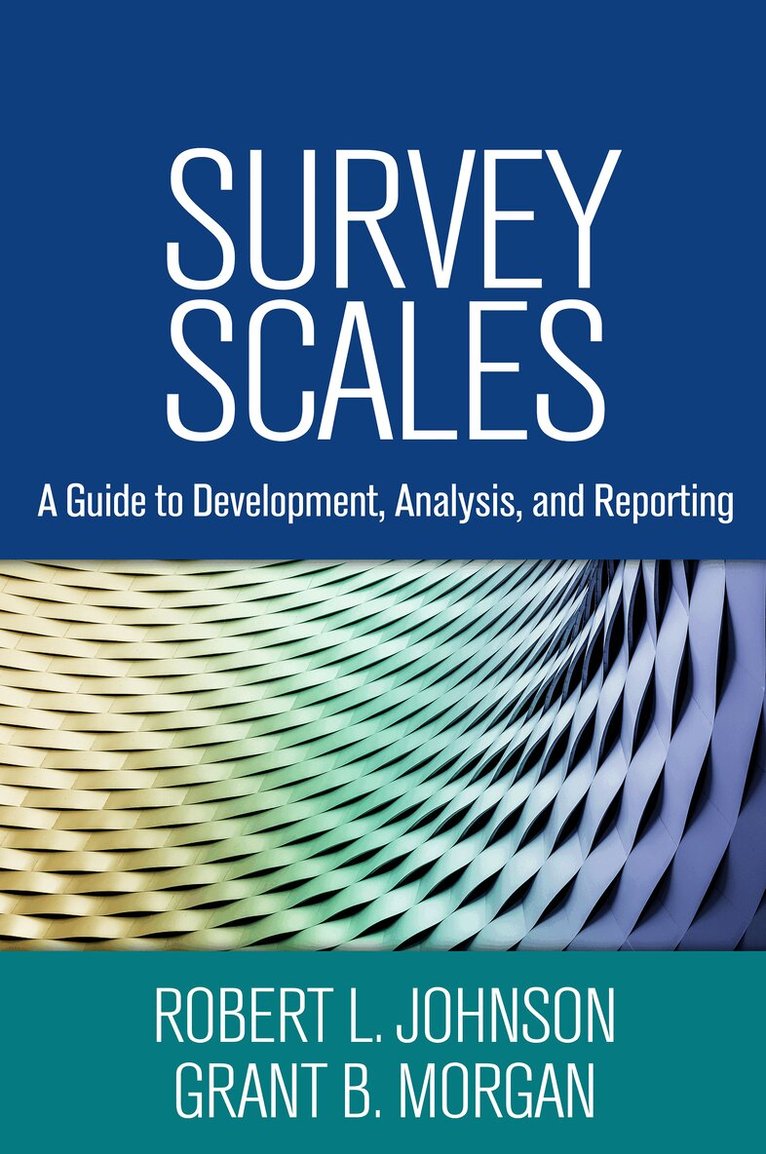
    Survey Scales

    A Guide to Development, Analysis, and Reporting

    AvRobert L. Johnson,Grant B. Morgan

    Häftad, Engelska, 2016

    621 kr

    Beställningsvara. Skickas inom 5-8 vardagar. Fri frakt över 249 kr.

    Fler format och utgåvor

    Inbunden

    1 198 kr

    Beskrivning

    Synthesizing the literature from the survey and measurement fields, this book explains how to develop closed-response survey scales that will accurately capture such constructs as attitudes, beliefs, or behaviors. It provides guidelines to help applied researchers or graduate students review existing scales for possible adoption or adaptation in a study; create their own conceptual framework for a scale; write checklists, true-false variations, and Likert-style items; design response scales; examine validity and reliability; conduct a factor analysis; and document the instrument development and its technical quality. Advice is given on constructing tables and graphs to report survey scale results. Concepts and procedures are illustrated with "Not This/But This" examples from multiple disciplines.User-Friendly Features*End-of-chapter exercises with sample solutions, plus annotated suggestions for further reading.*"Not This/But This" examples of poorly written and strong survey items.*Chapter-opening overviews and within-chapter summaries.*Glossary of key concepts.*Appendix with examples of parametric and nonparametric procedures for group comparisons.

    Produktinformation

    • Utgivningsdatum:2016-08-09
    • Mått:156 x 234 x 15 mm
    • Vikt:342 g
    • Format:Häftad
    • Språk:Engelska
    • Antal sidor:269
    • Förlag:Guilford Publications
    • ISBN:9781462526963

    Utforska kategorier

    • Psykologisk metod inom Psykologi och pedagogik

    Mer om författaren

    Robert L. Johnson, PhD, is Professor in the Department of Educational Studies at the University of South Carolina. His research focuses on the ethics of classroom assessment practices and the scoring of performance assessments in the language arts and the visual and performing arts. He also writes about the teaching of program evaluation and involvement of stakeholders in evaluations. Dr. Johnson's research has been published in such journals as Applied Measurement in Education, Language Assessment Quarterly, Assessing Writing, Teaching and Teacher Education, Assessment and Evaluation in Higher Education, and the American Journal of Evaluation. He teaches courses related to educational research, assessment, survey methodology, and program evaluation.Grant B. Morgan, PhD, is Associate Professor in the Department of Educational Psychology at Baylor University. His primary methodological research focuses on latent variable models, classification, and psychometrics. His research has been published in such journals as Structural Equation Modeling,Computational Statistics and Data Analysis, Psychological Assessment, School Psychology Quarterly, Language Assessment Quarterly, and Quality and Quantity. Dr. Morgan has evaluation experience at the local, state, and federal levels, and has extensive experience developing and using survey scales. He teaches graduate-level courses covering latent variable models, item response theory, psychometric theory, measurement and evaluation, experimental design, and research methods.

    Recensioner i media

    “Survey Scales is packed with helpful information and is easy to understand and navigate for specific issues. This is a great go-to guide for students, especially since it is reasonably priced.”--Sean Kelly, PhD, Department of Administrative and Policy Studies, University of Pittsburgh School of Education"Most texts on measurement and scale development focus on testing, with very little in the way of help for those constructing surveys, making this book an important contribution. I am particularly impressed by the very reader-friendly tone and the detailed discussions of all aspects of survey scale development, from the basics of writing items through the pilot testing of a survey. Practitioners and students alike will be able to pick up this book and immediately apply it to their own work. Survey Scales could serve as the primary text for a course devoted to survey or instrument design, and would be a very nice supplementary text for a general course on measurement."--Holmes Finch, PhD, George and Frances Ball Distinguished Professor of Educational Psychology, Ball State University"The ubiquity of surveys in research and evaluation holds potential for poor practice and inaccurate findings. Johnson and Morgan have provided an intelligent and comprehensive guide that will strengthen the researcher's or evaluator's ability to choose, design, implement, and analyze surveys. The authors describe research-based strategies for survey development and include many examples. They offer clear and accessible guidance for the entire process, even when it comes to complex topics like establishing the quality of survey instruments."--Donna M. Mertens, PhD, Department of Education (Emeritus), Gallaudet University"The book is clearly written and includes detailed, practical advice on everything from defining the conceptual framework of a survey and writing questions to exploratory factor analysis and reporting results. It succinctly answers questions that commonly arise in survey research, such as 'How many response categories should I use?' and 'Should I use a middle response category?' The authors are masterful at identifying and addressing critical aspects of survey research. This book will be of use to a wide range of researchers in the social sciences. It will prepare newcomers to survey research for high-quality data collection and sophisticated data analysis."--J. Patrick Meyer, PhD, Curry School of Education, University of Virginia"One of the few books that provides a comprehensive description of the survey development process from beginning to end, with examples from various disciplines and a glossary of terms. The book addresses issues that researchers must be cognizant of when constructing a questionnaire or interpreting findings. This is a great resource for individuals learning about survey development for the first time, as well as those in need of a refresher."--Dorinda J. Gallant, PhD, Department of Educational Studies, The Ohio State University"Presenting best practices in measurement and survey design, this handbook is a very helpful reference for students and practitioners conducting survey research. It guides readers through every step of survey development and provides thorough yet concise information on a large range of topics. The text is clearly organized, easy to read, and includes examples from a variety of fields."--Diana L. Mindrila, PhD, Department of Leadership, Research, and School Improvement, University of West Georgia -

    Innehållsförteckning

    • 1. Scales in SurveysIntroductionAn Overview of the Survey Scale Development ProcessAttitudes, Knowledge, and BehaviorsKey Qualities of a Survey Scale: Reliability and ValidityFurther ReadingChapter Exercises2. Adopting or Adapting an Existing ScaleIntroductionReviewing Potential Instruments for Adoption or AdaptationThe Mental Measurements Yearbook: A Source for Reviews of InstrumentsPlagiarism and Copyright InfringementFurther ReadingChapter Exercises3. Establishing a Framework for the Development of a Survey ScaleIntroductionElements and FormatFunctions of the Conceptual Framework in the Development of a Survey ScaleConstruction of a Conceptual FrameworkFurther ReadingChapter Exercises4. Item-Writing GuidelinesIntroductionAddressing RelevanceAddressing AudienceAddressing LanguageAddressing Item StructureAddressing ConventionsGuidelines Specific to Item TypeNumber of ItemsFurther ReadingChapter Exercises5. Development of Response ScalesIntroductionLength of the Item Response ScaleNumeric and Verbal Response LabelsThe Questionable Middle PositionFurther ReadingChapter Exercises6. Formatting and ReviewingIntroductionSurvey Format and Administration MethodItem Formats Specific to Administration MethodsComplete Reviews and a Pilot of the Survey ScaleFurther ReadingChapter Exercises7. Analysis of Survey Scale DataIntroductionLevels of MeasurementFrequenciesMeasures of Central TendencyMeasures of VariabilityMeasures of AssociationObtaining Descriptive StatisticsFurther ReadingChapter Exercises8. Investigating Scale QualityIntroductionField TestingResponse Distributions: Item QualityInvestigating ReliabilityInvestigating ValidityFurther ReadingChapter Exercises9. Factor AnalysisIntroductionGeneral Purposes and Processes Associated with Factor-Analytic ProceduresTesting AssumptionsDimensionalityExtraction: Principal Axis FactoringDetermining the Number of Factors (Model Selection)RotationHow to Interpret Factor SolutionsCalculating Factor ScoresSample SizeSteps after EFAHow to Obtain an EFA ModelFurther ReadingChapter Exercises10. Documenting the Development of the Survey ScaleIntroductionDetermining the Need for a Data DisplayDeveloping TablesTable StructureTable DataDeveloping GraphsStructure of a GraphOrganization of Data in a GraphNarrative about Table or GraphConcluding ThoughtsFurther ReadingChapter ExercisesAppendix. Analysis of Data: Inferential StatisticsIntroductionSamplingInferential StatisticsInferential ProceduresNonparametric Inferential StatisticsFurther ReadingAppendix ExercisesSample Solutions to Chapter ExercisesGlossary of Key TermsReferencesAuthor IndexSubject IndexAbout the Authors