• Fri frakt över 249 kr
  • •
  • Snabba leveranser
  • •
  • Billiga böcker
Kundservice

Du är på sajten för privatpersoner.

Företag, bibliotek eller offentlig verksamhet?

Du handlar på classic.bokus.com, där alla dina funktioner finns intakta.
Till classic.bokus.com
Bokus logotyp. Gå till startsidan.
  • Erbjudanden
  • Student
  • Topplistor
  • Barn & ungdom
  • Bokus Play
  • E-böcker
  • Ljudböcker
  • Pocketböcker
  • Spel och pussel

Pocketfynda! Hundratals böcker för 49 kr/st →

Sidfot

Mina sidor

    Hjälp

    • Kundservice
    • Vanliga frågor och svar
    • Frakt och leverans
    • Retur vid ångerrätt
    • Reklamera vara
    • Betalning
    • Köpvillkor
    • Allmänna villkor
    • Information om webbplatsens tillgänglighet

    Om Bokus

    • Om oss
    • Pressrum
    • För studenter
    • För företag
    • För bibliotek och offentlig verksamhet
    • För leverantörer
    • Hållbarhet

    Populärt

    • Aktuella erbjudanden
    • Presentkort
    • Studentlitteratur
    • Nya böcker
    • Topplistor
    • Signerade böcker
    • Engelska böcker

    Inspiration

    • Boktips
    • BookTok
    • Barnbokskaraktärer
    • Populära författare
    Logotyp för Bokus
    Följ oss på Facebook (extern länk)Följ oss på Instagram (extern länk)Följ oss på YouTube (extern länk)Följ oss på TikTok (extern länk)
    bokus @ CookiesAnpassa cookiesIntegritetspolicyKöpvillkor
    Till Citymail hemsida (extern länk)Till Budbee hemsida (extern länk)Till Postnord hemsida (extern länk)Till Schenker hemsida (extern länk)Till Early Bird hemsida (extern länk)Till Walleys hemsida (extern länk)
    1. Psykologi och pedagogik
    2. Psykologi
    3. Biologisk psykologi och neuropsykologi

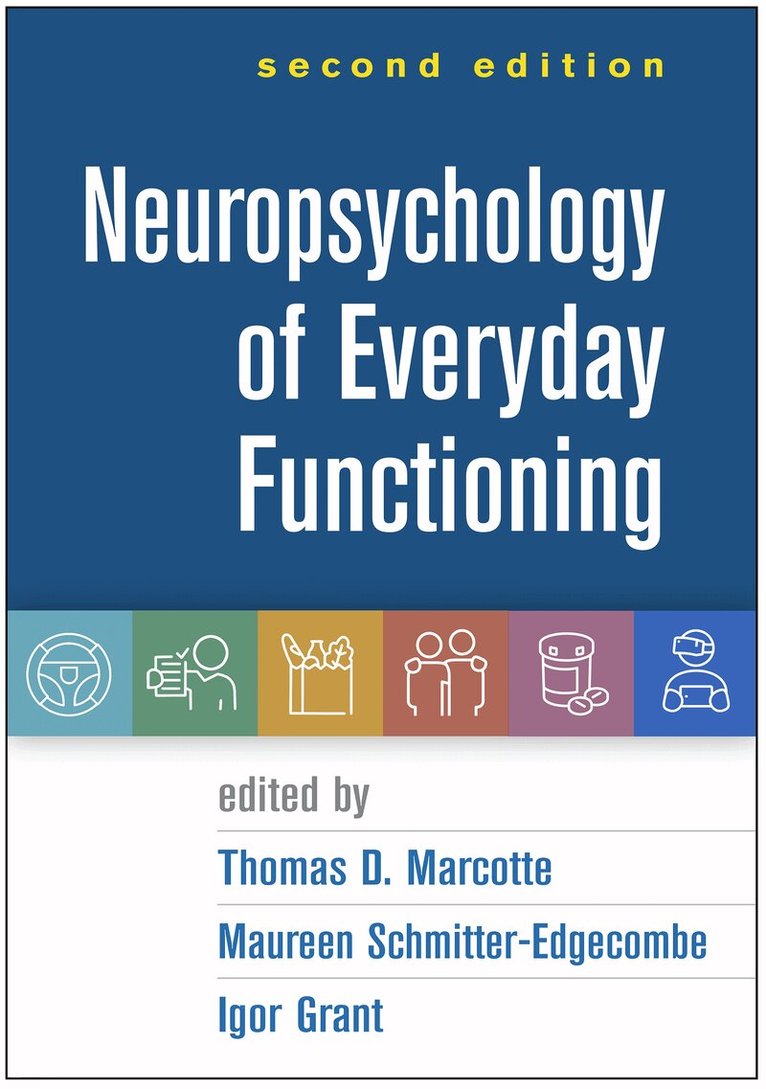
    Neuropsychology of Everyday Functioning, Second Edition

    AvThomas D. Marcotte,Maureen Schmitter-Edgecombe

    Inbunden, Engelska, 2022

    1 229 kr

    Beställningsvara. Skickas inom 5-8 vardagar. Fri frakt över 249 kr.

    Beskrivning

    The go-to resource for assessing and predicting functional abilities in persons with brain injury or cognitive decline has now been revised and expanded to reflect significant advances in the field. With a focus on key real-world capacities--independent living, vocational functioning, medication management, and driving--leading experts explore how individuals go about their daily lives, where and why disruptions occur, and potential opportunities for improving function. Strategies for direct assessment are reviewed, from standard neuropsychological tests to multimodal approaches and technology-based tools. Chapters also provide functional assessment guidance for specific neurological and psychiatric conditions: dementia, traumatic brain injury, depression, schizophrenia, and others.New to This Edition*Incorporates over a decade of technological and methodological innovations.*Chapter on theories and models of everyday functioning.*Chapters on naturalistic assessment, wearable sensors, ambulatory assessment, and virtual-reality-based tools.*Practical clinical implications are highlighted throughout.

    Produktinformation

    • Utgivningsdatum:2022-04-12
    • Mått:182 x 256 x 36 mm
    • Vikt:1 203 g
    • Format:Inbunden
    • Språk:Engelska
    • Antal sidor:598
    • Upplaga:2
    • Förlag:Guilford Publications
    • ISBN:9781462548880

    Utforska kategorier

    • Biologisk psykologi och neuropsykologi inom Psykologi och pedagogik
    • Åldrandets psykologi inom Psykologi och pedagogik

    Mer om författaren

    Thomas D. Marcotte, PhD, is Professor in the Department of Psychiatry at the University of California, San Diego (UCSD), Co-Director of the Center for Medicinal Cannabis Research, and Program Manager of the HIV Neurobehavioral Research Program at UCSD. Dr. Marcotte’s research focuses on the development of methods for assessing and predicting the impact of cognitive impairments, as a result of substance use or neurological conditions, on the ability to carry out a broad range of everyday activities, in particular, driving an automobile. He has published numerous articles and book chapters on these topics and has served on the editorial boards of the Journal of the International Neuropsychological Society and Neuropsychology.Maureen Schmitter-Edgecombe, PhD, is Regents Professor and H. L. Eastlick Distinguished Professor in the Department of Psychology at Washington State University. Dr. Schmitter-Edgecombe’s research focuses on investigating relationships between cognition and everyday functioning, and developing interventions and smart technologies to help delay functional disability and increase the quality of life of individuals with cognitive impairment. Her innovative interdisciplinary work with computer scientists and engineers has improved understanding of factors that can impact the ability to function independently and has led to the development of more ecologically valid assessment methods. She has published widely, serves on the editorial boards of leading neuropsychology journals, and has mentored many graduate students who are making significant contributions to the field.Igor Grant, MD, is Mary Gilman Marston Distinguished Professor of Psychiatry and Director of the HIV Neurobehavioral Research Program and the Center for Medicinal Cannabis Research at the University of California, San Diego. Dr. Grant has contributed extensively to the literature on neuropsychiatry, in particular, on the effects of alcohol abuse, drug abuse, HIV, and other disease states on neurocognitive functioning and underlying brain disease. His work has also touched on the effects of life stress on health. He is founding editor of the Journal of the International Neuropsychological Society and AIDS and Behavior. He is a recipient of the Distinguished Lifetime Contribution to Neuropsychology Award and the Nelson Butters Award for research contributions to clinical neuropsychology from the National Academy of Neuropsychology.

    Recensioner i media

    "The second edition of this well-written, practical, sometimes thought-provoking and always easy-to-digest book about everyday functioning is a welcome treat. It covers a breadth of topics, from driving to medication management, cultural issues, sensors, virtual reality, and more. Readers will learn about new tests, new approaches, and new ways of measuring problems encountered in everyday life. Psychologists, occupational therapists, and other professionals engaged in person-centered rehabilitation with different diagnostic groups--including patients with stroke, Alzheimer’s disease and traumatic brain injury--will benefit from this book."--Barbara A. Wilson, OBE, PhD, clinical neuropsychologist, Oliver Zangwill Centre for Neuropsychological Rehabilitation and St. George’s Hospital, United Kingdom"This updated guide is a 'must-have' for clinical neuropsychologists and other health professionals interested in the complex ways that cognition influences everyday functioning. The book takes an accessible, multidisciplinary approach to communicating important conceptual, methodological, and clinical issues. A particularly compelling feature of the second edition is the integration of new coeditor Schmitter-Edgecombe, who brings expertise in the technological aspects of cognition and functioning."--Steven Paul Woods, PsyD, Professor of Psychology, University of Houston, and Adjunct Professor of Psychological Science, University of Western Australia"This is a very solid, worthwhile information source for the applied clinician and a useful and accessible text for the neuropsychology trainee. The volume is at the forefront of the integrated field of cognition and everyday functioning, which is especially heartening given the rapidity of change in this field. I am particularly impressed with the up-to-date chapters on naturalistic observations and new, technologically derived methods for ecologically valid assessments. I can easily see myself using this second edition in my graduate cognitive assessment courses as well as in my own neuropsychology practice."--L. Stephen Miller, PhD, Department of Psychology, University of Georgia-

    Innehållsförteckning

    • I. Assessment Concepts and MethodsA. Approaches to Assessing the Relationship between Cognition and Everyday Functioning1. Neuropsychology and the Prediction of Everyday Functioning, Thomas D. Marcotte, Maureen Schmitter-Edgecombe, J. Cobb Scott, Rujvi Kamat, & Robert K. Heaton2. Theories and Models of Everyday Functioning, Deirdre R. Dawson, Tania Giovannetti, & Barry Trentham3. Human Factors/Ergonomics: Relevance to Assessments of Everyday Functioning, Laura H. Barg-Walkow, Cara B. Fausset, & Wendy A. Rogers4. The Relationship between Cognition and Function: The Occupational Therapy Perspective, Carolyn M. Baum, Anna E. Boone, & Timothy J. Wolf5. Cultural Considerations in the Assessment of Functional Abilities, Mariana Cherner & Lily KamalyanB. Assessment of Specific Functional Abilities and Assessment Considerations6. The Relationship between Instrumental Activities of Daily Living and Neuropsychological Performance, Rosie E. Curiel Cid, Amarilis Acevedo, & David A. Loewenstein7. The Prediction of Employment Functioning from Neuropsychological Performance, Joseph R. Sadek8. Medication Management, Terry R. Barclay, Matthew J. Wright, Taylor P. Kuhn, & Charles H. Hinkin9. The Brain on the Road, Jennifer Merickel & Matthew Rizzo10. Naturalistic Assessment: Everyday Environments and Emerging Technologies, Maureen Schmitter-Edgecombe & Kayela Arrotta11. Wearable Sensors, Ambulation, and Health, Catherine Sumida & Diane J. Cook12. Ambulatory Assessment, Naomi S. Chaytor & Luciana Mascarenhas Fonseca13. Virtual-Reality-Based Neuropsychological Assessments of Everyday Functioning, Thomas D. Parsons, Robert Kane, & Tyler C. DuffieldII. Everyday Impact of Normal Aging and Neuropsychiatric Disorders14. Normal Aging and Everyday Functioning, Karlene Ball & Rachel Benz15. Everyday Functioning in Alzheimer’s Disease and Mild Cognitive Impairment, Brian C. Castelluccio & Nicole C. R. McLaughlin16. Everyday Functioning in Vascular Cognitive Impairment, Robert H. Paul, Lauren E. Salminen, & Joseph A. D. McBride17. Everyday Impact of Traumatic Brain Injury, Catherine A. Mateer, Rema A. Lillie, Holly Tuokko, & Leslie H. Neipert18. Cognitive Functioning and Everyday Tasks in Multiple Sclerosis, Peter A. Arnett & Megan M. Smith19. Everyday Impact of HIV-Associated Neurocognitive Disorders, J. Cobb Scott, Haley Ceremony, & Thomas D. Marcotte20. The Influence of Depression on Cognition and Daily Functioning, David J. Moore, Raeanne C. Moore, Laura M. Campbell, & J. Hampton Atkinson21. Cognition and Daily Functioning in Schizophrenia, Amanda McCleery & Michael F. Green22. Future Directions in the Assessment of Everyday Functioning, Maureen Schmitter-Edgecombe, Thomas D. Marcotte, & Igor GrantIndex