• Fri frakt över 249 kr
  • •
  • Snabba leveranser
  • •
  • Billiga böcker
Kundservice

Du är på sajten för privatpersoner.

Företag, bibliotek eller offentlig verksamhet?

Du handlar på classic.bokus.com, där alla dina funktioner finns intakta.
Till classic.bokus.com
Bokus logotyp. Gå till startsidan.
  • Erbjudanden
  • Nyheter
  • Student
  • Topplistor
  • Barn & ungdom
  • Bokus Play
  • E-böcker
  • Pocketböcker
  • Spel & pussel

10% rabatt på allt med kod: NYSTART10 →

Sidfot

Mina sidor

    Hjälp

    • Kundservice
    • Vanliga frågor och svar
    • Frakt och leverans
    • Retur vid ångerrätt
    • Reklamera vara
    • Betalning
    • Köpvillkor
    • Allmänna villkor
    • Information om webbplatsens tillgänglighet

    Om Bokus

    • Om oss
    • Pressrum
    • För studenter
    • För företag
    • För bibliotek och offentlig verksamhet
    • För leverantörer
    • Hållbarhet

    Populärt

    • Aktuella erbjudanden
    • Presentkort
    • Studentlitteratur
    • Nya böcker
    • Topplistor
    • Signerade böcker
    • Engelska böcker

    Inspiration

    • Boktips
    • BookTok
    • Populära bokserier
    • Barnbokskaraktärer
    • Populära författare
    Logotyp för Bokus
    Följ oss på Facebook (extern länk)Följ oss på Instagram (extern länk)Följ oss på YouTube (extern länk)Följ oss på TikTok (extern länk)
    bokus @ CookiesAnpassa cookiesIntegritetspolicyKöpvillkor
    Till Citymail hemsida (extern länk)Till Budbee hemsida (extern länk)Till Postnord hemsida (extern länk)Till Schenker hemsida (extern länk)Till Early Bird hemsida (extern länk)Till Walleys hemsida (extern länk)
    1. Naturvetenskap och teknik
    2. Geovetenskap
    3. Geografi

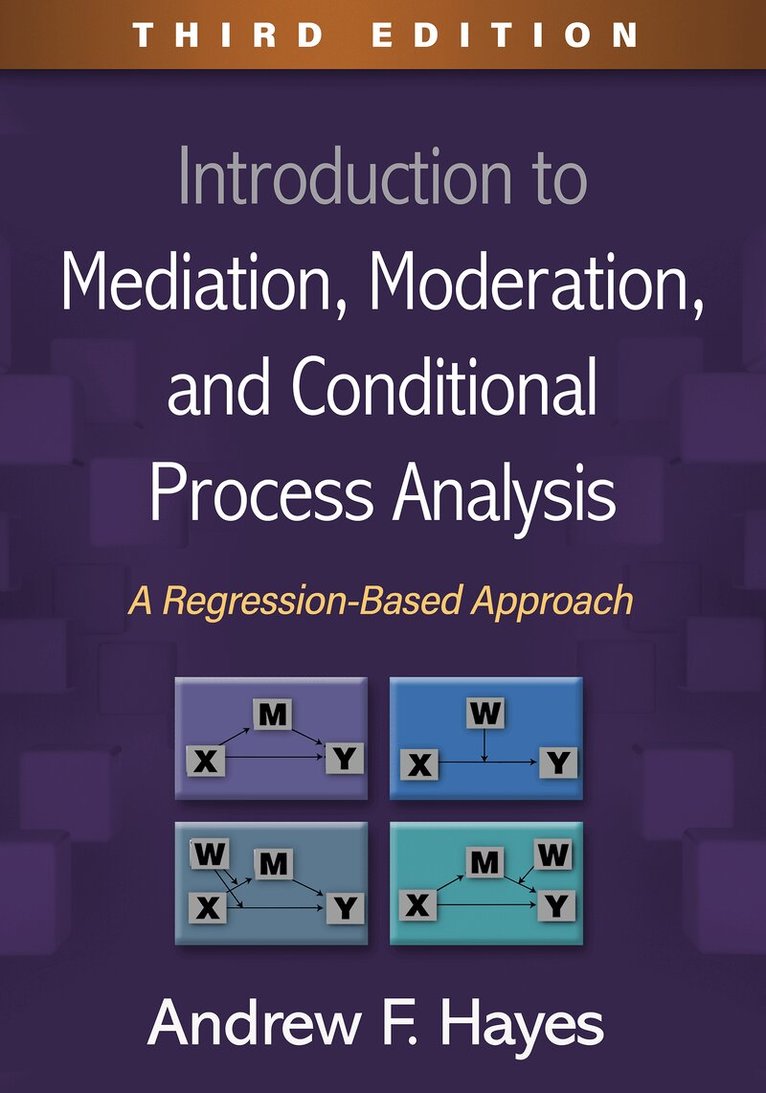
    Introduction to Mediation, Moderation, and Conditional Process Analysis, Third Edition

    A Regression-Based Approach

    AvAndrew F. Hayes

    Inbunden, Engelska, 2022

    1 088 kr

    Beställningsvara. Skickas inom 5-8 vardagar. Fri frakt över 249 kr.

    Beskrivning

    Acclaimed for its thorough presentation of mediation, moderation, and conditional process analysis, this book has been updated to reflect the latest developments in PROCESS for SPSS, SAS, and, new to this edition, R. Using the principles of ordinary least squares regression, Andrew F. Hayes illustrates each step in an analysis using diverse examples from published studies, and displays SPSS, SAS, and R code for each example. Procedures are outlined for estimating and interpreting direct, indirect, and conditional effects; probing and visualizing interactions; testing hypotheses about the moderation of mechanisms; and reporting different types of analyses. Readers gain an understanding of the link between statistics and causality, as well as what the data are telling them. The companion website (www.afhayes.com) provides data for all the examples, plus the free PROCESS download.New to This EditionRewritten Appendix A, which provides the only documentation of PROCESS, including a discussion of the syntax structure of PROCESS for R compared to SPSS and SAS. Expanded discussion of effect scaling and the difference between unstandardized, completely standardized, and partially standardized effects. Discussion of the meaning of and how to generate the correlation between mediator residuals in a multiple-mediator model, using a new PROCESS option. Discussion of a method for comparing the strength of two specific indirect effects that are different in sign. Introduction of a bootstrap-based Johnson–Neyman-like approach for probing moderation of mediation in a conditional process model. Discussion of testing for interaction between a causal antecedent variable [ital]X[/ital] and a mediator [ital]M[/ital] in a mediation analysis, and how to test this assumption in a new PROCESS feature.

    Produktinformation

    • Utgivningsdatum:2022-02-11
    • Mått:178 x 254 x 44 mm
    • Vikt:1 380 g
    • Format:Inbunden
    • Språk:Engelska
    • Antal sidor:732
    • Upplaga:3
    • Förlag:Guilford Publications
    • ISBN:9781462549030

    Utforska kategorier

    • Geografi inom Naturvetenskap och teknik
    • Psykologisk metod inom Psykologi och pedagogik

    Mer om författaren

    Andrew F. Hayes, PhD, is Distinguished Research Professor at the Haskayne School of Business at the University of Calgary, Alberta, Canada. His research and writing on data analysis has been published widely, and he is the author of Introduction to Mediation, Moderation, and Conditional Process Analysis, Third Edition, and Statistical Methods for Communication Science, as well as coauthor, with Richard B. Darlington, of Regression Analysis and Linear Models. Dr. Hayes teaches data analysis, primarily at the graduate level, and conducts workshops on statistical moderation and mediation analysis throughout the world. His website is www.afhayes.com.

    Recensioner i media

    “I know I speak for organizational researchers and graduate students everywhere when I say how much PROCESS, and prior editions of this book, have contributed to making some of the more difficult parts of the research process accessible and fun. I look forward to using the third edition in my own research, and (again) buying a copy for all my graduate students. Adding to the appeal of the third edition are features such as the new code for R users--now available for every example in the book--and techniques to analyze the strength of two specific direct effects that differ in sign. Hayes has made an immense contribution with his continual updates to PROCESS, and shows in his writing and his workshops that he is a gifted teacher.”--Julian Barling, PhD, FRSC, Distinguished University Professor and Borden Chair of Leadership, Smith School of Business, Queen’s University, Canada"This book would make an excellent companion text to accompany a course on regression analysis that also addresses mediation and moderation, two topics of enormous practical utility. It can also serve as a useful reference for more experienced researchers and methodologists wanting to learn about mediation, moderation, and advanced applications. Reading this book is like taking an immersive workshop on mediation and moderation analysis, with the author right there to explain everything."--Kristopher J. Preacher, PhD, Department of Psychology and Human Development, Peabody College, Vanderbilt University"This book is a staple on my bookshelf and a text that I recommend to all my students who are interested in quantitative research. The impressive third edition now includes code and examples for R. Making the incredibly flexible and useful analytic tools of PROCESS available for a free, open-source statistical software program is a huge contribution to the field. This is a most useful book for advanced graduate courses that focus on regression, as well as for faculty.”--Michael D. Broda, PhD, School of Education, Virginia Commonwealth University"I have used this text for several years in my graduate-level statistics classes. It makes the teaching of mediation and moderation much easier, and the associated PROCESS code makes conducting these analyses much less tedious. Colleagues have found this book and PROCESS very helpful in their research endeavors, and several of my students have used PROCESS in their theses and dissertations. The third edition has all of the things I liked about the earlier editions, plus some nice new stuff--the inclusion of R code will be helpful to those who do not have access to SAS or SPSS, and I especially enjoyed the more detailed discussion of unstandardized, standardized, and partially standardized coefficients. I recommend this book without reservation."--Karl L. Wuensch, PhD, Department of Psychology, East Carolina University-A very nice book that is readable enough for the intermediate statistics user but with enough technical detail to appeal to advanced users as well....This book would make an excellent textbook for an advanced graduate-level multiple regression course, or just a great resource for the interested reader. (on the first edition)--Journal of Educational Measurement, 8/1/2014ƒƒThis book elegantly presents both the basic and advanced issues of mediation and moderation analysis…It will be beneficial for graduate students and applied researchers who are interested in causal mechanisms using linear models. (on the first edition)--Journal of the American Statistical Association, 9/1/2014

    Innehållsförteckning

    • I. Fundamentals1. Introduction1.1. A Scientist in Training1.2. Questions of Whether, If, How, and When1.3. Conditional Process Analysis1.4. Correlation, Causality, and Statistical Modeling1.5. Statistical and Conceptual Diagrams, and Antecedent and Consequent Variables1.6. Statistical Software1.7. Overview of This Book1.8. Chapter Summary2. Fundamentals of Linear Regression Analysis2.1. Correlation and Prediction2.2. The Simple Linear Regression Model2.3. Alternative Explanations for Association2.4. Multiple Linear Regression2.5. Measures of Model Fit2.6. Statistical Inference2.7. Multicategorical Antecedent Variables2.8. Assumptions for Interpretation and Statistical Inference2.9. Chapter SummaryII. Mediation Analysis3. The Simple Mediation Model3.1. The Simple Mediation Model3.2. Estimation of the Direct, Indirect, and Total Effects of X3.3. Example with Dichotomous X: The Influence of Presumed Media Influence3.4. Statistical Inference3.5. An Example with Continuous X: Economic Stress among Small-Business Owners3.6. Chapter Summary4. Causal Steps, Scaling, Confounding, and Causal Order4.1. What about Baron and Kenny?4.2. Confounding and Causal Order4.3. Effect Scaling4.4. Multiple Xs or Ys: Analyze Separately or Simultaneously?4.5. Chapter Summary5. More Than One Mediator5.1. The Parallel Multiple Mediator Model5.2. Example Using the Presumed Media Influence Study5.3. Statistical Inference5.4. The Serial Multiple Mediator Model5.5. Models with Parallel and Serial Mediation Properties5.6. Complementarity and Competition among Mediators5.7. Chapter Summary6. Mediation Analysis with a Multicategorical Antecedent6.1. Relative Total, Direct, and Indirect Effects6.2. An Example: Sex Discrimination in the Workplace6.3. Using a Different Group Coding System6.4. Some Miscellaneous Issues6.5. Chapter SummaryIII. Moderation Analysis7. Fundamentals of Moderation Analysis7.1. Conditional and Unconditional Effects7.2. An Example: Climate Change Disasters and Humanitarianism7.3. Visualizing Moderation7.4. Probing an Interaction7.5. The Difference between Testing for Moderation and Probing It7.6. Artificial Categorization and Subgroups Analysis7.7. Chapter Summary8. Extending the Fundamental Principles of Moderation Analysis8.1. Moderation with a Dichotomous Moderator8.2. Interaction between Two Quantitative Variables8.3. Hierarchical versus Simultaneous Entry8.4. The Equivalence between Moderated Regression Analysis and a 2 x 2 Factorial Analysis of Variance8.5. Chapter Summary9. Some Myths and Additional Extensions of Moderation Analysis9.1. Truths and Myths about Mean-Centering9.2. The Estimation and Interpretation of Standardized Regression Coefficients in a Moderation Analysis9.3. A Caution on Manual Centering and Standardization9.4. More Than One Moderator9.5. Comparing Conditional Effects9.6. Chapter Summary10. Multicategorical Focal Antecedents and Moderators10.1. Moderation of the Effect of a Multicategorical Antecedent Variable10.2. An Example from the Sex Discrimination in the Workplace Study10.3. Visualizing the Model10.4. Probing the Interaction10.5. When the Moderator Is Multicategorical10.6. Using a Different Coding System10.7. Chapter SummaryIV. Conditional Process Analysis11. Fundamentals of Conditional Process Analysis11.1. Examples of Conditional Process Models in the Literature11.2. Conditional Direct and Indirect Effects11.3. Example: Hiding Your Feelings from Your Work Team11.4. Estimation of a Conditional Process Model Using PROCESS11.5. Quantifying and Visualizing (Conditional) Indirect and Direct Effects11.6. Statistical Inference11.7. Chapter Summary12. Further Examples of Conditional Process Analysis12.1. Revisiting the Disaster Framing Study12.2. Moderation of the Direct and Indirect Effects in a Conditional Process Model12.3. Statistical Inference12.4. Mediated Moderation12.5. Chapter Summary13. Conditional Process Analysis with a Multicategorical Antecedent13.1. Revisiting Sexual Discrimination in the Workplace13.2. Looking at the Components of the Indirect Effect of X13.3. Relative Conditional Indirect Effects13.4. Testing and Probing Moderation of Mediation13.5. Relative Conditional Direct Effects13.6. Putting It All Together13.7. Further Extensions and Complexities13.8. Chapter SummaryV. Miscellanea14. Miscellaneous Topics and Some Frequently Asked Questions14.1. A Strategy for Approaching a Conditional Process Analysis14.2. How Do I Write about This?14.3. Power and Sample Size Determination14.4. Should I Use Structural Equation Modeling Instead of Regression Analysis?14.5. The Pitfalls of Subgroups Analysis14.6. Can a Variable Simultaneously Mediate and Moderate Another Variable’s Effect?14.7. Interaction between X and M in Mediation Analysis14.8. Repeated Measures Designs14.9. Dichotomous, Ordinal, Count, and Survival Outcomes14.10. Chapter SummaryAppendix A. Using PROCESSAppendix B. Constructing and Customizing Models in PROCESS