• Fri frakt över 249 kr
  • •
  • Snabba leveranser
  • •
  • Billiga böcker
Kundservice

Du är på sajten för privatpersoner.

Företag, bibliotek eller offentlig verksamhet?

Du handlar på classic.bokus.com, där alla dina funktioner finns intakta.
Till classic.bokus.com
Bokus logotyp. Gå till startsidan.
  • Erbjudanden
  • Nyheter
  • Student
  • Topplistor
  • Barn & ungdom
  • Bokus Play
  • E-böcker
  • Pocketböcker
  • Spel & pussel

Må bättre, för mindre! Upp till 50% rabatt på hälsoböcker

Sidfot

Mina sidor

    Hjälp

    • Kundservice
    • Vanliga frågor och svar
    • Frakt och leverans
    • Retur vid ångerrätt
    • Reklamera vara
    • Betalning
    • Köpvillkor
    • Allmänna villkor
    • Information om webbplatsens tillgänglighet

    Om Bokus

    • Om oss
    • Pressrum
    • För studenter
    • För företag
    • För bibliotek och offentlig verksamhet
    • För leverantörer
    • Hållbarhet

    Populärt

    • Aktuella erbjudanden
    • Presentkort
    • Studentlitteratur
    • Nya böcker
    • Topplistor
    • Signerade böcker
    • Engelska böcker

    Inspiration

    • Boktips
    • BookTok
    • Populära bokserier
    • Barnbokskaraktärer
    • Populära författare
    Logotyp för Bokus
    Följ oss på Facebook (extern länk)Följ oss på Instagram (extern länk)Följ oss på YouTube (extern länk)Följ oss på TikTok (extern länk)
    bokus @ CookiesAnpassa cookiesIntegritetspolicyKöpvillkor
    Till Citymail hemsida (extern länk)Till Budbee hemsida (extern länk)Till Postnord hemsida (extern länk)Till Schenker hemsida (extern länk)Till Early Bird hemsida (extern länk)Till Walleys hemsida (extern länk)
    1. Naturvetenskap och teknik
    2. Matematik och naturvetenskap
    3. Biologi
    4. Biokemi

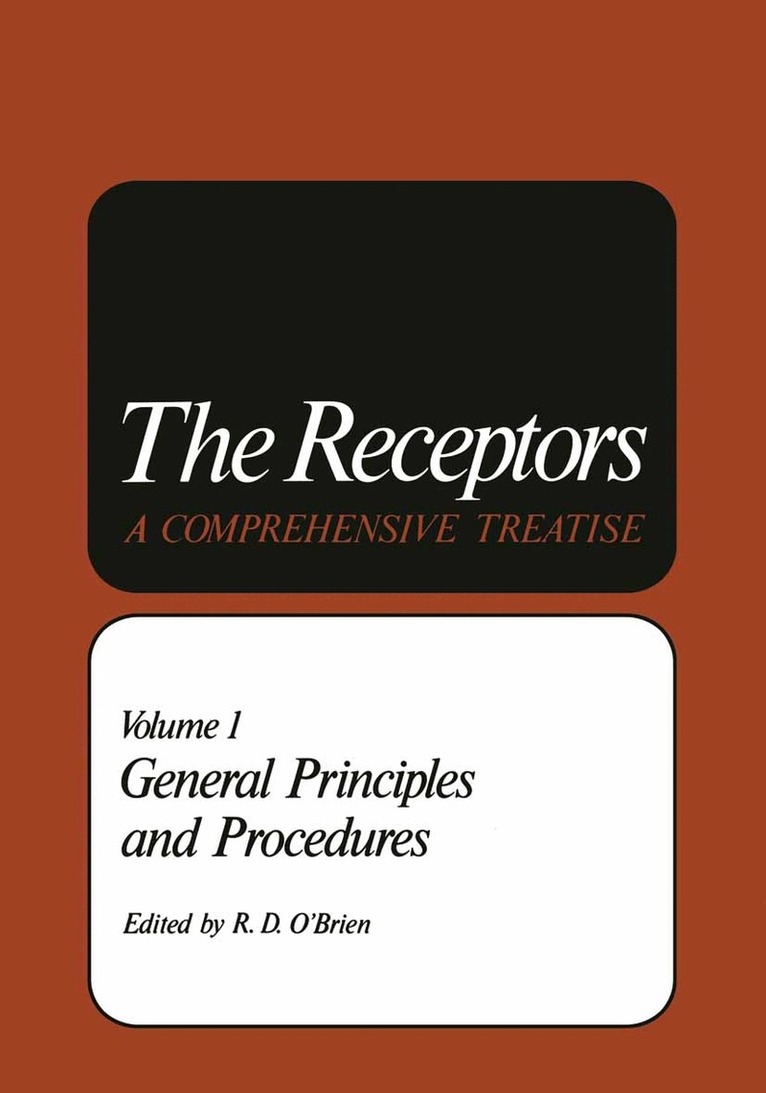
    General Principles and Procedures

    AvR.D. O'Brien

    Häftad, Engelska, 2012

    Del i serien Receptors

    547 kr

    Beställningsvara. Skickas inom 10-15 vardagar. Fri frakt över 249 kr.

    Beskrivning

    The following remarks are intended to serve as an introduction to this particular volume as well as to the whole series of volumes of which this is the first. The intent of the series is to provide an authentic and relatively complete statement about the status of our understanding of the receptors. The models we had in mind while developing this series are The Enzymes, The Proteins, and comparable groups of books. The receptors have received a degree of importance and richness of understanding that makes them deserving of comprehensive and complete coverage. The study of these molecules, which may well include such diverse items as the receptors for hormones, neurohumors, pheromones, taste, and many other chemical signals, have a great deal in common, so that the student of any one of them will wish to know the status of research about the others. This com­ monality is in part substantive, and in part practical and procedural. Substantively, the receptors are all macromolecules whose function is to re­ ceive some form of chemical signal and transduce it to a form which is usable by the receiving cell. In this way, a chemical signal may lead to a neural response, to the turning-on of a cell's chromosomes, or to the activation of some enzymic apparatus to produce or release a substance. Because most of these processes are noncatalytic, special techniques not previously commonplace in biochemistry have been developed in order to study the receptors.

    Produktinformation

    • Utgivningsdatum:2012-12-24
    • Mått:178 x 254 x 20 mm
    • Vikt:684 g
    • Format:Häftad
    • Språk:Engelska
    • Serie:Receptors
    • Antal sidor:345
    • Förlag:Springer-Verlag New York Inc.
    • ISBN:9781468409819

    Utforska kategorier

    • Biokemi inom Naturvetenskap och teknik

    Innehållsförteckning

    • 1 Reconstitution of Membrane Transport Functions.- 1. Introduction.- 2. Reconstitution of Active and Passive Transport Systems.- 3. General Techniques of Reconstitution.- 4. What We Can Learn from Reconstitution.- 5. Reconstitution in Planar Bilayer Membranes.- References.- 2 The Pharmacon-Receptor-Effector Concept: A Basis for Understanding the Transmission of Information in Biological Systems.- 1. Introduction.- 2. Biological Action.- 3. Receptors and Receptor Sites.- 4. Pharmacon-Receptor Interaction.- 5. Spare Receptors.- 6. Structure and Action.- 7. Accessory Receptor Sites.- 8. Steric Structure and Action.- 9. Selectivity in Action.- 10. Differentiation in Closely Related Receptor Types.- 11. Receptor Binding and Receptor Isolation.- 12. Dualism in Receptors for Agonists and Their Competitive Antagonists.- 13. The Aggregation-Segregation Concept.- 14. Dual Receptor Model.- 15. Combination of Pharmaca.- 16. The Slope of the Concentration-Effect Curves.- 17. The Allosteric Receptor Model.- 18. Binding and Displacement on Two or More Independent Classes of Receptor Sites.- 19. Two-Site Model.- 20. Reflection.- References.- 3 The Link between Drug Binding and Response: Theories and Observations.- 1. The Response to Acetylcholine-Like Drugs.- 2. The Binding of Drugs to Acetylcholine Receptors.- 3. The Link between Drug Binding and Response.- References.- 4 Kinetics of Cooperative Binding.- 1. Overview.- 2. General Introduction.- 3. Model I: koff as a Linear Function of Occupancy.- 4. Application to the Insulin-Receptor System.- 5. Model II: kon as a Linear Function of Occupancy.- 6. General Discussion.- 7. A Guide to the Experimentalist.- Appendix A: Model I: Differential Equations and Solutions.- Appendix B: Addition of Fresh (Empty) Receptors.- Appendix C: Model II:Labeled Ligand Only.- Appendix D: Model II: Labeled and Unlabeled Ligands.- Appendix E: Optimization of Testing for Model II with ? > 0.- References.- 5 Distinction of Receptor from Nonreceptor Interactions in Binding Studies.- 1. Defining a Pharmacologic Receptor.- 2. Criteria for Receptor Interactions.- 3. The Problem of Relating Binding to Biological Responsiveness.- 4. Nonspecific Binding: Definition and Examples of Complications of Binding Data Analysis.- 5. Estimating the Affinity of the Unlabeled Ligand.- 6. Examples of Receptor-Like Nonreceptor Interactions.- 7. Conclusion.- References.- 6 Incorporation of Transport Molecules into Black Lipid Membranes.- 1. Introduction.- 2. Methodology.- 3. Mechanisms of Ion Permeability.- 4. Models of Interactions of Proteins with BLMs.- 5. Ionophorous Properties in BLMs of Functional Transport Molecules.- 6. The BLM as a Test System for Ionophorous Function of Isolated Membrane Proteins.- 7. Coda.- References.- 7 Visualization and Counting of Receptors at the Light and Electron Microscope Levels.- 1. Receptors at the Cell Membrane.- 2. The Labeling of Receptors for Localization.- 3. Cell and Tissue Autoradiography.- 4. Counting Receptors per Cell or per Synapse.- 5. Electron Microscope Methods for Visualization of Receptors.- 6. Fluorescence Marker Methods.- 7. Possibilities of Quantitation of Receptors in Immunocytochemical and Other Nonradioisotopic Techniques.- 8. Conclusions.- References.- 8 Problems and Approaches in Noncatalytic Biochemistry.- 1. Introduction.- 2. Measurement.- 3. Relation of in Vivo to in Vitro Properties.- References.