• Fri frakt över 249 kr
  • •
  • Snabba leveranser
  • •
  • Billiga böcker
Kundservice

Du är på sajten för privatpersoner.

Företag, bibliotek eller offentlig verksamhet?

Du handlar på classic.bokus.com, där alla dina funktioner finns intakta.
Till classic.bokus.com
Bokus logotyp. Gå till startsidan.
  • Erbjudanden
  • Nyheter
  • Student
  • Topplistor
  • Barn & ungdom
  • Bokus Play
  • E-böcker
  • Pocketböcker
  • Spel & pussel

10% rabatt på allt med kod NYSTART10 →

Sidfot

Mina sidor

    Hjälp

    • Kundservice
    • Vanliga frågor och svar
    • Frakt och leverans
    • Retur vid ångerrätt
    • Reklamera vara
    • Betalning
    • Köpvillkor
    • Allmänna villkor
    • Information om webbplatsens tillgänglighet

    Om Bokus

    • Om oss
    • Pressrum
    • För studenter
    • För företag
    • För bibliotek och offentlig verksamhet
    • För leverantörer
    • Hållbarhet

    Populärt

    • Aktuella erbjudanden
    • Presentkort
    • Studentlitteratur
    • Nya böcker
    • Topplistor
    • Signerade böcker
    • Engelska böcker

    Inspiration

    • Boktips
    • BookTok
    • Populära bokserier
    • Barnbokskaraktärer
    • Populära författare
    Logotyp för Bokus
    Följ oss på Facebook (extern länk)Följ oss på Instagram (extern länk)Följ oss på YouTube (extern länk)Följ oss på TikTok (extern länk)
    bokus @ CookiesAnpassa cookiesIntegritetspolicyKöpvillkor
    Till Citymail hemsida (extern länk)Till Budbee hemsida (extern länk)Till Postnord hemsida (extern länk)Till Schenker hemsida (extern länk)Till Early Bird hemsida (extern länk)Till Walleys hemsida (extern länk)
    1. Samhälle och politik
    2. Samhälle och kultur
    3. Kultur och medier
    4. Referensverk och tvärvetenskap

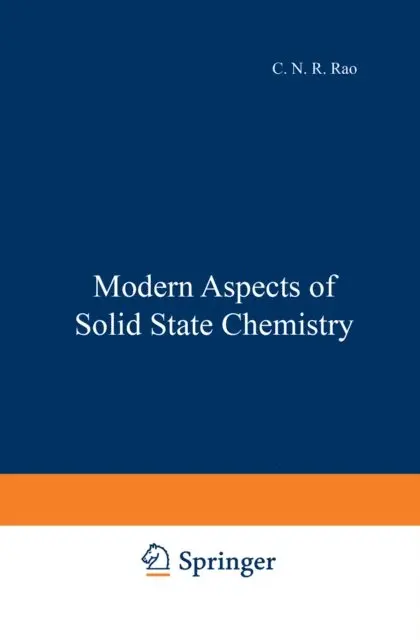
    Modern Aspects of Solid State Chemistry

    AvC.N.R. Rao

    Häftad, Engelska, 2012

    1 086 kr

    Beställningsvara. Skickas inom 10-15 vardagar. Fri frakt över 249 kr.

    Fler format och utgåvor

    E-bok

    1 413 kr

    Beskrivning

    The three natural streams of present-day chemistry are Structure, Dynamics and Synthesis and all these three elements are essential for the study of materials, particularly in the solid state. The solid state provides challenging opportunities for illustrating and applying principles of chemistry to systems of academic interest and technological importance. There are several practising solid state chemists in universities and research laboratories, but the subject has not yet become part of the formal training program in chemistry. Being one of the new frontiers of chemistry, Solid State Chemistry has a tremendous future and undoubtedly demands the active involvement of many more chemists. A Winter School in Solid State Chemistry was organized at the Indian Institute of Technology, Kanpur, to promote this area and to develop curricular material. Solid State Chemistry being lighly interdisciplinary in nature, the lecturers and participants at the Winter School had widely different backgrounds and interests. It was my great desire that the lecture material from the Winter School should become available to a larger body of students, teachers and research workers interested in the solid state and hence this volume.
    Produktinformation

    • Utgivningsdatum:2012-03-19
    • Mått:178 x 254 x 35 mm
    • Vikt:1 192 g
    • Format:Häftad
    • Språk:Engelska
    • Antal sidor:626
    • Upplaga:1970
    • Förlag:Springer-Verlag New York Inc.
    • ISBN:9781468418774

    Utforska kategorier

    • Referensverk och tvärvetenskap inom Samhälle och politik
    • Oorganisk kemi inom Naturvetenskap och teknik

    Innehållsförteckning

    • 1. Lattice Dynamics.- Theory of Small Oscillations.- Effect of Lattice Symmetry.- Density of Vibrational States.- Vibrational Thermodynamic Properties of Crystals.- X-ray and Neutron Scattering.- 2. Cohesive Energies of Ionic Solids.- Born-Haber Cycle.- Born Treatment of Ionic Solids.- Some Related Aspects.- 3. Defect Chemistry and Non-Stoichiometric Compounds.- Point Defect Equilibria in Crystals.- The Systematica of Non-Stoichiometric Compounds.- Grossly Non-Stoichiometric Compounds.- Ferrous Oxide: A Case History.- Strong Defect Ordering: Intermediate Superstructure Phases.- Elimination of Defects: Crystallo graphic Shear.- Imperfections of Ordered Structures (Lattice Imaging).- Conclusions and Outstanding Problems.- 4. Theory of Point Defects in Ionic Crystals.- to Point Defects in Ionic Crystals.- Experimental Studies of Point Defects.- Theoretical Calculations of the Formation Energies of Schottky Defects.- Defect Interaction Energies.- Migration Energies.- Interstitial Defects.- Concluding Remarks.- 5. Dielectric Properties.- Definitions and Units.- Mechanisms of Polarization.- Alternating Current Phenomena.- Ferroelectrics.- 6. Magnetism.- Non-Interacting Atoms.- Magnetic Interactions.- Long-Range Order.- Spiral Configurations.- Magnetic Atoms in a Crystal.- Superexchange Interactions.- Collective d-Electron Model.- 7. Neutron Diffraction and Solid State Properties.- Thermal Neutrons.- Elastic Scattering.- Inelastic Scattering.- Conclusions.- 8. Magnetic Resonance.- Nuclear Moments end Nuclear Magnetic Resonance.- Spin-Lattice Relaxation.- Bloch Equations and Transverse Relaxation.- Experimental Arrangements.- NMR in Non-metallic Solids.- Quadrupolar Splittings in NMR.- NMR in Metals.- Chemical Shift and Spin Coupling in Solids.- Pure Quadrupole Resonance in Solids.- Electron Paramagnetic Resonance.- Concluding Remarks.- 9. Nuclear Magnetic Resonance in Superconductors and Dilute Alloys.- NMR in Superconductors.- NMR in Dilute Alloys.- 10. Magnetostriction in Materials.- Behaviour of Common Materials.- Conclusions.- 11. Mössbauer Effect and Dynamics of Atomic Motion in Solids.- Resonance Fluorescence.- Mossbauer’s Experiment.- Resonance Absorption of Gamma Rays and Dynamics of Atomic Motion.- Experimental Results.- Concluding Remarks.- 12. Positron Annihilation in Solids.- Methods and Results.- 13. Elements of Order-Disorder Theory and Diverse Applications.- Statement of the Problem.- The Zero Order Approximation (Langmuir Isotherm).- The Fermi-Dirac Distribution Function.- Decomposition of the Lattice into Subfigures.- The Fowler-Guggenheim Adsorption Isotherm.- Thermodynamic Properties of Binary Mixtures in the Bragg-Williams Approximation.- 14. Diffusion in Solids.- The Diffusion Coefficient.- Intrinsic Diffusion Coefficients.- Self-Diffusion Coefficients.- Experimental Procedures.- 15. Ionic Conductivity.- Conduction Mechanisms in Ionic Crystals.- Anisotropy of Conduction in Ionic Crystals.- 16. Inorganic Glasses.- Constitution of Glass.- Glass formation.- Inorganic Glass Forming Systems.- Transport Properties of Glasses.- 17. Electrical Properties of Solid Catalysts.- Historical Introduction.- Classification of Solid Catalysts based on Electronic Properties.- Inverse Mixed Catalysts.- Conclusions.- 18. Dislocations and Solid State Reactions.- Dislocations, Their Structure and Properties.- The Role of Dislocations in Chemical Reactions.- 19. Solid State Reactions.- Role of Defects in the Reactivity of Solids.- Solid-Gas Reactions: Oxidation of Metals.- Solid-Solid Reactions.- Thermal Decomposition of Solids.- 20. Bandand Transport Theories in Solids.- to Band Structure Concepts (Particle-in-the-Box).- Kronig-Penney Model.- Bloch Functions for the Circular Chain.- Band Structure for a Circular Chain in the Tight Binding Approximation.- Pauli Exclusion Principle and Fermi-Dirac Statistics.- Heat Capacity of a Metal.- Classification of Materials.- Elementary Discussion of Yarious Transport Phenomena.- Fermi Levels and Conductivity in Intrinsic and Extrinsic Semiconductors.- Transport Effects in Materials Characterized by ‘Hopping’ Electrons.- Brief Survey of Experimental Results.- 21. Spectroscopy of Metals and Semiconductors.- Macroscopic Theory and Experimental Methods.- Microscopic Theory of Optical Properties.- Optical Properties of Metals.- Optical Properties of Semiconductors.- Conclusions.- 22. Phase Transformations in Solids.- Thermodynamic Considerations.- Structural Changes in Transformations.- Kinetics of Transformations.- Order-Disorder Transitions.- Martensite Transformations.- Ferroelectric Transformations.- Magnetic Transitions.- Semiconductor-Metal Transitions.- High Pressure Transformations.- Born Treatment of Phase Transformations in Alkali Halides.- Comments on Experimental Techniques.