• Fri frakt över 249 kr
  • •
  • Snabba leveranser
  • •
  • Billiga böcker
Kundservice

Du är på sajten för privatpersoner.

Företag, bibliotek eller offentlig verksamhet?

Du handlar på classic.bokus.com, där alla dina funktioner finns intakta.
Till classic.bokus.com
Bokus logotyp. Gå till startsidan.
  • Erbjudanden
  • Nyheter
  • Student
  • Topplistor
  • Barn & ungdom
  • Bokus Play
  • E-böcker
  • Pocketböcker
  • Spel & pussel

10% studentrabatt med kod TERM26

Sidfot

Mina sidor

    Hjälp

    • Kundservice
    • Vanliga frågor och svar
    • Frakt och leverans
    • Retur vid ångerrätt
    • Reklamera vara
    • Betalning
    • Köpvillkor
    • Allmänna villkor
    • Information om webbplatsens tillgänglighet

    Om Bokus

    • Om oss
    • Pressrum
    • För studenter
    • För företag
    • För bibliotek och offentlig verksamhet
    • För leverantörer
    • Hållbarhet

    Populärt

    • Aktuella erbjudanden
    • Presentkort
    • Studentlitteratur
    • Nya böcker
    • Topplistor
    • Signerade böcker
    • Engelska böcker

    Inspiration

    • Boktips
    • BookTok
    • Populära bokserier
    • Barnbokskaraktärer
    • Populära författare
    Logotyp för Bokus
    Följ oss på Facebook (extern länk)Följ oss på Instagram (extern länk)Följ oss på YouTube (extern länk)Följ oss på TikTok (extern länk)
    bokus @ CookiesAnpassa cookiesIntegritetspolicyKöpvillkor
    Till Citymail hemsida (extern länk)Till Budbee hemsida (extern länk)Till Postnord hemsida (extern länk)Till Schenker hemsida (extern länk)Till Early Bird hemsida (extern länk)Till Walleys hemsida (extern länk)
    1. Naturvetenskap och teknik
    2. Geovetenskap
    3. Miljövetenskap och miljöpolitik

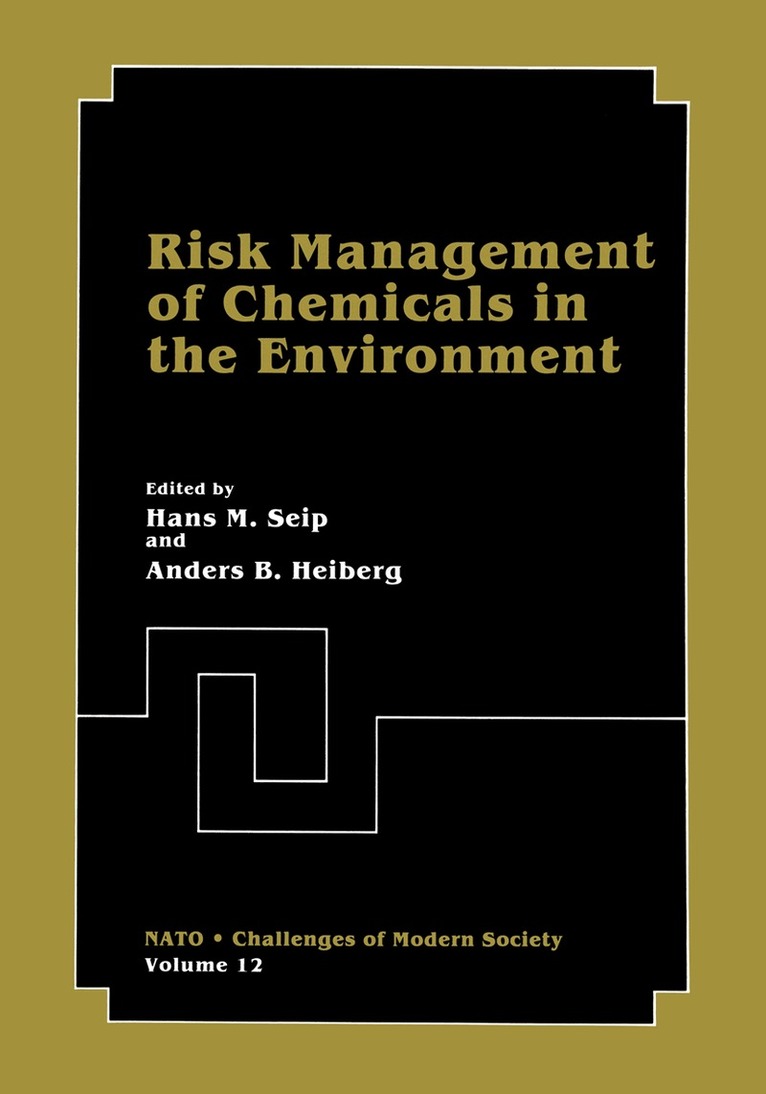
    Risk Management of Chemicals in the Environment

    AvHans M. Seip,Anders B. Heiberg

    Häftad, Engelska, 2012

    Del 12 i serien Nato Challenges of Modern Society

    549 kr

    Beställningsvara. Skickas inom 10-15 vardagar. Fri frakt över 249 kr.

    Beskrivning

    The Council of the North Atlantic Treaty Organization (NATO) established the "Committee on the Challenges of Modern Society" (CCMS) in 1969. The CCMS was charged with developing meaningful environmental and social programmes for solving existing problems and developing long-range goals for environmental protection. In 1983, at the Fall Plenary of the CCMS, the Norwegian delegate Dr. H.C. Christensen, proposed a Pilot Study on "Risk Management of Chemicals in the Environment". A draft proposal, written by Dr. Kari Kveseth of the Center for Industrial Research in Oslo, was presented. Dr. Christensen also informed the participants at the meeting that Norway was willing to act as the Pilot Country. The project was initially planned for 3 years, but it was later extended through 1987. The inaugural meeting was held in Oslo in April 1984 with participants from Denmark, Greece, France and Italy, in addition to representatives from several Norwegian institutions. The attendees concluded that a Pilot Study, as delineated in the draft proposal, would be useful, and it was decided to work out a detailed project plan based on the proposal.

    Produktinformation

    • Utgivningsdatum:2012-03-18
    • Mått:178 x 254 x 14 mm
    • Vikt:460 g
    • Format:Häftad
    • Språk:Engelska
    • Serie:Nato Challenges of Modern Society
    • Antal sidor:227
    • Förlag:Springer-Verlag New York Inc.
    • ISBN:9781468456066

    Utforska kategorier

    • Miljövetenskap och miljöpolitik inom Naturvetenskap och teknik
    • Kemi inom Naturvetenskap och teknik
    • Miljöteknik inom Naturvetenskap och teknik

    Innehållsförteckning

    • 1: Pilot Study of Risk Management of Chemicals in the Environment: An Introduction.- 1 Background of the Pilot Study.- 2 Components of Risk Assessment and Risk Management.- 3 Quantitative Decision Analysis Techniques.- 4 Public Acceptability.- 5 Outcome of the Pilot Study.- 6 Acknowledgements.- 7 References.- 2: Quantification of Health Risk Due to Chemicals: Methods and Uncertainties.- 1 Introduction.- 2 Methods of Determining Dose-Response Relationships.- 3 Uncertainties in Health Risk Quantification.- 4 Conclusion.- 5 References.- 3: Methods for Assessing the Risk of Environmental Contamination.- 1 Introduction.- 2 Environmental Risk Analysis.- 3 Examples of a simplified approach.- 4 Conclusions.- 5 References.- 4: Methods Used in the United States for the Assessment and Management of Health Risk Due to Chemicals.- 1 Introduction.- 2 National Research Council, 1983.- 3 Committee on Science and Technology, 1983.- 4 Office of Science and Technology Policy, 1985.- 5 United States Department of Health and Human Services, 1985.- 6 United States Environmental Protection Agency, 1986.- 7 Example of a Recent EPA Risk Assessment.- 8 List of Abbreviations.- 9 References.- 5: Assessment of Ecologic Risks Related to Chemical Exposure: Methods and Strategies Used in the United States.- >1 Current Status.- 2 Future Directions.- 3 Ecological Risk Assessment Guidelines.- 4 References.- 6: Attitudes toward Risk-Benefit Analysis for Managing Effects of Chemical Exposures.- 1 Introduction.- 2 Data and Methods.- 3 Findings.- 4 Conclusion.- 5 Acknowledgement.- 6 Appendix.- 7 References.- 7: Modelling Behaviour of Pollutants in Soil for Risk Assessment Purposes.- 1 Soil Dispersed Contaminants: Behaviour and Risk for Human Exposure.- 2 Processes Occurring in Soil: Theoretical Basis for Modelling.- 3 An Empirical Model for the Calculation of Mobility of Chemicals in Soil.- 4 Conclusion.- 5 Acknowledgements.- 6 References.- 8: Environmental and Health Impact Assessment of Soil Pollutants. The Seveso Accident as a Typical Example.- 1 Introduction.- 2 The Seveso accident.- 3 Environmental Persistence of TCDD.- 4 Vertical Distribution of TCDD in soil.- 5 Plant Contamination and Soil-to-Plant Transfer of TCDD.- 6 Soil-to-Air Transfer of TCDD Contaminated Dust.- 7 Discussion and Conclusions.- 8 References.- 9: Mathematical and Biological Uncertainties in the Assessment of a Permissible Blood Lead Concentration.- 1 Introduction.- 2 Uncertainties in the Use of NOAEL.- 3 Mathematical Uncertainty.- 4 Biological Uncertainty.- 5 From Risk Assessment to Risk Management.- 6 Acknowledgements l.- 7 References l.- 10: Use of Formal Methods in Evaluating Countermeasures to Coastal Water Pollution. A Case Study of the Kristiansand Fjord, Southern Norway.- 1 Introduction.- 2 The Kristiansand fjord — A Case of Marine Pollution.- 3 Analysis of Countermeasures — Initial Tasks.- 4 Identification of Pollution Control Actions.- 5 Effects of Control Actions.- 6 Valuation of a Total Cleanup by Use of an Economic Method.- 7 Valuation of Pollution Control Actions by Use of “SMART”.- 8 Summary and Conclusions.- 9 Acknowledgement.- 10 References.- 11: Abatement of Air Pollution in Oslo.- 1 Introduction.- 2 Methodological Approach.- 3 Countermeasures.- 4 Objectives and Attributes.- 5 Estimating the Impact of the Countermeasures.- 6 Valuation of the Impact of the Countermeasures.- 7 Results.- 8 Dealing with Uncertainties.- 9 Sensitivity Analysis.- 10 Closing Remarks.- 11 Acknowledgement.- 12 References.- 12: Summary, Conclusions and Recommendations.- 1 Introduction.- 2 Summary ofthe Individual Chapters in the Report.- 3 Conclusions and Recommendations.- APPENDIX A: Names and addresses of Study Group members.- APPENDIX B: Names and addresses of recipients of CCMS Fellowships who contributed to the Pilot Study.- APPENDIX C: Study Group programme.- APPENDIX D: Work done by recipients of CCMS Fellowships.- APPENDIX E: Questionnaire — Willingness-to-pay survey.- APPENDIX F: Questionnaire — SMART study.- APPENDIX G: Summary report of the Pilot Study on Risk Management of Chemicals in the Environment.