• Fri frakt över 249 kr
  • •
  • Snabba leveranser
  • •
  • Billiga böcker
Kundservice

Du är på sajten för privatpersoner.

Företag, bibliotek eller offentlig verksamhet?

Du handlar på classic.bokus.com, där alla dina funktioner finns intakta.
Till classic.bokus.com
Bokus logotyp. Gå till startsidan.
  • Erbjudanden
  • Nyheter
  • Student
  • Topplistor
  • Barn & ungdom
  • Bokus Play
  • E-böcker
  • Pocketböcker
  • Spel & pussel

10% rabatt på allt med kod: NYSTART10 →

Sidfot

Mina sidor

    Hjälp

    • Kundservice
    • Vanliga frågor och svar
    • Frakt och leverans
    • Retur vid ångerrätt
    • Reklamera vara
    • Betalning
    • Köpvillkor
    • Allmänna villkor
    • Information om webbplatsens tillgänglighet

    Om Bokus

    • Om oss
    • Pressrum
    • För studenter
    • För företag
    • För bibliotek och offentlig verksamhet
    • För leverantörer
    • Hållbarhet

    Populärt

    • Aktuella erbjudanden
    • Presentkort
    • Studentlitteratur
    • Nya böcker
    • Topplistor
    • Signerade böcker
    • Engelska böcker

    Inspiration

    • Boktips
    • BookTok
    • Populära bokserier
    • Barnbokskaraktärer
    • Populära författare
    Logotyp för Bokus
    Följ oss på Facebook (extern länk)Följ oss på Instagram (extern länk)Följ oss på YouTube (extern länk)Följ oss på TikTok (extern länk)
    bokus @ CookiesAnpassa cookiesIntegritetspolicyKöpvillkor
    Till Citymail hemsida (extern länk)Till Budbee hemsida (extern länk)Till Postnord hemsida (extern länk)Till Schenker hemsida (extern länk)Till Early Bird hemsida (extern länk)Till Walleys hemsida (extern länk)
    1. Data och IT
    2. Programmeringsböcker
    3. Programvaruutveckling

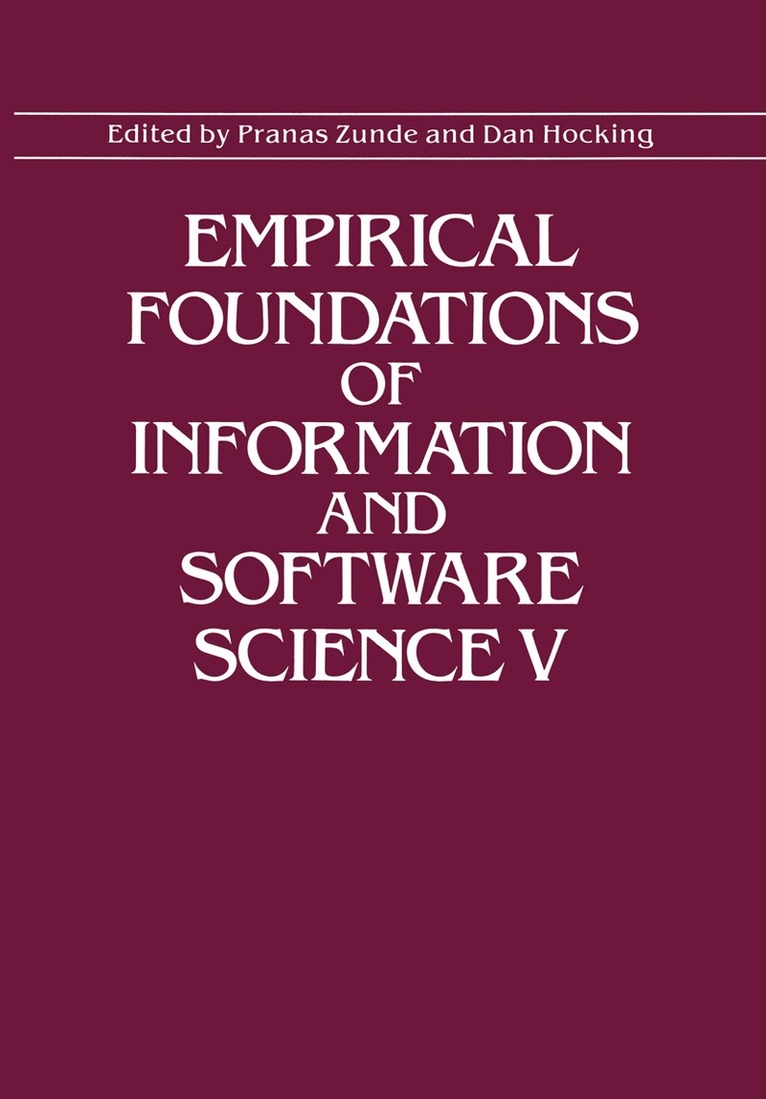
    Empirical Foundations of Information and Software Science V

    AvPranas Zunde,D. Hocking

    Häftad, Engelska, 2012

    563 kr

    Beställningsvara. Skickas inom 10-15 vardagar. Fri frakt över 249 kr.

    Beskrivning

    This is the proceedings of the Sixth Symposium on Empirical Foundations of Information and Software Sciences (EFISS), which was held in Atlanta, Georgia, on October 19-21, 1988. The purpose of the symposia is to explore subjects and methods of scientific inquiry which are of common interest to information and software sciences, and to identify directions of research that would benefit from the mutual interaction of these two disciplines. The main theme of the sixth symposium was modeling in information and software engineering, with emphasis on methods and tools of modeling. The symposium covered topics such as models of individual and organizational users of information systems, methods of selecting appropriate types of models for a given type of users and a given type of tasks, deriving models from records of system usage, modeling system evolution, constructing user and task models for adaptive systems, and models of system architectures. This symposium was sponsored by the School of Information and Computer Science of the Georgia Institute of Technology and by the U.S. Army Institute for Research in Management Information, Communications, and Computer Sciences (AIRMICS). 17le Editors vii CONTENTS 1 I. KEYNOTE ADDRESS ............................................. .

    Produktinformation

    • Utgivningsdatum:2012-03-13
    • Mått:170 x 244 x 27 mm
    • Vikt:854 g
    • Format:Häftad
    • Språk:Engelska
    • Antal sidor:490
    • Förlag:Springer-Verlag New York Inc.
    • ISBN:9781468458640

    Utforska kategorier

    • Programvaruutveckling inom Data och IT
    • Tillämpad datateknik inom Data och IT

    Innehållsförteckning

    • I. Keynote Address.- Software for Human Hardware?.- II. Invited Papers.- Software Process Modeling: The TRIAD Approach.- Modeling the Software Design Process.- Methodological Principles of Uncertainty in Information Systems Modeling.- CAST — Modelling Approaches in Software Design.- Organizational Integration: Modeling Technology and Management.- Parallel Models in Software Life Cycle.- III. Modeling Methodologies.- A Methodology for Eliciting Users Cognitive Models of Computer-Based Systems.- Use of a Blackboard Framework to Model Software Design.- The Entity-Relationship Data Model Considered Harmful.- Automatic Generation of Conceptual Database Design Tools.- IV. Modeling Information Systems.- Modeling and Evaluation of Information Systems.- Static vs. Dynamic Information Systems Modeling: A Cooperation Based Approach. ..- Architectural Modeling of Complex Information Systems.- A Management Model for Effective Information-Use in Research Work.- Software Implementation and Applications of the Generalized Information System.- V. Modeling Human-Machine Interaction.- Building a User Modelling Shell.- Evaluation of Human-Computer Interface Development Tools: Problems and Promises.- Modelling Human Machine Interaction: Techniques for Prediction of Performance.- A Model of the Operator’s Task in Diagnostic Problem Solving.- Intent Inferencing with a Model-Based Operator’s Associate.- Computer Aided Decision Making Using Uncertain and Imprecise Information.- VI. Models of Language Use.- Statistical Models of Language Use.- A Speech Act Based Model for Analyzing Cooperative Work in Office Information Systems.- Quantitative Regularities of the Diversity of Lexical Meaning.- VII. Database Models.- Database Management Models for Reusability in Integrated SoftwareEngineering Environments.- An Adaptive Data Distribution Model For Distributed Databases Based on Empirical Measurement of Local and Global Database Transactions.- Implementing Recursive Data Structures in ADA.- VIII. Software Measurement and Metrics.- ADA Reusability Analysis and Measurement.- Object-Based Measurement in the Requirements Specification Phase.- Comparison of Subjective Entropy and User Estimates of Software Complexity.- A Metrics-Driven Approach to the Automatic Acquisition of Software Engineering Knowledge.- IX. Software Engineering.- Observing ADA Software Components.- KEESEE: A Behavioral Object-Oriented Database Framework for Software Engineering.- Environmental Effects on the Detection of Errors in Software Systems.- X. Software Reusability.- Issues in Reusable ADA Library Tools.- Verification and Validation of Reusable ADA Components.- The Rapid Center: A Model for Software Reuse Policy.- Knowledge Based Tools for Reusable ADA Software.- Model for Life Cycle Reusability in Information and Software Engineering.