• Fri frakt över 249 kr
  • •
  • Snabba leveranser
  • •
  • Billiga böcker
Kundservice

Du är på sajten för privatpersoner.

Företag, bibliotek eller offentlig verksamhet?

Du handlar på classic.bokus.com, där alla dina funktioner finns intakta.
Till classic.bokus.com
Bokus logotyp. Gå till startsidan.
  • Erbjudanden
  • Student
  • Topplistor
  • Barn & ungdom
  • Bokus Play
  • E-böcker
  • Ljudböcker
  • Pocketböcker
  • Spel och pussel

Pocketfynda! Hundratals böcker för 49 kr/st →

Sidfot

Mina sidor

    Hjälp

    • Kundservice
    • Vanliga frågor och svar
    • Frakt och leverans
    • Retur vid ångerrätt
    • Reklamera vara
    • Betalning
    • Köpvillkor
    • Allmänna villkor
    • Information om webbplatsens tillgänglighet

    Om Bokus

    • Om oss
    • Pressrum
    • För studenter
    • För företag
    • För bibliotek och offentlig verksamhet
    • För leverantörer
    • Hållbarhet

    Populärt

    • Aktuella erbjudanden
    • Presentkort
    • Studentlitteratur
    • Nya böcker
    • Topplistor
    • Signerade böcker
    • Engelska böcker

    Inspiration

    • Boktips
    • BookTok
    • Barnbokskaraktärer
    • Populära författare
    Logotyp för Bokus
    Följ oss på Facebook (extern länk)Följ oss på Instagram (extern länk)Följ oss på YouTube (extern länk)Följ oss på TikTok (extern länk)
    bokus @ CookiesAnpassa cookiesIntegritetspolicyKöpvillkor
    Till Citymail hemsida (extern länk)Till Budbee hemsida (extern länk)Till Postnord hemsida (extern länk)Till Schenker hemsida (extern länk)Till Early Bird hemsida (extern länk)Till Walleys hemsida (extern länk)
    1. Naturvetenskap och teknik
    2. Teknik och industri
    3. Elektronik och kommunikationer

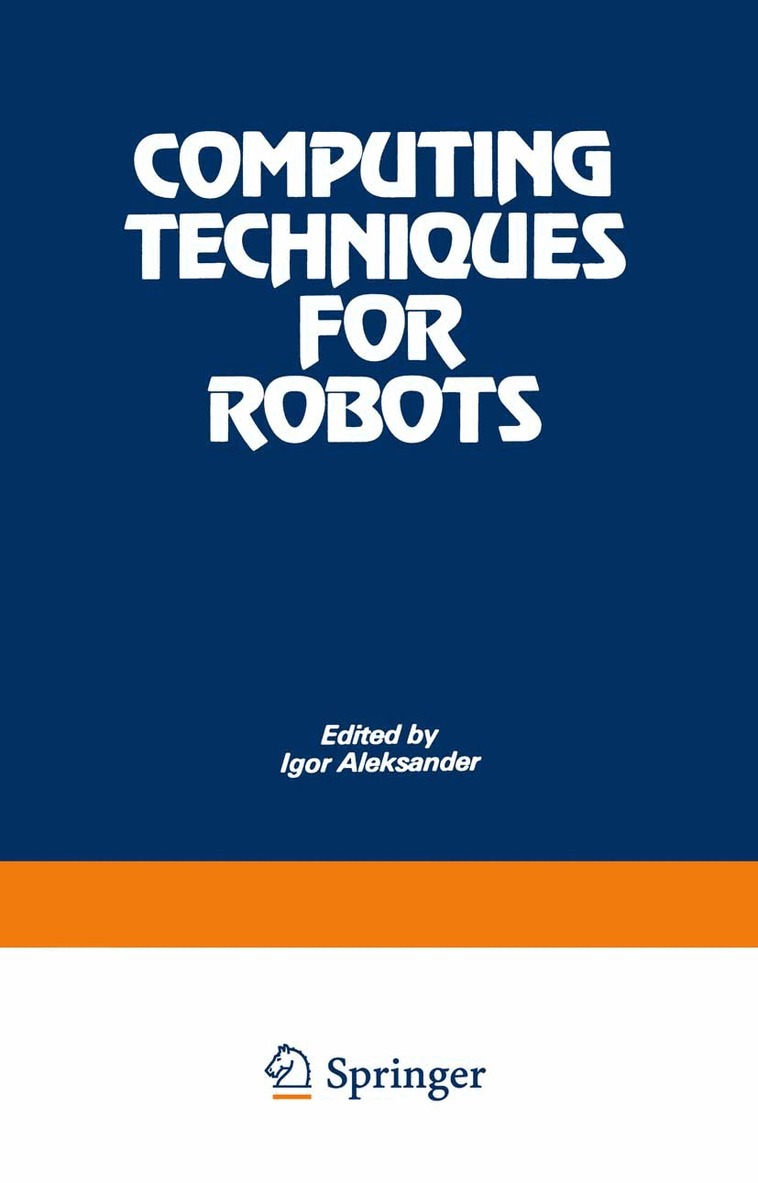
    Computing Techniques for Robots

    AvIgor Aleksander

    Häftad, Engelska, 2014

    542 kr

    Beställningsvara. Skickas inom 10-15 vardagar. Fri frakt över 249 kr.

    Fler format och utgåvor

    E-bok

    700 kr

    Beskrivning

    I. ALEKSANDER Kobler Unit for Information Technology Management, Imperial College of Science and Technology, London, England It is now over half a decade since Joseph Engelberger wrote: 'Given a six-articulation arm of any configuration, software can be powerful enough to think only in tool coordinates. That is, a programmer concerns himself only with the tool on the end of the robot arm. He can think of the tool's frame of reference and com­ puter subroutines automatically make the various articulations move so as to accomplish the desired tool manipulation. ' As is often the case with statements of this kind, they are appealing and generally well-founded in technological feasibility. But in order to turn the prediction into reality it requires the dedication and in­ ventiveness of an international community of researchers. The object of this book is to provide a window on to some of the advances made by this community which go towards the fulfilment of Engelberger's predictions. A significant factor in the framework within which this work is being pursued is the phenomenal advance in the availability of inex­ pensive and highly compact computing power. It becomes increas­ ingly possible to imagine powerful microprocessors providing local intelligence at key points in a robot arm Uoints, gripper, etc) by being connected through a communications network and controlled by some specially designated supervisory microchip.

    Produktinformation

    • Utgivningsdatum:2014-01-18
    • Mått:140 x 216 x 16 mm
    • Vikt:356 g
    • Format:Häftad
    • Språk:Engelska
    • Antal sidor:276
    • Förlag:Springer-Verlag New York Inc.
    • ISBN:9781468468632

    Utforska kategorier

    • Elektronik och kommunikationer inom Naturvetenskap och teknik

    Innehållsförteckning

    • 1 Introduction.- Robotic Practice 10; Exploiting Mathematics 11; Making Sense of Sensors 12; Computing for Design 13; Future Directions 14.- I: Sensor Information Processing.- 2 A method for grasping randomly oriented objects using touch sensing.- 3 Method of contour recognition.- 4 The design of sensors for a mobile teleoperator robot.- II: Mathematical Concerns.- 5 Constrained average path tracking for industrial robots.- 6 The application of spline functions to trajectory generation for computer-controlled manipulators.- 7 Kinematic equations of robot manipulators.- 8 Solution of kinematic equations for robot manipulators.- III: Practical Concerns.- 9 A strategy to achieve an assembly by means of an inaccurate, flexible robot.- 10 Trajectory planning for a multi-arm robot in an assembly task.- 11 Cooperation of two manipulators in assembly tasks.- IV: Computer Aids to Robot Design.- 12 A CAD system for programming and simulating robots’ actions.- 13 The development of a suite of programs for the analysis of mechanisms.