• Fri frakt över 249 kr
  • •
  • Snabba leveranser
  • •
  • Billiga böcker
Kundservice

Du är på sajten för privatpersoner.

Företag, bibliotek eller offentlig verksamhet?

Du handlar på classic.bokus.com, där alla dina funktioner finns intakta.
Till classic.bokus.com
Bokus logotyp. Gå till startsidan.
  • Erbjudanden
  • Student
  • Topplistor
  • Barn & ungdom
  • Bokus Play
  • Bokus Play
  • E-böcker
  • Ljudböcker
  • Pocketböcker
  • Spel & pussel

10% rabatt på allt med kod NYSTART10 →

Sidfot

Mina sidor

    Hjälp

    • Kundservice
    • Vanliga frågor och svar
    • Frakt och leverans
    • Retur vid ångerrätt
    • Reklamera vara
    • Betalning
    • Köpvillkor
    • Allmänna villkor
    • Information om webbplatsens tillgänglighet

    Om Bokus

    • Om oss
    • Pressrum
    • För studenter
    • För företag
    • För bibliotek och offentlig verksamhet
    • För leverantörer
    • Hållbarhet

    Populärt

    • Aktuella erbjudanden
    • Presentkort
    • Studentlitteratur
    • Nya böcker
    • Topplistor
    • Signerade böcker
    • Engelska böcker

    Inspiration

    • Boktips
    • BookTok
    • Populära bokserier
    • Barnbokskaraktärer
    • Populära författare
    Logotyp för Bokus
    Följ oss på Facebook (extern länk)Följ oss på Instagram (extern länk)Följ oss på YouTube (extern länk)Följ oss på TikTok (extern länk)
    bokus @ CookiesAnpassa cookiesIntegritetspolicyKöpvillkor
    Till Citymail hemsida (extern länk)Till Budbee hemsida (extern länk)Till Postnord hemsida (extern länk)Till Schenker hemsida (extern länk)Till Early Bird hemsida (extern länk)Till Walleys hemsida (extern länk)
    1. Data och IT
    2. Systemvetenskap och AI

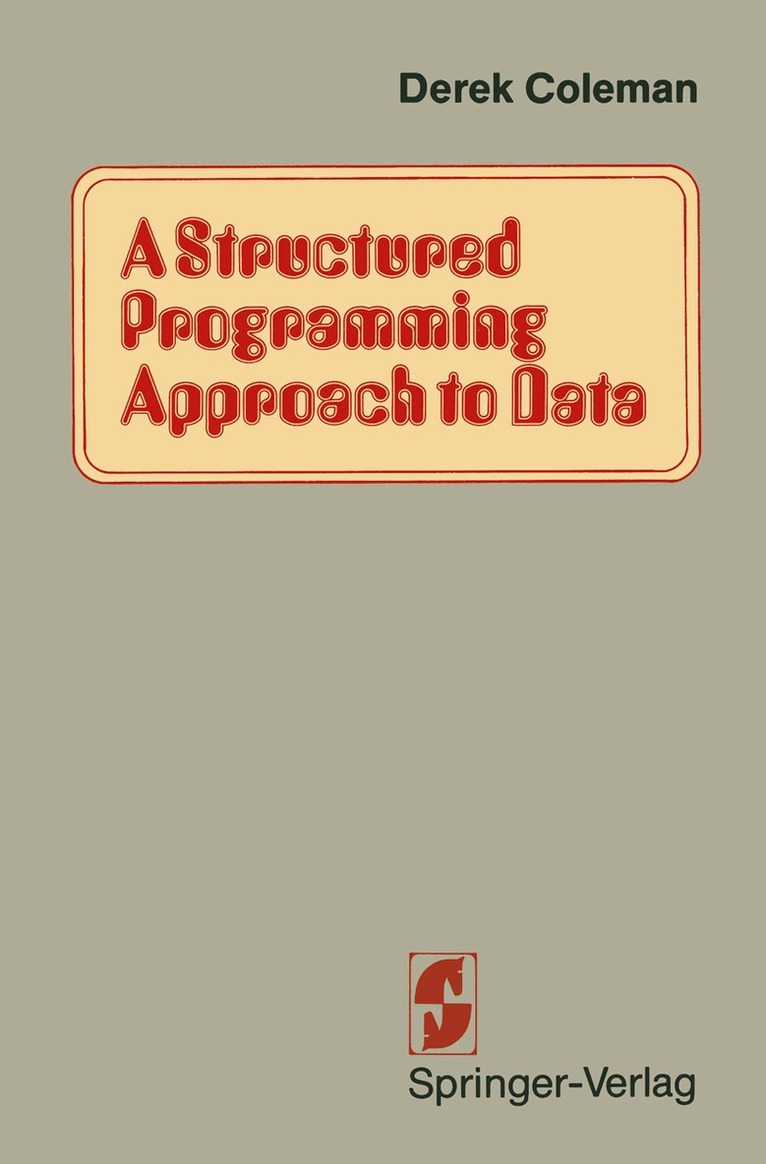
    Structured Programming Approach to Data

    AvCOLEMAN

    Häftad, Engelska, 2012

    562 kr

    Beställningsvara. Skickas inom 10-15 vardagar. Fri frakt över 249 kr.

    Fler format och utgåvor

    E-bok

    732 kr

    Beskrivning

    Much of current programming practice is basically empirical and ad hoc in approach. Each problem is tackled without relation to those that have gone before; experiences are made and stored as a series of fragments. Now, under the pressure of events, this unsatisfactory state of affairs is coming to an end. Programming is becoming a technology, a theory known as structured programming is developing. The purpose of a theory is to categorise and explain existing practice, thus enabling it to be improved through the development of new and sharper techniques. The resulting experiences have then to be fed back into the theory so that the process of enrichment may continue. This dialectical relationship between theory and practice is essential to a healthy programming technology. The lack of such a relationship in the 1950s and 60s and the accompanying software crisis certainly confirm the converse of this proposition. My aim in writing this book has been to explain the current state of the theory of structured programming, so that it may be used to improve the reader's practice. The book deals with two facets of programming - how to design a program in terms of abstract data structures and how to represent the data structures on real and bounded computers. The separation between program design and data structure representation leads to more reliable and flexible programs.

    Produktinformation

    • Utgivningsdatum:2012-08-27
    • Mått:155 x 235 x 13 mm
    • Vikt:365 g
    • Format:Häftad
    • Språk:Engelska
    • Antal sidor:222
    • Upplaga:1979
    • Förlag:Springer-Verlag New York Inc.
    • ISBN:9781468479874

    Utforska kategorier

    • Systemvetenskap och AI inom Data och IT
    • Programvaruutveckling inom Data och IT
    • Programmeringsböcker inom Data och IT

    Innehållsförteckning

    • 1. An Overview of Program Design.- 1.1 Introduction — The Software Crisis.- 1.2 Objectives of Program Design.- 1.3 The Heart of the Problem.- 1.4 Stepwise Refinement.- 1.5 What Do We Mean When We Say a Program ‘Works’?.- 1.6 Summary.- 1.7 Bibliographical Notes.- 2. Program Design Notation.- 2.1 An Abstract Programming Language.- 2.2 Structuring Control.- 2.3 Structuring Data.- 2.4 What is a Data Structure?.- 2.5 Unstructured Data Types.- 2.6 Implementation of Unstructured Types.- 2.7 Summary.- 2.8 Bibliographical Notes.- 3. Arrays.- 3.1 Array Structures.- 3.2 Arrays and Functions.- 3.3 Implementation of Arrays.- 3.4 Summary.- 3.5 Bibliographical Notes.- 4. Simple Data Structuring.- 4.1 Record Types.- 4.2 Implementation of Record Types.- 4.3 Use of Structured Types.- 4.4 Variant Types.- 4.5 Implementation of Variant Types.- 4.6 Summary.- 4.7 Bibliographical Notes.- 5. On Program Design.- 5.1 Stepwise Refinement of Programs.- 5.2 Two Examples.- 5.3 Summary.- 5.4 Bibliographical Notes.- Exercises 1.- 6. Set Structures.- 7. The Class Construct.- 8. Dynamic Data Structures.- 9. Sequences.- Exercises 2.- 10. Simple Searching Techniques.- 11. Hashing Techniques.- 12. Recursion and Recursive Algorithms.- 13. Binary Search Trees.- Exercises 3.- 14. Designing Programs From Data Structures.- Exercises 4.- References.