• Fri frakt över 249 kr
  • •
  • Snabba leveranser
  • •
  • Billiga böcker
Kundservice

Du är på sajten för privatpersoner.

Företag, bibliotek eller offentlig verksamhet?

Du handlar på classic.bokus.com, där alla dina funktioner finns intakta.
Till classic.bokus.com
Bokus logotyp. Gå till startsidan.
  • Erbjudanden
  • Student
  • Topplistor
  • Barn & ungdom
  • Bokus Play
  • E-böcker
  • Ljudböcker
  • Pocketböcker
  • Spel & pussel

Upp till 25% på utvalda nyheter →

Sidfot

Mina sidor

    Hjälp

    • Kundservice
    • Vanliga frågor och svar
    • Frakt och leverans
    • Retur vid ångerrätt
    • Reklamera vara
    • Betalning
    • Köpvillkor
    • Allmänna villkor
    • Information om webbplatsens tillgänglighet

    Om Bokus

    • Om oss
    • Pressrum
    • För studenter
    • För företag
    • För bibliotek och offentlig verksamhet
    • För leverantörer
    • Hållbarhet

    Populärt

    • Aktuella erbjudanden
    • Presentkort
    • Studentlitteratur
    • Nya böcker
    • Topplistor
    • Signerade böcker
    • Engelska böcker

    Inspiration

    • Boktips
    • BookTok
    • Populära bokserier
    • Barnbokskaraktärer
    • Populära författare
    Logotyp för Bokus
    Följ oss på Facebook (extern länk)Följ oss på Instagram (extern länk)Följ oss på YouTube (extern länk)Följ oss på TikTok (extern länk)
    bokus @ CookiesAnpassa cookiesIntegritetspolicyKöpvillkor
    Till Citymail hemsida (extern länk)Till Budbee hemsida (extern länk)Till Postnord hemsida (extern länk)Till Schenker hemsida (extern länk)Till Early Bird hemsida (extern länk)Till Walleys hemsida (extern länk)
    1. Juridik
    2. Rättsvetenskap
    3. Lag och samhälle

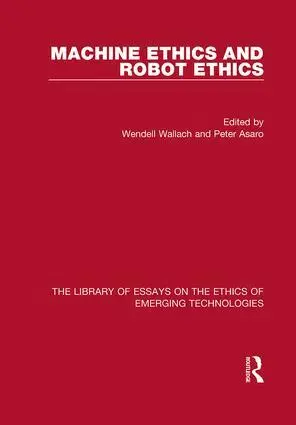
    Machine Ethics and Robot Ethics

    AvWendell Wallach,Peter Asaro

    Inbunden, Engelska, 2016

    6 724 kr

    Beställningsvara. Skickas inom 10-15 vardagar. Fri frakt över 249 kr.

    Beskrivning

    Once the stuff of science fiction, recent progress in artificial intelligence, robotics, and machine learning means that these rapidly advancing technologies are finally coming into widespread use within everyday life. Such rapid development in these areas also brings with it a host of social, political and legal issues, as well as a rise in public concern and academic interest in the ethical challenges these new technologies pose. This volume is a collection of scholarly work from leading figures in the development of both robot ethics and machine ethics; it includes essays of historical significance which have become foundational for research in these two new areas of study, as well as important recent articles. The research articles selected focus on the control and governance of computational systems; the exploration of ethical and moral theories using software and robots as laboratories or simulations; inquiry into the necessary requirements for moral agency and the basis and boundaries of rights; and questions of how best to design systems that are both useful and morally sound. Collectively the articles ask what the practical ethical and legal issues, arising from the development of robots, will be over the next twenty years and how best to address these future considerations.

    Produktinformation

    • Utgivningsdatum:2016-11-29
    • Mått:174 x 246 x 38 mm
    • Vikt:1 210 g
    • Format:Inbunden
    • Språk:Engelska
    • Antal sidor:566
    • Förlag:Taylor & Francis Ltd
    • ISBN:9781472430397

    Utforska kategorier

    • Lag och samhälle inom Juridik
    • Informationsteknik: allmänt inom Data och IT
    • Juridik: metod och teori inom Juridik

    Mer om författaren

    Wendell Wallach is a lecturer and consultant at Yale University’s Interdisciplinary Center for Bioethics, USA. Peter Asaro is Assistant Professor and Director of Graduate Programs in the School of Media Studies at the New School for Public Engagement, USA.

    Innehållsförteckning

    • Acknowledgments -- Series Preface -- Introduction -- Appendix 1: The Future of Life Institute: Research Priorities for Robust and Beneficial Artificial Intelligence: An Open Letter -- Appendix 2: Research Priorities for Robust and Beneficial Artificial Intelligence -- Part I: Laying foundations -- 1 Clarke, Roger. (1993). “Asimov’s laws of robotics: Implications for information technology (1).” IEEE Computer, 26(12), 53-61 -- 2 Clarke, Roger. (1994). “Asimov’s laws of robotics: Implications for information technology (2).” IEEE Computer, 227(1), 57-66 -- 3 Allen, Colin, Gary Varner, & Jason Zinser. (2000). “Prolegomena to any future artificial moral agent.” Journal of Experimental and Theoretical Artificial Intelligence, 12, 251-261 -- 4 Nissenbaum, Helen. (2001). “How computer systems embody values.” Computer, 34(3), 118-119 -- 5 Bostrom, Nick. (2003). “The ethical issues of advanced artificial intelligence.” Paper presented at the IIAS 2003, Baden Baden, GE. In Smit, S., Wallach, W., and Lasker, L. (eds.) Cognitive, Emotive and Ethical Aspects of Decision Making in Humans and in Artificial Intelligence, Vol 11, IIAS, pp. 12-17 -- Part II: Robot ethics -- 6 Veruggio, Gianmarco, & Fiorella Operto. (2006). “Roboethics: A bottom-up interdisciplinary discourse in the field of applied ethics in robotics.” International Review of Information Ethics, 6, 2-8 -- 7 Asaro, Peter. (2006). “What should we want from a robot ethic?” International Review of Information Ethics, 6, 10-16 -- 8 Sparrow, Robert. (2004). “The Turing triage test.” Ethics and Information Technology, 6.4, 203-213 -- 9 Turkle, Sherry. (2006). “A nascent robotics culture: New complicities for companionship.” American Association for Artificial Intelligence AAAI -- 10 Coeckelbergh, Mark. (2010). “Moral appearances: Emotions, robots, and human morality.” Ethics and Information Technology, 12.3, 235-241 -- 11 Borenstein, Jason, & Yvette Pearson. (2010). “Robot caregivers: Harbingers of expanded freedom for all?” Ethics and Information Technology, 12.3, 277-288 -- 12 Vallor, Shannon. (2011). “Carebots and caregivers: Sustaining the ethical ideal of care in the twenty-first century.” Philosophy & Technology, 24.3, 251-268 -- 13 Sharkey, Noel, & Amanda Sharkey. (2010). “The crying shame of robot nannies: an ethical appraisal.” Interaction Studies, 11.2, 161-190 -- 14 van Wynsberghe, Aimee. (2013). “Designing robots for care: Care centered value-sensitive design.” Science and Engineering Ethics, 19.2, 407-433 -- 15 Sullins, John P. (2012). “Robots, love, and sex: The ethics of building a love machine.” Affective Computing, IEEE Transactions, 3.4, 398-409 -- 16 Malle, Bertram, & Matthias Scheutz. (2014). “Moral competence in social robots.” IEEE International Symposium on Ethics in Engineering, Science, and Technology, Chicago -- Part III: Machine ethics -- 17 Moor, James H. (2006). “The nature, importance, and difficulty of machine ethics.” Intelligent Systems, IEEE, 21.4, 18-21 -- 18 Anderson, Michael, & Susan Leigh Anderson. (2007). “Machine ethics: Creating an ethical intelligent agent.” AI Magazine, 28.4, 15-26 -- 19 Wallach, Wendell, Colin Allen, & Iva Smit. (2008). “Machine morality: Bottom-up and top-down approaches for modelling human moral faculties.” AI & Society, 22.4, 565-582 -- 20 McDermott, Drew. (2008). “Why ethics is a high hurdle for AI.” North American Conference on Computing and Philosophy. Bloomington, Indiana -- 21 Powers, Thomas M. (2006). “Prospects for a Kantian machine.” Intelligent Systems, IEEE, 21.4, 46-51 -- 22 Guarini, Marcello. (2005). “Particularism and generalism: How AI can help us to better understand moral cognition.” Machine Ethics: Papers from the 2005 AAAI Fall Symposium -- 23 Bringsjord, Selmer, Konstantine Arkoudas, & Paul Bello. (2006). “Toward a general logicist methodology for engineering ethically correct robots.” IEEE Intelligent Systems, 21(4), 38-44 -- 24 Wallach, Wendell, Colin Allen, & Stan Franklin. (2011). “Consciousness and ethics: Artificially conscious moral agents.” International Journal of Machine Consciousness, 3.01, 177-192 -- Part IV: Moral agents and agency -- 25 Floridi, Luciano, & Jeff W. Sanders. (2004). “On the morality of artificial agents.” Minds and Machines, 14.3, 349-379 -- 26 Johnson, Deborah G., & Keith W. Miller. (2008). “Un-making artificial moral agents.” Ethics and Information Technology, 10.2-3, 123-133 -- 27 Suchman, Lucy. (2007). “Agencies in technology design: Feminist reconfigurations.” In Hackett, Edward J., Olga Amsterdamska, Michael E. Lynch, & Judy Wajcman (eds.) The Handbook of Science and Technology Studies, third edition, excerpt from pp. 139-163 -- 28 Marino, Dante, & Guglielmo Tamburrini. (2006). “Learning robots and human responsibility.” International Review of Information Ethics, 6, 46-51 -- 29 Torrance, Steve. (2014). “Artificial consciousness and artificial ethics: Between realism and social relationism.” Philosophy & Technology, 27.1, 9-29 -- 30 Murphy, Robin R., & David D. Woods. (2009). “Beyond Asimov: The three laws of responsible robotics.” Intelligent Systems, IEEE, 24.4, 14-20 -- Part V: Law and policy -- 31 Solum, Lawrence. (1992). “Legal personhood for artificial intelligences.” North Carolina Law Review, 70, 1231-1287 -- 32 Nagenborg, Michael, et al. (2008). “Ethical regulations on robotics in Europe.” Ai & Society, 22.3, 349-366 -- 33 Calo, M. Ryan. (2010). “Robots and privacy.” Robot Ethics: The Ethical and Social Implications of Robotics, 187-204 -- 34 Lin, Patrick. “The robot car of tomorrow may just be programmed to hit you.” Wired Magazine, May 6, 2014 -- 35 Gunkel, David J. (2014). “A vindication of the rights of machines.” Philosophy & Technology, 27, 113-132 -- Index.