• Fri frakt över 249 kr
  • •
  • Snabba leveranser
  • •
  • Billiga böcker
Kundservice

Du är på sajten för privatpersoner.

Företag, bibliotek eller offentlig verksamhet?

Du handlar på classic.bokus.com, där alla dina funktioner finns intakta.
Till classic.bokus.com
Bokus logotyp. Gå till startsidan.
  • Erbjudanden
  • Nyheter
  • Student
  • Topplistor
  • Barn & ungdom
  • Bokus Play
  • E-böcker
  • Pocketböcker
  • Spel & pussel

10% rabatt på allt med kod NYSTART10 →

Sidfot

Mina sidor

    Hjälp

    • Kundservice
    • Vanliga frågor och svar
    • Frakt och leverans
    • Retur vid ångerrätt
    • Reklamera vara
    • Betalning
    • Köpvillkor
    • Allmänna villkor
    • Information om webbplatsens tillgänglighet

    Om Bokus

    • Om oss
    • Pressrum
    • För studenter
    • För företag
    • För bibliotek och offentlig verksamhet
    • För leverantörer
    • Hållbarhet

    Populärt

    • Aktuella erbjudanden
    • Presentkort
    • Studentlitteratur
    • Nya böcker
    • Topplistor
    • Signerade böcker
    • Engelska böcker

    Inspiration

    • Boktips
    • BookTok
    • Populära bokserier
    • Barnbokskaraktärer
    • Populära författare
    Logotyp för Bokus
    Följ oss på Facebook (extern länk)Följ oss på Instagram (extern länk)Följ oss på YouTube (extern länk)Följ oss på TikTok (extern länk)
    bokus @ CookiesAnpassa cookiesIntegritetspolicyKöpvillkor
    Till Citymail hemsida (extern länk)Till Budbee hemsida (extern länk)Till Postnord hemsida (extern länk)Till Schenker hemsida (extern länk)Till Early Bird hemsida (extern länk)Till Walleys hemsida (extern länk)
    1. Samhälle och politik
    2. Samhälle och kultur
    3. Kultur och medier
    4. Referensverk och tvärvetenskap

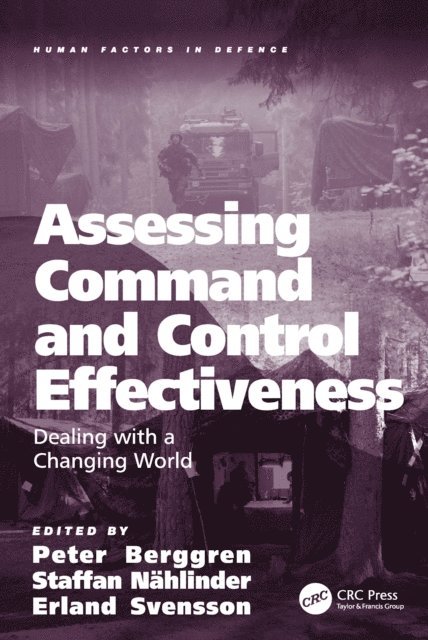
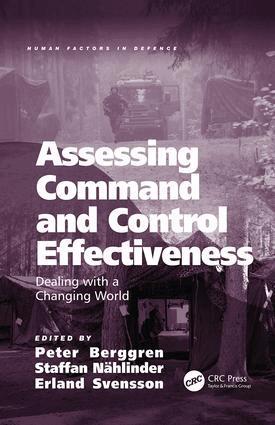
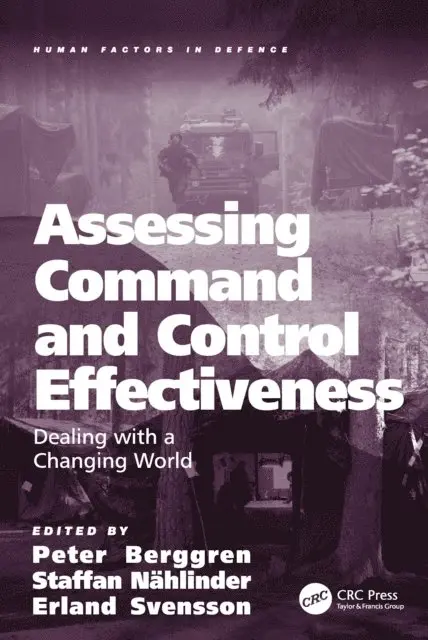
    Assessing Command and Control Effectiveness

    Dealing with a Changing World

    AvPeter Berggren,Staffan Nählinder

    Inbunden, Engelska, 2014

    Del i serien Human Factors in Defence

    2 647 kr

    Beställningsvara. Skickas inom 10-15 vardagar. Fri frakt över 249 kr.

    Fler format och utgåvor

    Häftad

    906 kr

    Beskrivning

    Assessing Command and Control Effectiveness: Dealing with a Changing World offers a description of the current state of Command and Control (C2) research in imperfect settings, showing how a research process should assess, analyse and communicate results to the development cycle of methods, work, manning and C2-technology. Special attention is given to the development of C2 research methods to meet the current and coming needs. The authors also look forward towards a future where effective assessment of C2 abilities are even more crucial, for instance in agile organisations. The purpose of the C2 research is to improve the process and make it more effective while still saving time and money. Research methods have to be chosen carefully to be effective and simple, yet provide results of high quality. The methodological concerns are a major consideration when working under such circumstances. Furthermore, there is often a need for a swift iterative development cycle, and thus a demand to quickly deliver results from the research process. This book explains how field research experimentation can be quick, simple and effective, being able to draw valid conclusions even when sample sizes are small and resources are limited, collecting empirical data using measures and procedures that are minimally intrusive.

    Produktinformation

    • Utgivningsdatum:2014-06-28
    • Mått:156 x 234 x 20 mm
    • Vikt:544 g
    • Format:Inbunden
    • Språk:Engelska
    • Serie:Human Factors in Defence
    • Antal sidor:226
    • Förlag:Taylor & Francis Ltd
    • ISBN:9781472436948

    Utforska kategorier

    • Referensverk och tvärvetenskap inom Samhälle och politik
    • Vapen och utrustning inom Samhälle och politik

    Mer om författaren

    Peter Berggren is a senior scientist at FOI, the Swedish Defence Research Agency. He holds a MSc in Cognitive Science from the University of Linköping. His principle research interests lies in measures and analysis of teamwork effectiveness, decision-making, and Command and Control performance assessments. Peter has worked with Human Factors research since 1998. He has studied fighter pilots, individual soldiers, tank commanders, Brigade staffs, as well as civil crisis management and emergency response. By participating in military exercises as a scientist, Peter has a long experience of working closely with the military in field experimentation-like situations. Peter is a project manager for an Armed Forces project on assessing Command and Control effectiveness. Staffan Nählinder is a senior scientist at FOI, the Swedish Defence Research Agency. He holds a PhD in Human Machine Interaction from the University of Linköping and a MSc in Psychology and Statistics from University of Uppsala. His principle research interests lies in training, performance assessment, decision-making, mental workload, and situation awareness. He has worked with Human Factors research since 1998. Among other things he has worked with various psychophysiological measures to assess mental workload in both military and civil pilots in both simulated and real flight. Staffan has also worked with transfer of training questions in military training facilities. Erland Svensson, Ph.D., is retired director of research at the Swedish Defence Research Agency (FOI) and professor emeritus at the University of Linköping. He is former director of the Department of Man-System-Interaction (FOI-MSI) and of the Institute of Aviation Medicine, Linköping. His research includes measurements of mental workload, situational awareness, operative performance, modelling and simulation. Erland has been Swedish PfP-representative of NATO RTO Human Factors and Medicine Panel. He has been national point of contact for co-operative activities between USAF/RL, TNO, DSTL and DRDC, and governmental expert in European Defence Agency (EDA). Erland has been a member of the Royal Aeronautical Society, London, of the board of the Swedish Society for Human Factors, and he is a member of the Swedish Society for M.P.s and Scientists (RIFO). He has been secretary of the board of the Swedish Aeronautical and Naval Medical Association. In his retired position Erland is developing techniques for measurement of dynamic processes at FOI, and he is associated to the department of cardiology, University of Linköping, in research on psychophysiological modelling.

    Recensioner i media

    ’I enjoyed reading the book. The text gives a thorough and initiated review of current R&D accomplishments within the Swedish Military and Crisis Response domains. I find it refreshing that the human perspective is emphasized systematically by all authors. To me it is clear that we need to develop our methods, tools and technologies to meet future needs in command and control R&D. This publication will be a rich source for the education of officers and operators, and provide a solid basis for further scientific undertakings.' Major General Dennis Gyllensporre, Head of Policy & Plans Department, Swedish Armed Forces Headquarters

    Innehållsförteckning

    • Contents: Forewords; Preface; Introduction, P. Berggren, S. Nählinder and E. Svensson; Analysing tactical cognitive systems: theories, models and methods, A. Norlander; Designing case studies using a systems analysis approach, P. Wikberg; Dynamic measures of effectiveness in command and control, E. Svensson and S. Nählinder; Organizational agility - an overview, B.J.E. Johansson and P.V. Pearce; Characteristics of command and control in response to emergencies and disasters, J. Trnka and R. Woltjer; Empirical studies of command and control centres at the Swedish Air Force, E. Svensson, C. Rencrantz, J. Marklund and P. Berggren; The advance of a valid and reliable tool for assessing shared understanding, P. Berggren; Evaluating the effectiveness of an armoured brigade staff, P. Thunholm, P. Berggren and P. Wikberg; Organizational effectiveness at the Kosovo Force headquarters: a case study, M. Granåsen and J. Marklund; Agility in command and control - functional models of cognition, B.J.E. Johansson; Conclusions, P. Berggren, S. Nählinder and E. Svensson; Index.