• Fri frakt över 249 kr
  • •
  • Snabba leveranser
  • •
  • Billiga böcker
Kundservice

Du är på sajten för privatpersoner.

Företag, bibliotek eller offentlig verksamhet?

Du handlar på classic.bokus.com, där alla dina funktioner finns intakta.
Till classic.bokus.com
Bokus logotyp. Gå till startsidan.
  • Erbjudanden
  • Nyheter
  • Student
  • Topplistor
  • Barn & ungdom
  • Bokus Play
  • E-böcker
  • Pocketböcker
  • Spel & pussel

10% rabatt på allt med kod: NYSTART10 →

Sidfot

Mina sidor

    Hjälp

    • Kundservice
    • Vanliga frågor och svar
    • Frakt och leverans
    • Retur vid ångerrätt
    • Reklamera vara
    • Betalning
    • Köpvillkor
    • Allmänna villkor
    • Information om webbplatsens tillgänglighet

    Om Bokus

    • Om oss
    • Pressrum
    • För studenter
    • För företag
    • För bibliotek och offentlig verksamhet
    • För leverantörer
    • Hållbarhet

    Populärt

    • Aktuella erbjudanden
    • Presentkort
    • Studentlitteratur
    • Nya böcker
    • Topplistor
    • Signerade böcker
    • Engelska böcker

    Inspiration

    • Boktips
    • BookTok
    • Populära bokserier
    • Barnbokskaraktärer
    • Populära författare
    Logotyp för Bokus
    Följ oss på Facebook (extern länk)Följ oss på Instagram (extern länk)Följ oss på YouTube (extern länk)Följ oss på TikTok (extern länk)
    bokus @ CookiesAnpassa cookiesIntegritetspolicyKöpvillkor
    Till Citymail hemsida (extern länk)Till Budbee hemsida (extern länk)Till Postnord hemsida (extern länk)Till Schenker hemsida (extern länk)Till Early Bird hemsida (extern länk)Till Walleys hemsida (extern länk)
    1. Samhälle och politik
    2. Sociologi och antropologi
    3. Sociologi

    The SAGE Handbook of Qualitative Research Ethics

    AvRon Iphofen,Martin Tolich

    Inbunden, Engelska, 2018

    3 371 kr

    Beställningsvara. Skickas inom 3-6 vardagar. Fri frakt över 249 kr.

    Beskrivning

    This handbook is a much-needed and in-depth review of the distinctive set of ethical considerations which accompanies qualitative research. This is particularly crucial given the emergent, dynamic and interactional nature of most qualitative research, which too often allows little time for reflection on the important ethical responsibilities and obligations

    Contributions from leading international researchers have been carefully organised into six key thematic sections:

    Part One: Thick Descriptions Of Qualitative Research Ethics
    Part Two: Qualitative Research Ethics By Technique
    Part Three: Ethics As Politics
    Part Four: Qualitative Research Ethics With Vulnerable Groups
    Part Five: Relational Research Ethics
    Part Six: Researching Digitally

    This Handbook is a one-stop resource on qualitative research ethics across the social sciences that draws on the lessons learned and the successful methods for surmounting problems – the tried and true, and the new.

    Produktinformation

    • Utgivningsdatum:2018-03-02
    • Mått:183 x 249 x 38 mm
    • Vikt:1 158 g
    • Format:Inbunden
    • Språk:Engelska
    • Antal sidor:584
    • Upplaga:1
    • Förlag:SAGE Publications
    • ISBN:9781473970977

    Utforska kategorier

    • Sociologi inom Samhälle och politik

    Mer om författaren

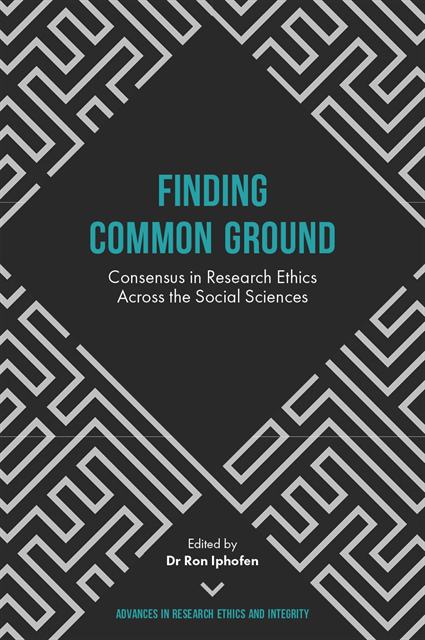
    Ron Iphofen is an independent research consultant, a fellow of the UK Academy of Social Sciences, the Higher Education Academy, and the Royal Society of Medicine. Since his retirement as director of postgraduate studies in the School of Healthcare Sciences, Bangor University, he got involved as an adviser to the European Commission and a range of research agencies (in government and independent) across Europe. He was the vice chair of the UK Social Research Association and convenes their research ethics forum. He has advised the UK Research Integrity Office, the National Disability Authority of the Irish Ministry of Justice, and the UK Parliamentary Office of Science and Technology, among many others. Ron is the founding executive editor of the gerontology journal Quality in Ageing and Older Adults. He published Ethical Decision Making in Social Research: A Practical Guide, with Palgrave Macmillan (2009/2011). He is the executive editor of a book series for Emerald Publishing: Advances in Research Ethics and Integrity and edited volume 1 in the Series: Finding Common Ground: Consensus in Research Ethics Across the Social Sciences (2017).Martin Tolich is an associate professor at the University of Otago, New Zealand, teaching research ethics and research methods in the sociology department. In 2012, he was awarded a blue skies 3-year Marsden Grant from the Royal Society of New Zealand to study tensions around ethics review (Research Ethics Boards) and indigenous (Māori) consultation. His recent books are with Joan Sieber (2013) Planning Ethically Responsible Research, Sage, Thousand Oaks; Barry Smith (2015) The Politicisation of Research Ethics in New Zealand, Dunmore, Auckland; and a Routledge text he edited (2015) Qualitative Ethics in Practice Routledge. Forthcoming books (in 2018) include the Sage Handbook on Qualitative Research Ethics (with Ron Iphofen) and the fourth edition of Social Science Research in New Zealand (with Carl Davidson).

    Recensioner i media

    This is a landmark collection in the field of qualitative research ethics, and a Handbook with a key message.  The contributions are full of insights about ethical issues in diverse research contexts, populations and methods. Taken together they build the case for an institutional approach to ethical review for qualitative research that can deal with specificity and complexity.  Iphofen and Tolich’s Handbook will be richly informative for academic researchers but it should be required reading for ethics committee members.

    Innehållsförteckning

    • Editors′ Introduction: Foundational Issues in Qualitative Research Ethics - Ron Iphofen and Martin TolichPART ONE: THICK DESCRIPTIONS OF QUALITATIVE RESEARCH ETHICSPart One Introduction - Ron Iphofen and Martin TolichChapter 1: Values in Social Research - Martyn HammersleyChapter 2: Ethics, Reflexivity and Virtue - David CarpenterChapter 3: A Posthumanist Ethics of Mattering: New Materialisms and the Ethical Practice of Inquiry - Natasha S. MauthnerChapter 4: Feminist Epistemologies And Ethics: Ecological Thinking, Situated Knowledges, Epistemic Responsibilities - Andrea DoucetChapter 5: Ethical Imperialism? Exporting Research Ethics to the Global South - Mark IsraelChapter 6: Democratizing Research in Practice - Helen KaraPART TWO: QUALITATIVE RESEARCH ETHICS BY TECHNIQUEPart Two Introduction - Ron Iphofen and Martin TolichChapter 7: The Ethics of Ethnography - Sara Delamont and Paul AtkinsonChapter 8: He Said, She Said, We Said: Ethical Issues In Conducting Dyadic Interviews - Karen LowtonChapter 9: Ethical Issues when Undertaking Autoethnographic Research with Families - Anita GibbsChapter 10: Between Dance and Detention: Ethical Considerations of Mesearch in Performance - Mark EdwardChapter 11: Walking Interview Ethics - Penelope KinneyChapter 12: Ethics and Power in Visual Research Methods - Anne Harley & Jonathon LangdonChapter 13: Ethics Working In An Ever-Changing Ethnographic Environment - Olivia Marcus and Shir LermanPART THREE: ETHICS AS POLITICSPart Three Introduction - Ron Iphofen and Martin TolichChapter 14: Confronting Political Dilemmas in Ethnographic Field Work: Consent, Personal Safety and Triangulation - Jon Shefner and Zachary McKenneyChapter 15: Qualitative Ethics in a Positivist frame: The Canadian Experience 1998-2010 - Igor GontcharovChapter 16: When Ethics Review Boards Get Ethnographic Research Wrong - Lisa WynnChapter 17: Reflexivity: overcoming distrust between Research Ethics Committees and Researchers - Marilys Guillemin and Lynn GillamChapter 18: Moving beyond Regulatory Compliance: Building Institutional Support for Ethical Reflection in Research - Gary Allen and Mark IsraelChapter 19: Research Ethics Committees - What are they good for? - David HunterPART FOUR: QUALITATIVE RESEARCH ETHICS WITH VULNERABLE GROUPSPart Four Introduction - Ron Iphofen and Martin TolichChapter 20: The Vulnerability of Vulnerability: Why Social Science Researchers Should Abandon the Doctrine of Vulnerability - Will C. van den HoonaardChapter 21: Researching hate crime against disabled people – working through ethical considerations when the ‘personal is political’ - Chih Hoong SinChapter 22: Participatory Action Research With Indigenous Youth And Their Communities - Linda Liebenberg, Michele Wood, and Darlene WallChapter 23: . Role Conflict and Questions of Rigour: Working with Community Researchers in Sexual Health - Julie Mooney-Somers and Anna OlsenChapter 24: Fair Warnings: The Ethics of Ethnography with Children - Angel A. Escamilla García and Gary Alan FineChapter 25: Protecting And Empowering Research With The Vulnerable Older Person - Fiona Poland and Linda BirtChapter 26: Ethics Unleashed: Developing Responsive Ethical Practice And Review For The Inclusion Of Non-Human Animal Participants In Qualitative Research - Emma Tumilty, Catherine M. Smith, Peter Walker and Gareth TreharneChapter 27: Paternalism and the Ethics of Researching with People who use Drugs - Lucy PickeringPART FIVE: RELATIONAL RESEARCH ETHICSPart Five Introduction - Ron Iphofen and Martin TolichChapter 28: An Exception To The Rule: Journalism And Research Ethics - Donald MathesonChapter 29: The Dual Imperative in Disaster Research Ethics - Dónal O’MathúnaChapter 30: Ethical Issues in Insider-Outsider Research - Bridgette Toy-CroninChapter 31: Covert: The Fear And Fascination Of A Methodological Pariah - David CalveyChapter 32: Ethical issues in Grounded Theory - Karin OlsonPART SIX: RESEARCHING DIGITALLYPart Six Introduction - Elizabeth BuchananChapter 33: Research That Hurts: Ethical Considerations When Studying Vulnerable Populations Online - Camilla Granholm and Eva Svedmark Chapter 34: . ‘What if they’re bastards?’: Ethics and the Imagining of the Other in the Study of Online Fan Cultures - Natasha WhitemanChapter 35: Negotiating the ethics of gendered online spaces in Mainland China and Hong Kong - Tom McDonald, Karen Joe-Laidler and Marissa DeanConcluding Thoughts: The Virtues of a Reflexive Qualitative Researcher - Ron Iphofen and Martin Tolich