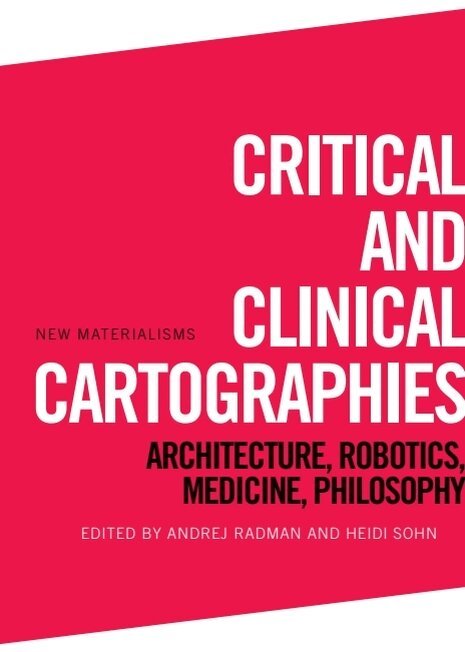
Häftad, Engelska, 2018
Critical and Clinical Cartographies
Architecture, Robotics, Medicine, Philosophy
Av Andrej Radman, Andrej Radman, Heidi Sohn
Del i serien New Materialisms
409 kr
Beställningsvara. Skickas inom 7-10 vardagar. Fri frakt över 249 kr.
Beskrivning
Produktinformation
- Utgivningsdatum: 2018-08-12
- Mått: 164 x 230 x 19 mm
- Vikt: 528 g
- Format: Häftad
- Språk: Engelska
- Serie: New Materialisms
- Antal sidor: 328
- Förlag: Edinburgh University Press
- ISBN: 9781474437370
Utforska kategorier
Mer om författaren
Andrej Radman is Assistant Professor of Architecture Philosophy and Theory at Delft University of Technology, where he coordinates the Ecologies of Architecture research group. Over the past two decades, his research has focused on the nexus between architecture and radical empiricism. He serves as a member of the National Committee on Deleuze and Guattari Scholarship, a founding editor of the TU Delft OPEN Publishing Ecologies of Architecture book series, and was Executive Editor of the peer-reviewed architecture theory journal Footprint (2011–2024). Radman is co-editor of Critical and Clinical Cartographies (2017), Architecture of Life and Death (2021), The Space of Technicity (2024), and Noetics Without a Mind (2024). He is the author of Gibsonism (2012) and Ecologies of Architecture: Essays on Territorialisation (2021). A licensed architect with a portfolio of built and competition-winning projects, Radman received the Croatian Association of Architects’ annual award for housing architecture in 2002. In 2023, he was honoured with the Mark Cousins Theory Award presented by DigitalFUTURES, recognising leading theorists in architecture and design for forward-thinking contributions to the field. Heidi Sohn is Assiociate Professor of Architecture Theory at Delft University of Technology. She is a licensed architect and has published her work in several academic journals and books. They are both on the editorial board of the Footprint journal.
Recensioner i media
This collection answers, through an impressive range of perspectives, the call of Nietzsche’s ‘great health’ – the health that ‘one does not merely have but also acquires continually,’ an impersonal health that traverses the whole of life. Displaying the unique ability to embody and map out those pulsing vitalities at the always more-than- and other-than-human intersections of architecture, robotics, medicine and philosophy, these chapters ultimately carry forward Deleuze’s ‘critical and clinical’ answer to Nietzsche’s call. Enjoy this symptomatology!
Betyg & recensioner
0 recensioner
Inga recensioner tillgängliga.