Andrej Radman – författare
Visar alla böcker från författaren Andrej Radman. Handla med fri frakt och snabb leverans.
8 produkter
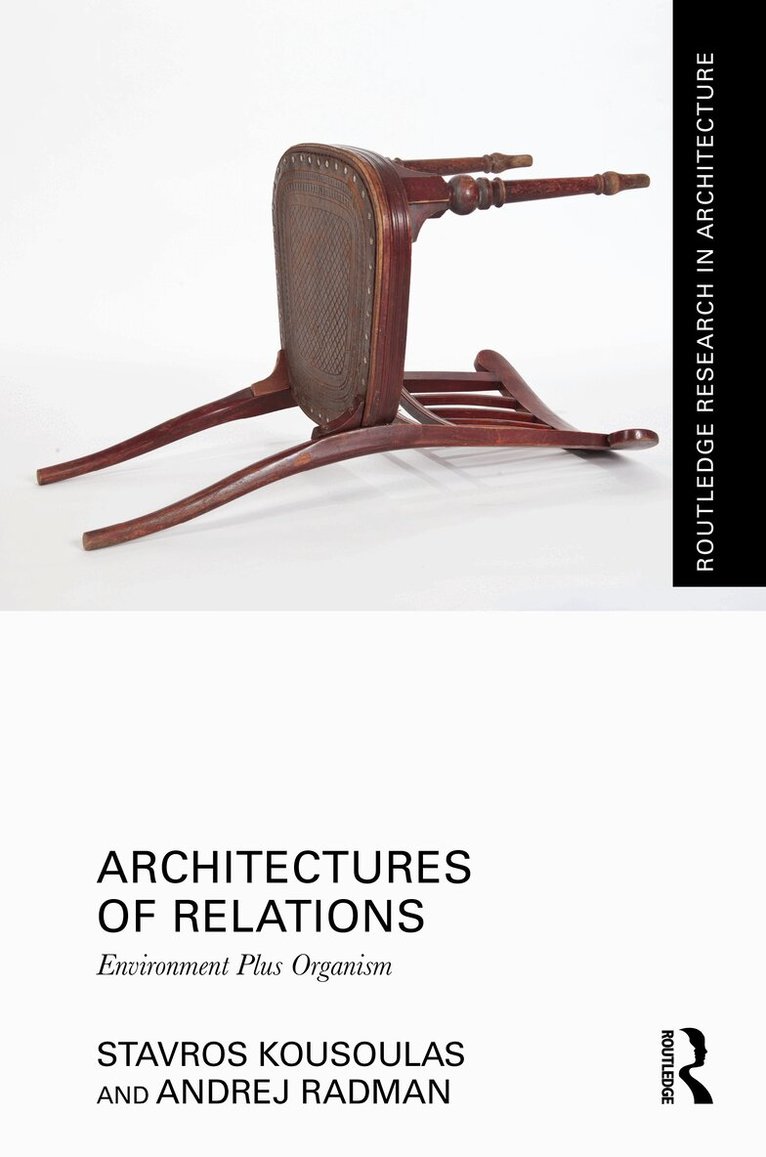
Architectures of Relations
Environment Plus Organism
Av Andrej Radman, Stavros Kousoulas
E-bok, 2026
831 kr
Lägg i varukorg
This book examines how environments and organisms dynamically produce one another. As such, it takes its title very seriously (and very literally): to speak of environment plus organism is the only viable way where neither term gets to be reduced to the other. It is rather their coming together, …
Architectures of Relations
Environment Plus Organism
Av Andrej Radman, Stavros Kousoulas
E-bok, 2026
831 kr
Lägg i varukorg
This book examines how environments and organisms dynamically produce one another. As such, it takes its title very seriously (and very literally): to speak of environment plus organism is the only viable way where neither term gets to be reduced to the other. It is rather their coming together, …
Architectures of Relations
Environment Plus Organism
Av Stavros Kousoulas, Andrej Radman
Inbunden, 2026
2510 kr
Lägg i varukorg
This book examines how environments and organisms dynamically produce one another. As such, it takes its title very seriously (and very literally): to speak of environment plus organism is the only viable way where neither term gets to be reduced to the other. It is rather their coming together, …
Critical and Clinical Cartographies
Architecture, Robotics, Medicine, Philosophy
Inbunden, 2017
1530 kr
Lägg i varukorg
Critical and Clinical Cartographies rethinks medical and design pedagogies in the context of both the Affective and Digital Turns that are occurring under the umbrella of New Materialism. This collection is framed through Deleuze’s symptomalogical approach which creates the ideal terrain for …
Critical and Clinical Cartographies
Architecture, Robotics, Medicine, Philosophy
Av Andrej Radman, Andrej Radman m. fl.
Häftad, 2018
409 kr
Lägg i varukorg
Critical and Clinical Cartographies rethinks medical and design pedagogies in the context of both the Affective and Digital Turns that are occurring under the umbrella of New Materialism. This collection is framed through Deleuze’s symptomalogical approach which creates the ideal terrain for …
Ecologies of Architecture
Essays on Territorialisation
Inbunden, 2021
2033 kr
Lägg i varukorg
Drawing on a range of philosophical texts, Andrej Radman brings together a collection of his essays, published over the last decade, to show that when a society manipulates its matter it is not a reflection of culture, it is culture. To speak of ecologies of architecture is to break with judgement …
Ecologies of Architecture
Essays on Territorialisation
Häftad, 2023
517 kr
Lägg i varukorg
Interprets architecture theory through the lens of Continental philosophyDrawing on a range of philosophical texts, Andrej Radman brings together a collection of 11 of his essays, published over the last decade, to show that when a society manipulates its matter it is not a reflection of culture; …
Architectures of Life and Death
The Eco-Aesthetics of the Built Environment
Av Andrej Radman, Stavros Kousoulas
Inbunden, 2021
1278 kr
Lägg i varukorg
Driven by the Foucauldian attitude of subsuming architectural history into a genealogy of techne, Architectures of Life and Death advances a transdisciplinary approach rethinking subjectivity and exploring the political ramifications of these processes for the discipline of architecture and beyond. …