• Fri frakt över 249 kr
  • •
  • Snabba leveranser
  • •
  • Billiga böcker
Kundservice

Du är på sajten för privatpersoner.

Företag, bibliotek eller offentlig verksamhet?

Du handlar på classic.bokus.com, där alla dina funktioner finns intakta.
Till classic.bokus.com
Bokus logotyp. Gå till startsidan.
  • Erbjudanden
  • Nyheter
  • Student
  • Topplistor
  • Barn & ungdom
  • Bokus Play
  • E-böcker
  • Pocketböcker
  • Spel & pussel

Må bättre, för mindre! Upp till 50% rabatt på hälsoböcker

Sidfot

Mina sidor

    Hjälp

    • Kundservice
    • Vanliga frågor och svar
    • Frakt och leverans
    • Retur vid ångerrätt
    • Reklamera vara
    • Betalning
    • Köpvillkor
    • Allmänna villkor
    • Information om webbplatsens tillgänglighet

    Om Bokus

    • Om oss
    • Pressrum
    • För studenter
    • För företag
    • För bibliotek och offentlig verksamhet
    • För leverantörer
    • Hållbarhet

    Populärt

    • Aktuella erbjudanden
    • Presentkort
    • Studentlitteratur
    • Nya böcker
    • Topplistor
    • Signerade böcker
    • Engelska böcker

    Inspiration

    • Boktips
    • BookTok
    • Populära bokserier
    • Barnbokskaraktärer
    • Populära författare
    Logotyp för Bokus
    Följ oss på Facebook (extern länk)Följ oss på Instagram (extern länk)Följ oss på YouTube (extern länk)Följ oss på TikTok (extern länk)
    bokus @ CookiesAnpassa cookiesIntegritetspolicyKöpvillkor
    Till Citymail hemsida (extern länk)Till Budbee hemsida (extern länk)Till Postnord hemsida (extern länk)Till Schenker hemsida (extern länk)Till Early Bird hemsida (extern länk)Till Walleys hemsida (extern länk)
    1. Historia och arkeologi
    2. Historia
    3. Historia: särskilda händelser och ämnen
    4. Slaveri

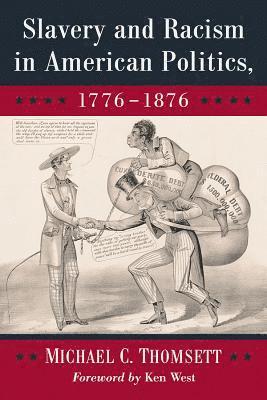
    Slavery and Racism in American Politics, 1776-1876

    AvMichael C. Thomsett

    Häftad, Engelska, 2019

    486 kr

    Beställningsvara. Skickas inom 5-8 vardagar. Fri frakt över 249 kr.

    Beskrivning

    From the very inception of the United States, few issues have been so divisive and defining as American slavery. Even as the U.S. was founded on principles of liberty, independence and freedom, slavery advocates and sympathizers positioned themselves in every aspect of American influence. Over the centuries, the characterization of early American figures, legislation and party platforms has been debated.The author seeks to clarify often unanswered--or ignored--questions about notable figures, sociopolitical movements and their positions on slavery. From early legislation like the Fugitive Slave Law of 1793 to Reconstruction and the rise of the Ku Klux Klan, this book explores some of America's most controversial moments. Spanning the first American century, it offers a detailed chronology of slavery and racism in early U.S. politics and society.

    Produktinformation

    • Utgivningsdatum:2019-12-16
    • Mått:152 x 229 x 13 mm
    • Vikt:336 g
    • Format:Häftad
    • Språk:Engelska
    • Antal sidor:249
    • Förlag:McFarland & Co Inc
    • ISBN:9781476670997

    Utforska kategorier

    • Slaveri inom Historia och arkeologi
    • Diskriminering och rättvisa inom Samhälle och politik
    • Amerikas historia inom Historia och arkeologi

    Mer om författaren

    Michael C. Thomsett is the author, coauthor or compiler of many books including topical dictionaries, collections of quotations and history books. He lives in Spring Hill, Tennessee.

    Recensioner i media

    “No serious student of American history can deny the importance of this book's focus—slavery and white racism as a leitmotif during the first 100 years of US history. Positioning southern slavery at the core of this history, the author surveys how the ‘peculiar institution’ began, evolved, and concluded during the crucible of the Civil War, but reemerged in a different guise during Reconstruction...factually driven...extremely well-illustrated...recommended”—Choice

    Innehållsförteckning

    • Table of ContentsForeword by Ken WestPrefacePart I: Slavery, Political Parties and the Supreme Court1. A Pill Too Bitter to SwallowThe Presentation of a Complex History 7 • Racism in Context 9 • Jim Crow 112. The Most Oppressive DominionSlavery in the New World 17 • The ­Three-Fifths Compromise 19 • The Slave Power 22 • The Northwest Ordinance of 1787 26 • The Fugitive Slave Law of 1793 27 • The Slave Trade Act of 1794 28 • Act Prohibiting Importation of Slaves of 1807 29 • The Missouri Compromise 29 • The Wilmot Proviso 31 • The Compromise of 1850 36 • Fugitive Slave Act of 1850 37 • Kansas–Nebraska Act of 1854 38 • The Ostend Manifesto 423. The Greatest Political EvilThe First Party System 45 • The Federalist Party 47 • The Emergence of the Whig Party 49 • The Free Soil Party 51 • Founders’ Concerns About a Party System 53 • The Era of Good Feelings 54 • Democracy and Andrew Jackson 55 • The Second Party System 56 • A Change in Political Climate 58 • Republicans from 1854 to 1860 59 • The Know Nothing Movement 62 • The Opposition Party and the Constitutional Union Party 64 • The Election of 1860 654. “A Slave, and Not a Citizen”­Slavery-Related Cases and the Supreme Court 71 • The Nullification Battle 72 • McCullough v. Maryland 73 • Gibbons v. Ogden 74 • The Antelope 75 • Roger B. Taney 76 • New York v. Miln 78 • The Amistad 79 • “Unless prohibited by state legislation” 82 • Strader v. Graham 84 • Dred Scott v. Sandford 85 • Ableman v. Booth 92 • Unintended Consequences 93 • Slavery and Racism in Context 94Part II: Politics During the Civil War Years5. Let Us Cross Over the RiverThe Secession Movement in South Carolina 100 • The Crittenden Compromise 101 • The Struggle Toward Secession 103 • Virginia’s Debate 105 • Lincoln’s Policies in 1861 107 • The Rise of the Copperheads 112 • Controversy About Secession and Slavery 116 • Suspension of Habeas Corpus 118 • Copperhead Editorials on Slavery 1206. The Age of the Copperheads, 1862–1863The Evolution of a Struggle: 1862 123 • Copperhead Racism in the North 125 • Lincoln’s Decision: The Emancipation Proclamation 127 • Copperhead Reaction 131 • The Copperhead Response 135 • The Intellectual Arm of the Copperheads 136 • ­Pro-Lincoln Responses 138 • The Enrollment Act 139 • Growing Copperhead Strength 143 • A Change in Sentiment 1457. Copperhead Resistance, 1864–1865Possible Replacement Candidates for Lincoln 148 • Southern Economic Problems in 1864 151 • The Party Platforms 154 • Conspiracy in 1864 by Copperhead Groups 158 • Confederate Efforts at Negotiating Peace 162 • The Political Climate in 1864 163 • Political Responses to Lincoln’s Victory 165 • ­Post-Election Conditions and the Thirteenth Amendment 166Part III: Politics During Reconstruction8. Parties in Conflict—The Johnson AdministrationAndrew Johnson and the ­Post-War Era 173 • The New Administration and the South 174 • The Freedmen’s Bureau Bill 175 • Black Codes in 1865 and 1866 178 • The Civil Rights Act of 1866 180 • Johnson’s Loyalty to the Democrats 182 • Concerns Among Democrats 185 • The Election of 1868 1879. Presidents Grant and Hayes and the Ku Klux KlanPresident Grant’s Election 192 • Origins of Secret Societies in the U.S. 195 • The Klan’s Purpose Evolves 198 • The Klan As an Underground Terrorist Organization 200 • Grant’s Second Administration 203Chapter NotesBibliographyIndex