• Fri frakt över 249 kr
  • •
  • Snabba leveranser
  • •
  • Billiga böcker
Kundservice

Du är på sajten för privatpersoner.

Företag, bibliotek eller offentlig verksamhet?

Du handlar på classic.bokus.com, där alla dina funktioner finns intakta.
Till classic.bokus.com
Bokus logotyp. Gå till startsidan.
  • Erbjudanden
  • Nyheter
  • Student
  • Topplistor
  • Barn & ungdom
  • Bokus Play
  • E-böcker
  • Pocketböcker
  • Spel & pussel

10% rabatt på allt med kod: NYSTART10 →

Sidfot

Mina sidor

    Hjälp

    • Kundservice
    • Vanliga frågor och svar
    • Frakt och leverans
    • Retur vid ångerrätt
    • Reklamera vara
    • Betalning
    • Köpvillkor
    • Allmänna villkor
    • Information om webbplatsens tillgänglighet

    Om Bokus

    • Om oss
    • Pressrum
    • För studenter
    • För företag
    • För bibliotek och offentlig verksamhet
    • För leverantörer
    • Hållbarhet

    Populärt

    • Aktuella erbjudanden
    • Presentkort
    • Studentlitteratur
    • Nya böcker
    • Topplistor
    • Signerade böcker
    • Engelska böcker

    Inspiration

    • Boktips
    • BookTok
    • Populära bokserier
    • Barnbokskaraktärer
    • Populära författare
    Logotyp för Bokus
    Följ oss på Facebook (extern länk)Följ oss på Instagram (extern länk)Följ oss på YouTube (extern länk)Följ oss på TikTok (extern länk)
    bokus @ CookiesAnpassa cookiesIntegritetspolicyKöpvillkor
    Till Citymail hemsida (extern länk)Till Budbee hemsida (extern länk)Till Postnord hemsida (extern länk)Till Schenker hemsida (extern länk)Till Early Bird hemsida (extern länk)Till Walleys hemsida (extern länk)
    1. Samhälle och politik
    2. Samhälle och kultur
    3. Sociala och etiska frågor
    4. Migration

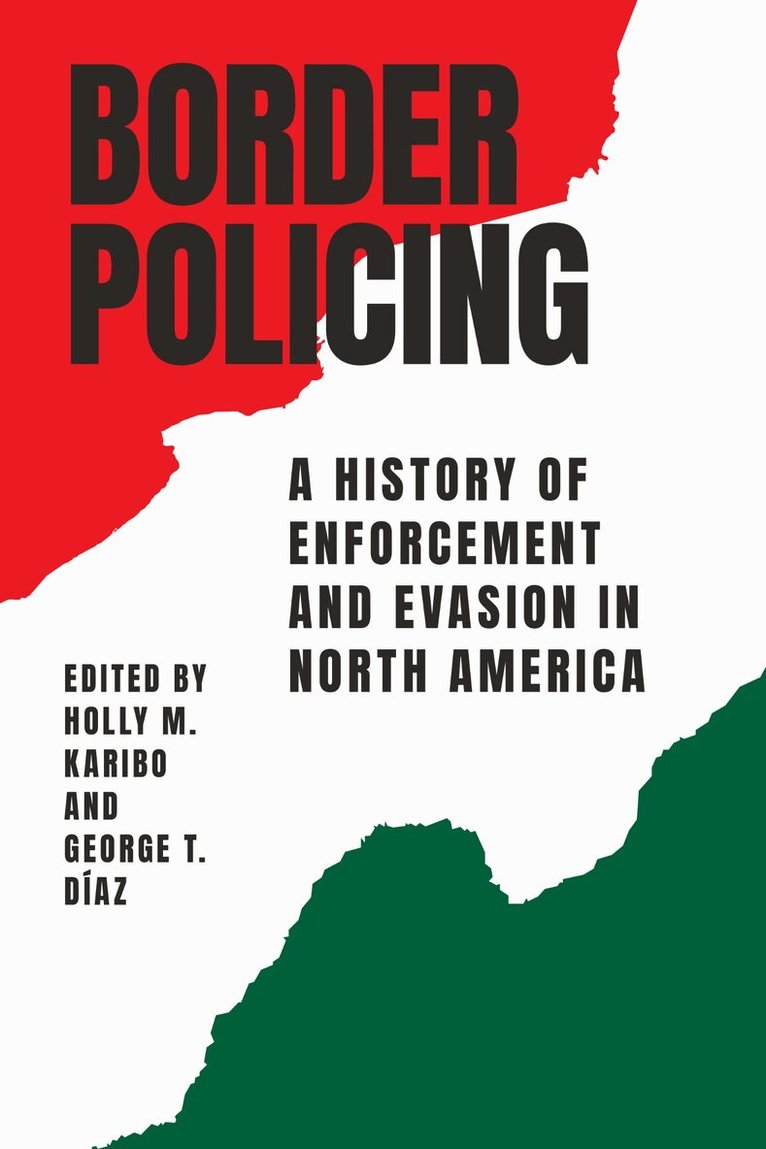
    Border Policing

    A History of Enforcement and Evasion in North America

    AvHolly M. Karibo,George T. Díaz

    Häftad, Engelska, 2024

    331 kr

    Beställningsvara. Skickas inom 5-8 vardagar. Fri frakt över 249 kr.

    Beskrivning

    An interdisciplinary group of borderlands scholars provide the first expansive comparative history of the way North American borders have been policed-and transgressed-over the past two centuries.An extensive history examining how North American nations have tried (and often failed) to police their borders, Border Policing presents diverse scholarly perspectives on attempts to regulate people and goods at borders, as well as on the ways that individuals and communities have navigated, contested, and evaded such regulation. The contributors explore these power dynamics though a series of case studies on subjects ranging from competing allegiances at the northeastern border during the War of 1812 to struggles over Indian sovereignty and from the effects of the Mexican Revolution to the experiences of smugglers along the Rio Grande during Prohibition. Later chapters stretch into the twenty-first century and consider immigration enforcement, drug trafficking, and representations of border policing in reality television. Together, the contributors explore the powerful ways in which federal authorities impose political agendas on borderlands and how local border residents and regions interact with, and push back against, such agendas. With its rich mix of political, legal, social, and cultural history, this collection provides new insights into the distinct realities that have shaped the international borders of North America.

    Produktinformation

    • Utgivningsdatum:2024-02-06
    • Mått:152 x 229 x 30 mm
    • Vikt:454 g
    • Format:Häftad
    • Språk:Engelska
    • Antal sidor:304
    • Förlag:University of Texas Press
    • ISBN:9781477321287

    Utforska kategorier

    • Migration inom Samhälle och politik
    • Amerikas historia inom Historia och arkeologi

    Mer om författaren

    Holly M. Karibo is an associate professor of history at Oklahoma State University. She is the author of the award-winning book Sin City North: Sex, Drugs, and Citizenship in the Detroit-Windsor Borderland.George T. DÍaz is an associate professor of history at the University of Texas Rio Grande Valley and the author of the award-winning book Border Contraband: A History of Smuggling across the Rio Grande.

    Recensioner i media

    [Border Policing] is an excellent updated introduction to borderlands studies of the region. Readers will find that the authors, based primarily in the discipline of history, make the volume accessible to academic and nonacademic audiences alike as they deftly connect the themes over time...The contributions of this volume are timely. (Gender, Place & Culture) An intelligent and engaging collection of mostly historical scholarship on the often nettlesome challenges arising along the two international borders that trisect North America...despite this volume’s geographic, topical, and chronological range, the essays in Border Policing work together nicely...Borderlands scholars across disciplinary boundaries will find this volume rewarding. (American Historical Review) A volume such as this one could not be more timely...One cannot read through the fine essays in this collection without encountering fascinating historical examples of contemporary border realities and follies. Everything old is indeed new again along the nation's frontiers...Highly recommended. (CHOICE) Border Policing is an important collection of scholarship. Its most exciting and innovative sections center on Indigenous sovereignty, settler colonialism, and colonial border policies. Cohesively, this volume demonstrates that borders have historically been both permeable and policed. (Journal of American History) The framing of 'crisis' has been a recurring feature of border policing in U.S. history since at least the early nineteenth century. This much is deftly and effectively argued in [Border Policing]...the book aptly shows the partial, incomplete, and contingent nature of border policing itself...Scholars of Texas history would do well to engage this book for its range of case studies grappling with, among other things, transborder political collaboration (chapter 2), the policing of Mexican identity (chapter 4), vigilantism (chapter 7), peyotism (chapter 8), and the policing of smuggling and gender roles (chapter 9). (Southwestern Historical Quarterly) Border Policing is...one of the best of a small but growing number of anthologies that put the histories of US-Mexico and US-Canada borderlands in conversation...this is an exceptionally well-organized and thoughtfully arranged anthology. Every essay can be grouped with at least two or three others either thematically, chronologically, or geographically, which makes it an excellent teaching resource for courses about nationalism, borderlands, or policing. The amount of fresh scholarship and interpretations means this collection is also pushing the field forward in distinct ways. (H-Net Reviews) Border Policing presents the story of border control from the perspective of the borderlands. The authors offer rigorous and insightful contributions on 'the experiences of borderlands residents.' … This focus brings to light important experiences too-long hidden and ignored. (Criminal Law and Criminal Justice Books) [Border Policing] is important, if for no other reason than our need to know more about how these borders became the complex, contentious zones they are today...The empirical richness of the case studies is impressive...the volume is a great resource for scholars and students of borders and security issues alike. (Journal of Strategic Security) Temporally and spatially expansive...Border Policing is an impressive collection of essays on enforcement and invasion in the North American borderlands. (Journal of Arizona History)

    Innehållsförteckning

    • AbbreviationsForeword (Elaine Carey and Andrae Marak)Introduction (Holly M. Karibo and George T. DÍaz)Part I: Emerging Borders: Policing Boundaries in the Nineteenth Century 1. Defining the Acceptable Bounds of Deception: Policing the Prize Game in the Northeastern Borderlands, 1812–1815 (Edward J. Martin)2. Dominance in an Imagined Border: Santos Benavides’s and Santiago Vidaurri’s Policing of the Rio Grande (Luis Alberto GarcÍa)3. A Border without Guards: First Nations and the Enforcement of National Space (Benjamin Hoy)Part II: Solidifying States, Testing Boundaries 4. To Protect and Police: Mexican Consuls in the American Borderlands at the Turn of the Twentieth Century (MarÍa de JesÚs Duarte)5. Enforcing US Immigration Laws at the US-Canada Border, 1891–1940: The View from Detroit (Thomas A. Klug)6. The Roots of the Border Patrol: Line Riders and the Bureaucratization of US-Mexican Border Policing, 1894–1924 (James Dupree)7. Home Guard: State-Sponsored Vigilantism and Violence in the Texas-Mexico Borderlands (Miguel A. Levario)Part III: Building and Resisting a Prohibition Apparatus 8. Policing Peyote Country in the Early Twentieth Century (Lisa D. Barnett)9. Skirting the Law: Female Liquor Smugglers and Sellers and Policing through Prohibition along the Rio Grande (Carolina MonsivÁis)10. Building a Villain/Hero Binary: Public Rhetoric, Smuggling, and Enforcement in the Postwar Borderlands (Holly M. Karibo)Part IV: Expanding State Authority and Its Challenges 11. Diversity and the Border Patrol: Race and Gender in Immigration Enforcement along the US-Mexico Border (Jensen Branscombe)12. Refusing Borders: Haudenosaunee Resistance, Tobacco, and Settler-Colonial Borderlands (Devin Clancy and Tyler Chartrand)13. Border Surge: Drug Trafficking and Escalating Police Power on the Rio Grande (Santiago Ivan Guerra)14. Bordering Reality: Dramatizing Policing the North American Borderlands in Reality Television (Anita Huizar-HernÁndez)Afterword: Within and Without Borders (Karl Jacoby)AcknowledgmentsNotesContributorsIndex