• Fri frakt över 249 kr
  • •
  • Snabba leveranser
  • •
  • Billiga böcker
Kundservice

Du är på sajten för privatpersoner.

Företag, bibliotek eller offentlig verksamhet?

Du handlar på classic.bokus.com, där alla dina funktioner finns intakta.
Till classic.bokus.com
Bokus logotyp. Gå till startsidan.
  • Erbjudanden
  • Nyheter
  • Student
  • Topplistor
  • Barn & ungdom
  • Bokus Play
  • E-böcker
  • Pocketböcker
  • Spel & pussel

10% rabatt på allt med kod: NYSTART10 →

Sidfot

Mina sidor

    Hjälp

    • Kundservice
    • Vanliga frågor och svar
    • Frakt och leverans
    • Retur vid ångerrätt
    • Reklamera vara
    • Betalning
    • Köpvillkor
    • Allmänna villkor
    • Information om webbplatsens tillgänglighet

    Om Bokus

    • Om oss
    • Pressrum
    • För studenter
    • För företag
    • För bibliotek och offentlig verksamhet
    • För leverantörer
    • Hållbarhet

    Populärt

    • Aktuella erbjudanden
    • Presentkort
    • Studentlitteratur
    • Nya böcker
    • Topplistor
    • Signerade böcker
    • Engelska böcker

    Inspiration

    • Boktips
    • BookTok
    • Populära bokserier
    • Barnbokskaraktärer
    • Populära författare
    Logotyp för Bokus
    Följ oss på Facebook (extern länk)Följ oss på Instagram (extern länk)Följ oss på YouTube (extern länk)Följ oss på TikTok (extern länk)
    bokus @ CookiesAnpassa cookiesIntegritetspolicyKöpvillkor
    Till Citymail hemsida (extern länk)Till Budbee hemsida (extern länk)Till Postnord hemsida (extern länk)Till Schenker hemsida (extern länk)Till Early Bird hemsida (extern länk)Till Walleys hemsida (extern länk)
    1. Samhälle och politik
    2. Sociologi och antropologi
    3. Antropologi

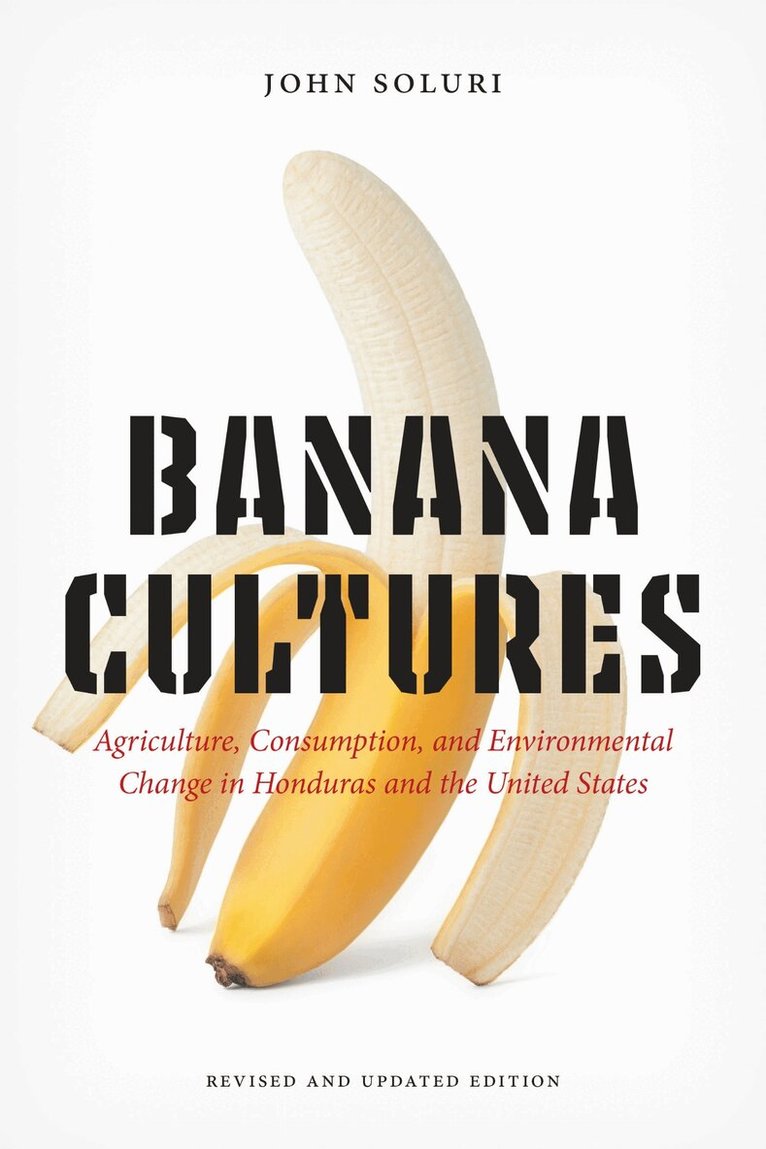
    Banana Cultures

    Agriculture, Consumption, and Environmental Change in Honduras and the United States

    AvJohn Soluri

    Häftad, Engelska, 2021

    360 kr

    Beställningsvara. Skickas inom 5-8 vardagar. Fri frakt över 249 kr.

    Beskrivning

    Bananas, the most frequently consumed fresh fruit in the United States, have been linked to Miss Chiquita and Carmen Miranda, "banana republics," and Banana Republic clothing stores-everything from exotic kitsch, to Third World dictatorships, to middle-class fashion. But how did the rise in banana consumption in the United States affect the banana-growing regions of Central America? In this lively, interdisciplinary study, John Soluri integrates agroecology, anthropology, political economy, and history to trace the symbiotic growth of the export banana industry in Honduras and the consumer mass market in the United States.Beginning in the 1870s, when bananas first appeared in the U.S. marketplace, Soluri examines the tensions between the small-scale growers, who dominated the trade in the early years, and the shippers. He then shows how rising demand led to changes in production that resulted in the formation of major agribusinesses, spawned international migrations, and transformed great swaths of the Honduran environment into monocultures susceptible to plant disease epidemics that in turn changed Central American livelihoods. Soluri also looks at labor practices and workers' lives, changing gender roles on the banana plantations, the effects of pesticides on the Honduran environment and people, and the mass marketing of bananas to consumers in the United States. His multifaceted account of a century of banana production and consumption adds an important chapter to the history of Honduras, as well as to the larger history of globalization and its effects on rural peoples, local economies, and biodiversity.

    Produktinformation

    • Utgivningsdatum:2021-03-30
    • Mått:152 x 229 x 33 mm
    • Vikt:567 g
    • Format:Häftad
    • Språk:Engelska
    • Antal sidor:368
    • Upplaga:2
    • Förlag:University of Texas Press
    • ISBN:9781477322802

    Utforska kategorier

    • Antropologi inom Samhälle och politik
    • Amerikas historia inom Historia och arkeologi

    Mer om författaren

    John Soluri is Associate Professor of History at Carnegie Mellon University in Pittsburgh.

    Recensioner i media

    An historian by profession, John Soluri has written a book that defies disciplinary pigeonholing. This ambitious treatise on ‘banana cultures' links Honduran production with North American consumption, ecumenically drawing on archival records and oral histories as well as the burgeoning field of agroecology and the interpretive methodologies of cultural studies. . . . Soluri has accomplished what I thought impossible: writing a new and innovative book on one of the most-mined topics in Central American history. This book makes an important contribution to the field by connecting banana production and consumption, and its accessible style makes it well suited for classroom use. - Edward F. Fischer (Journal of Latin American Studies) [Soluri] provides a well-written, balanced, and multifaceted perspective on the banana. . . . Banana Cultures leaves the reader with an understanding of the banana export trade that combines history and the botany and agriculture of the banana with a discussion of production, economics, and the changing culture of consumption in the United States. The reader will never take a banana for granted again. - Marcus B. Griffin (Gastronomica) Emphasizing a dimension of banana production mentioned in passing by others-the ecological challenges posed by monoculture farming-Soluri offers a major rewriting of the industry's history. His eminently readable account starts on the north coast of Honduras, one of the first regions incorporated into the banana trade. . . . [Soluri's account] is significant both for its rethinking of industry history and its skillful integration of the material, ecological, and symbolic aspects of banana production and consumption. In sum, the book is essential reading for anyone interested in the production and social life of everyday commodities. - Mark Moberg (American Historical Review) [A] splendid transnational history…this is a path-breaking study that makes a major contribution to agroecology and to the history of business strategies, agricultural science and technology, work processes, and the marketing and consumption of tropical commodities in North America. (The Americas) "[Banana Cultures] will be a standard-bearer in banana plantation history for years to come." (Environmental History) Soluri’s narrative, well written and informed by popular culture and oral histories, is also very engaging for readers of any background.  By providing a comparative perspective in his last chapter, he also highlights the implications of his approach and points to some other commodities, such as coffee and sugar, that could benefit from his approach. - Felipe Cruz (Not Even Past) Soluri’s volume remains distinctive for its sweeping consideration of the social, ecological and symbolic contexts of banana production and consumption...Banana Cultures remains essential reading on the social, cultural and ecological dimensions of the fruit and firms that transformed much of Central America. (Journal of Latin American Studies) Soluri has taken an already classic and wonderfully accessible work and further enhanced it by bookending it with these two new thought-provoking and insightful essays. In doing so, he has only strengthened an already pioneering work. (The Americas)

    Innehållsförteckning

    • Preface to the Second Edition: Bananas, SeriouslyPreface to the First EditionAcknowledgmentsIntroduction. Linking Places of Production and ConsumptionChapter 1. Going BananasChapter 2. Space InvadersChapter 3. Altered Landscapes and Transformed LivelihoodsChapter 4. Sigatoka, Science, and ControlChapter 5. Revisiting the Green PrisonChapter 6. The Lives and Time of Miss ChiquitaChapter 7. La QuÍmicaChapter 8. Bananas Cultures in Comparative PerspectivePostscript to the Second Edition: Beyond Banana CulturesNotesBibliographyIndex