• Fri frakt över 249 kr
  • •
  • Snabba leveranser
  • •
  • Billiga böcker
Kundservice

Du är på sajten för privatpersoner.

Företag, bibliotek eller offentlig verksamhet?

Du handlar på classic.bokus.com, där alla dina funktioner finns intakta.
Till classic.bokus.com
Bokus logotyp. Gå till startsidan.
  • Erbjudanden
  • Student
  • Topplistor
  • Barn & ungdom
  • Bokus Play
  • E-böcker
  • Ljudböcker
  • Pocketböcker
  • Spel och pussel

5% studentrabatt – använd koden KURSBOK27 →

Sidfot

Mina sidor

    Hjälp

    • Kundservice
    • Vanliga frågor och svar
    • Frakt och leverans
    • Retur vid ångerrätt
    • Reklamera vara
    • Betalning
    • Köpvillkor
    • Allmänna villkor
    • Information om webbplatsens tillgänglighet

    Om Bokus

    • Om oss
    • Pressrum
    • För studenter
    • För företag
    • För bibliotek och offentlig verksamhet
    • För leverantörer
    • Hållbarhet

    Populärt

    • Aktuella erbjudanden
    • Presentkort
    • Studentlitteratur
    • Nya böcker
    • Topplistor
    • Signerade böcker
    • Engelska böcker

    Inspiration

    • Boktips
    • BookTok
    • Barnbokskaraktärer
    • Populära författare
    Logotyp för Bokus
    Följ oss på Facebook (extern länk)Följ oss på Instagram (extern länk)Följ oss på YouTube (extern länk)Följ oss på TikTok (extern länk)
    bokus @ CookiesAnpassa cookiesIntegritetspolicyKöpvillkor
    Till Citymail hemsida (extern länk)Till Budbee hemsida (extern länk)Till Postnord hemsida (extern länk)Till Schenker hemsida (extern länk)Till Early Bird hemsida (extern länk)Till Walleys hemsida (extern länk)
    1. Historia och arkeologi
    2. Historia
    3. Historia: särskilda händelser och ämnen
    4. Kolonialism och imperialism

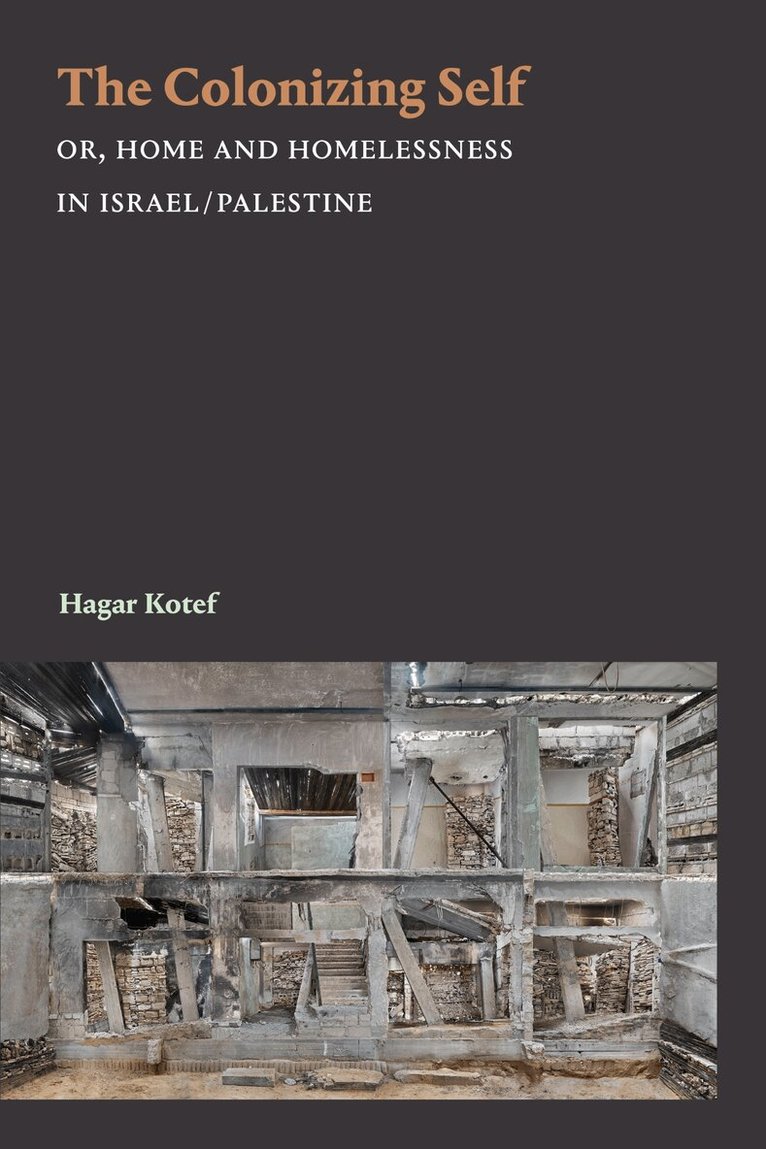
    Colonizing Self

    Or, Home and Homelessness in Israel/Palestine

    AvHagar Kotef

    Inbunden, Engelska, 2020

    Del i serien Theory in Forms

    1 213 kr

    Beställningsvara. Skickas inom 5-8 vardagar. Fri frakt över 249 kr.

    Fler format och utgåvor

    Häftad

    316 kr

    E-bok

    471 kr

    Beskrivning

    Colonizers continuously transform spaces of violence into spaces of home. Israeli Jews settle in the West Bank and in depopulated Palestinian houses in Haifa or Jaffa. White missionaries build their lives in Africa. The descendants of European settlers in the Americas and Australia dwell and thrive on expropriated indigenous lands. In The Colonizing Self Hagar Kotef traces the cultural, political, and spatial apparatuses that enable people and nations to settle on the ruins of other people's homes. Kotef demonstrates how the mass and structural modes of violence that are necessary for the establishment and sustainment of the colony dwell within settler-colonial homemaking, and through it shape collective and individual identities. She thus powerfully shows how the possibility to live amid the destruction one generates is not merely the possibility to turn one's gaze away from violence but also the possibility to develop an attachment to violence itself. Kotef thereby offers a theoretical framework for understanding how settler-colonial violence becomes inseparable from one's sense of self.

    Produktinformation

    • Utgivningsdatum:2020-12-18
    • Mått:152 x 229 x 22 mm
    • Vikt:567 g
    • Format:Inbunden
    • Språk:Engelska
    • Serie:Theory in Forms
    • Antal sidor:320
    • Förlag:Duke University Press
    • ISBN:9781478010289

    Utforska kategorier

    • Kolonialism och imperialism inom Historia och arkeologi
    • Geografi inom Naturvetenskap och teknik
    • Mellanösterns historia inom Historia och arkeologi

    Mer om författaren

    Hagar Kotef is Associate Professor in Political Theory and Comparative Political Thought at SOAS University of London and author of Movement and the Ordering of Freedom: On Liberal Governances of Mobility, also published by Duke University Press.

    Recensioner i media

    “Hagar Kotef has written a fierce, rigorous, intimate, unrelenting, account of settler colonialism. We who make our homes on stolen land live in the crevices of all-too-concrete structures of oppression. We turn our faces to the wall. Kotef faces what we too often ignore. This may be harshest in Israel where Kotef's book is set, but the import of the work goes beyond that site. Perhaps all homes are built on cruel exclusions and indefensible claims. Perhaps all homes shelter cruelties. Hagar Kotef's ability to raise these unsettling questions is admirable for its intellectual clarity and its courage.” - Anne Norton, author of (On the Muslim Question) “An incredibly detailed and engaging study that illustrates Palestinian erasure from within the settler consciousness, the book brings forth an understanding from within that does much to bring the Palestinian trauma to the fore.”(Middle East Monitor) “The Colonizing Self is an incisive book about the dispossessor. In lyrical prose and through wide-ranging source material, Hagar Kotef traces the constitutive violence of settler colonialism.... Kotef’s book alerts us to the task of uprooting desires that secure settler colonialism.” - Derek S. Denman (Political Theory) “Two intuitions inform this book about the Israeli ‘colonizing self ‘: one is about home, the other about violence. Taken together, these two intuitions converge on the understanding of the specific ways in which the settler’s identity consolidates, which is a crucial question and has been overlooked by scholars so far.” - Lorenzo Veracini (Journal of Palestine Studies) “The ongoing challenge of decolonization . . . will inevitably require an unsettling of the very notion that the colonizer possesses a single self. Kotef ’s book is a critical milestone in this endeavor.” - Noam Leshem (American Historical Review)

    Innehållsförteckning

    • Preface  ixAcknowledgments  xiiiIntroduction: Home  1Theoretical Overview: Violent Attachments  29Part I. HomesInterlude. Home/Homelessness: A Reading in Arendt  551. The Consuming Self: On Locke, Aristotle, Feminist Theory, and Domestic Violences  73Epilogue. Unsettlement  109Part II. RelicsInterlude. A Brief Reflection on Death and Decolonization  1272. Home (and the Ruins That Remain)  137Epilogue. A Phenomenology of Violence: Ruins  185Part III. SettlementInterlude. A Moment of Popular Culture: The Home of MasterChef  2033. On Eggs and Dispossession: Organic Agriculture and the New Settlement Movement  215Epilogue. An Ethic of Violence: Organic Washing  251Conclusion  261Bibliography  267Index  293