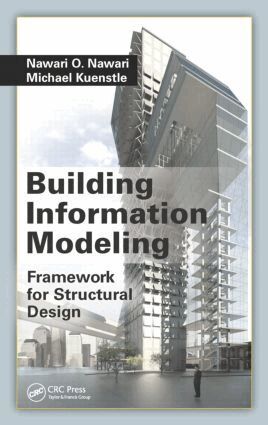
Inbunden, Engelska, 2015
Building Information Modeling
Framework for Structural Design
Av Nawari O. Nawari, Michael Kuenstle
1274 kr
Tillfälligt slut
Beskrivning
Produktinformation
- Utgivningsdatum: 2015-04-21
- Mått: 156 x 234 x 20 mm
- Vikt: 521 g
- Format: Inbunden
- Språk: Engelska
- Antal sidor: 284
- Förlag: Taylor & Francis Inc
- ISBN: 9781482240436
Utforska kategorier
Mer om författaren
Dr. Nawari, (Ph.D., P.E., M.ASCE) has over 20 years of experience in design, teaching, and research specializing in building structures and building information modeling. Currently, he teaches graduate and undergraduate courses at the University of Florida. He has written and co-authored over 70 publications and three books. He is an active member of the U.S. National Building Information Modeling Standard Committee (NBIMS), BIM Committee of the Structural Engineering Institute (SEI), and co-chair of the subcommittee on BIM in education and many other professional societies. Dr. Nawari is also a board certified professional engineer in the states of Florida and Ohio. Michael W. Kuenstle, AIA, received his graduate architecture degree from Columbia University in New York City. He holds a bachelor of architecture degree from the University of Houston. Kuenstle served as adjunct associate professor at the New York Institute of Technology from 1990 to 1993. He has been a professor in the School of Architecture at the University of Florida since 1993 where he teaches architecture design studio and advanced graduate structures courses. His building design projects have received several AIA design awards and have been published and exhibited throughout North America. A licensed architect, he serves as a member of the Board of Trustees to the Florida Foundation for Architecture.
Recensioner i media
"The main strength of this book lies in its focus on applications of BIM on structural engineering, coupling the structural design task with architectural design."—Gian A. Rassati, University of Cincinnati"The detailed description of the steps in using a BIM tool for various aspects of structural design, together with aspects of interoperability with FEM and other tools, is the main strength of the material … Such detailed description is particularly useful for students to understand how to integrate BIM efficiently in the structural engineering. The descriptions followed by related exercises should foster ‘learning through examples and learning by doing’ and such content is currently missing in BIM textbooks."—Vishal Singh, Aaalto University
Betyg & recensioner
0 recensioner
Inga recensioner tillgängliga.