• Fri frakt över 249 kr
  • •
  • Snabba leveranser
  • •
  • Billiga böcker
Kundservice

Du är på sajten för privatpersoner.

Företag, bibliotek eller offentlig verksamhet?

Du handlar på classic.bokus.com, där alla dina funktioner finns intakta.
Till classic.bokus.com
Bokus logotyp. Gå till startsidan.
  • Erbjudanden
  • Nyheter
  • Student
  • Topplistor
  • Barn & ungdom
  • Bokus Play
  • E-böcker
  • Pocketböcker
  • Spel & pussel

10% rabatt på allt med kod: NYSTART10 →

Sidfot

Mina sidor

    Hjälp

    • Kundservice
    • Vanliga frågor och svar
    • Frakt och leverans
    • Retur vid ångerrätt
    • Reklamera vara
    • Betalning
    • Köpvillkor
    • Allmänna villkor
    • Information om webbplatsens tillgänglighet

    Om Bokus

    • Om oss
    • Pressrum
    • För studenter
    • För företag
    • För bibliotek och offentlig verksamhet
    • För leverantörer
    • Hållbarhet

    Populärt

    • Aktuella erbjudanden
    • Presentkort
    • Studentlitteratur
    • Nya böcker
    • Topplistor
    • Signerade böcker
    • Engelska böcker

    Inspiration

    • Boktips
    • BookTok
    • Populära bokserier
    • Barnbokskaraktärer
    • Populära författare
    Logotyp för Bokus
    Följ oss på Facebook (extern länk)Följ oss på Instagram (extern länk)Följ oss på YouTube (extern länk)Följ oss på TikTok (extern länk)
    bokus @ CookiesAnpassa cookiesIntegritetspolicyKöpvillkor
    Till Citymail hemsida (extern länk)Till Budbee hemsida (extern länk)Till Postnord hemsida (extern länk)Till Schenker hemsida (extern länk)Till Early Bird hemsida (extern länk)Till Walleys hemsida (extern länk)
    1. Psykologi och pedagogik
    2. Pedagogik
    3. Pedagogisk psykologi

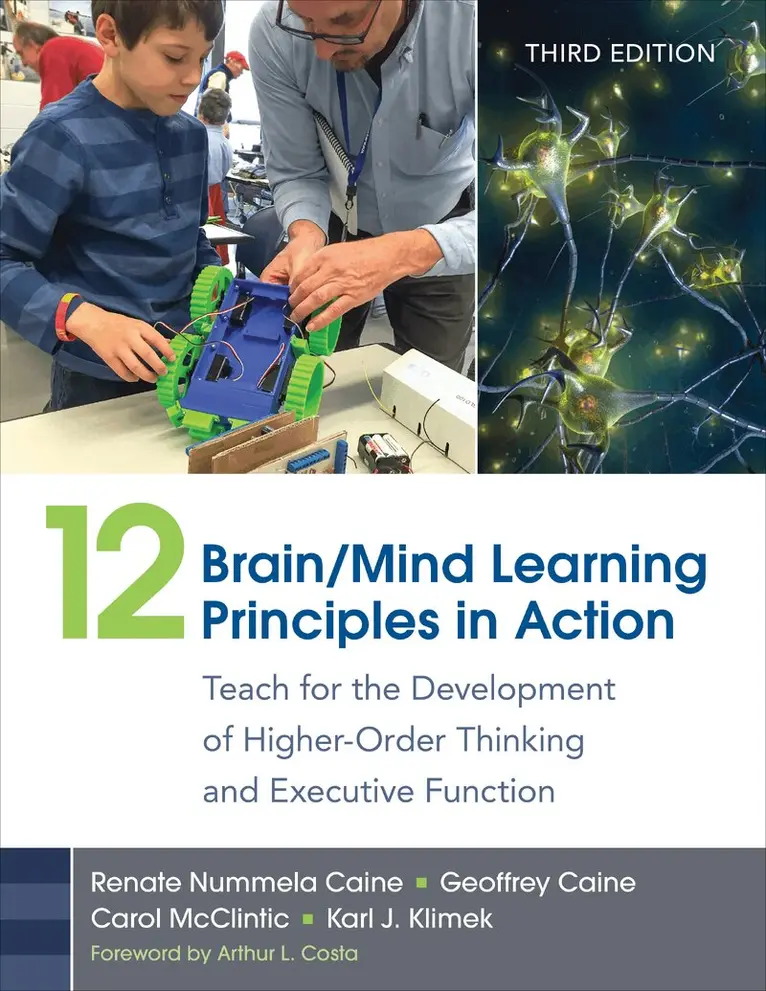
    12 Brain/Mind Learning Principles in Action

    Teach for the Development of Higher-Order Thinking and Executive Function

    AvRenate Nummela Caine,Geoffrey Caine

    Häftad, Engelska, 2015

    458 kr

    Beställningsvara. Skickas inom 3-6 vardagar. Fri frakt över 249 kr.

    Beskrivning

    Raise the bar with the best of what is known about how the brain/mind learns Higher-order skills such as critical thinking, planning, decision-making and persistence are the key to success for today’s students. With its novel approach to teaching and learning, 12 Brain/Mind Learning Principles in Action has been the go-to resource for thousands of teachers in leading their students to greater confidence and achievement. Now in an expanded third edition, Caine et al. offer three practical approaches to instruction—direct, problem or project-based learning, and the guided experience approach—while providing common-sense strategies to turn theory into effective classroom teaching. Features of the new edition include More strategies to deeply engage students and build foundational learning skillsGuidance on peer-based professional development through Process Learning CirclesReflective questions and checklists for assessing progress Updated, real-life examples that illustrate brain-compatible learning in actionBridge research to practice through these innovative strategies to create a school environment where students and faculty learn and thrive."12 Brain/Mind Learning Principles in Action is a treasure trove of thoughtful, heartfelt, and effective ideas that will empower brains to grow, minds to expand, and classrooms to thrive. In our present system good teaching is often a subversive act – use this as a manual for guerilla warfare."  Louis Cozolino, Professor of PsychologyPepperdine University "This book provides compelling evidence that the traditional paradigm of education, which emphasizes "factual" learning, is profoundly narrow and limiting. The volume, depth, and relevance of research the authors bring to the fore about effective and lasting models of teaching, learning, and leadership is impressive. May its brilliant and enlightening message once and for all replace the limited and limiting habits of mind that have legitimated educational policy and practice for centuries in the Western World." William Spady, DirectorThe 5th Paradigm

    Produktinformation

    • Utgivningsdatum:2015-09-29
    • Mått:215 x 279 x 23 mm
    • Vikt:900 g
    • Format:Häftad
    • Språk:Engelska
    • Antal sidor:320
    • Upplaga:3
    • Förlag:SAGE Publications Inc
    • ISBN:9781483382722

    Utforska kategorier

    • Pedagogisk psykologi inom Psykologi och pedagogik
    • Lärarutbildning inom Psykologi och pedagogik

    Mer om författaren

    Renate Nummela Caine is a principal of Caine Learning LLC and consultant to districts, schools, teachers, administrators, and communities to implement brain-based learning. She is the senior author, with Geoffrey Caine, of the groundbreaking Making Connections: Teaching and the Human Brain. She has worked with countless educators in the U.S. and around the globe. Recently, Renate and Geoffrey Caine worked with a low-income, underachieving K-5 elementary school in California to help teachers design more innovative teaching strategies using the brain/mind learning principles and district standards. Caine is professor emeritus of education at California State University in San Bernardino, where she was also executive director of the Center for Research in Integrative Learning and Teaching. She has taught every level from kindergarten to university. She earned her PhD from the University of Florida in educational psychology. Geoffrey Caine, a director of Caine Learning LLC, is a learning consultant and process coach. Caine has been published extensively and is co-author of six books, including Making Connections: Teaching and the Human Brain. His work carries him throughout the United States and abroad. He works in the worlds of education, business, and government, where he capitalizes on his prior experiences as a professor of law, an education services manager of a national software company, a state manager of a national publishing company, and national director of the Mind/Brain Network of the American Society for Training and Development.    He has given keynote addresses or made presentations to the Campaign for Learning in the United Kingdom, the World Conference on Education for All, the Eighth International Conference on Thinking, the Whole Schools Institute sponsored by the Mississippi Arts Commission, and numerous other national and regional organizations and associations. Caine′s major interest is in how best to improve the ways in which people learn together. He directs his attention to the arts of deep listening, dwelling in the question, and processing experience for the lessons it has to offer.  Carol Lynn McClintic is an educational leader with diverse experience as a teacher at numerous levels, including preschool, elementary, middle, high, and university. She is a master teacher (over eighteen student teachers, plus BITSA and peer coach), a mentor teacher, and a model teacher. She has led and co-led many workshops for her district, taught numerous education extension classes for teachers at local universities—including co-creating a certificate program for conflict resolution—been a coordinator for university and district grant programs, and consulted with Caine Learning since 1995, participating in workshops throughout the United States. McClintic has co-authored the book Wouldn’t It Be Wonderful: A Guide to Teaching in the Twenty-first Century and co-written an article with Geoffrey and Renate Nummela Caine. She has received several awards and retired from active teaching in 2002 after thirty-five years. Karl Klimek is the Executive Orchestrator of the Square One Education Network, a nonprofit organization that incorporates brain/mind learning theory and practices in schools, with special focus on science, technology, engineering, and mathematics projects (www.squareonenetwork.org). He is lead author of Generative Leadership: Shaping New Futures for Today’s Schools (2008, Corwin Press), co-author of 12 Brain-Mind Learning Principles in Action: Developing Executive Functions of the Human Brain (2004 / 2008, Corwin Press) and has taught in Washington, Wyoming, and Michigan at both the public school and university levels. His school administrative experience includes service as a principal and as assistant superintendent for curriculum and instruction in a suburban Detroit, Michigan district. Karl is President of 2 Perspectives: Learning Through Leadership (www.2perspectives.us.com) and has worked extensively in career and technology education developing state and federal programs. He is a Senior Associate of the Caine Learning Institute, Idyllwild, CA and is Board Vice President of the Natural Learning Research Institute. Karl received his undergraduate degree in education from Central Washington University and his master’s in educational leadership from Eastern Michigan University. He is recognized for his practical and enthusiastic presentations as a speaker and project development/design facilitator.

    Recensioner i media

    "In today’s education world of standardization and prescriptive narrow testing outcomes, this book reminds us as educators and leaders what it means to be human. The research and examples paint a clear picture of how we learn and provide a path towards student-centered-learning that reflects our intelligence and connectedness. Administrators and educators looking for innovative solutions and a means to meet students where they are, and then advance beyond, would be wise to adopt this third edition of 12 Brain/Mind Learning Principles in Action. I encourage schools to include this book in their professional development and learning community."

    Innehållsförteckning

    • Foreword to the Third EditionPrefaceAcknowledgmentsAbout the Authors1. Getting StartedPART I: The First Foundational Element--Relaxed Alertness2. Why Relaxed Alertness Provides the Optimum Emotional Climate for Learning3. Brain/Mind Learning Principle—Complex Learning Is Enhanced by Challenge and Inhibited by Threat, Helplessness, and Fatigue4. Brain/Mind Learning Principle--The Brain/Mind Is Social5. Brain/Mind Learning Principle--The Search for Meaning Is Innate6. Brain/Mind Learning Principle--Emotions Are Critical to PatterningPART II: The Second Foundational Element--Orchestrated Immersion in Complex Experience7. Creating the Richest Learning Environments Using Orchestrated Immersion in Complex Experience8. Brain/Mind Learning Principle--The Brain/Mind Processes Parts and Wholes Simultaneously9. Brain/Mind Learning Principle--All Learning Engages the Physiology10. Brain/Mind Learning Principle--The Search for Meaning Occurs Through Patterning11. Brain/Mind Learning Principle--Learning Is DevelopmentalPART III: The Third Foundational Element--Active Processing of Experience12. Helping Learners Digest and Consolidate Learning13. Brain/Mind Learning Principle--Each Brain Is Uniquely Organized14. Brain/Mind Learning Principle--There Are at Least Two Ways to Approach Memory15. Brain/Mind Learning Principle--Learning Engages Both Focused Attention and Peripheral Perception16. Brain/Mind Learning Principle--Learning Is Both Conscious and Unconscious17. Teaching with Body/Mind Interconnectedness in MindResource A: The Brain/Mind Capacities WheelResource B: The Brain/Mind Principles WheelResource C: How to Develop Process Learning CirclesResource D: Guided Experiences CycleResource E: Guidelines for the Guided Experiences ModelResource F: Global Experiences Design WheelResource G: Sensory PoemReferencesIndex