• Fri frakt över 249 kr
  • •
  • Snabba leveranser
  • •
  • Billiga böcker
Kundservice

Du är på sajten för privatpersoner.

Företag, bibliotek eller offentlig verksamhet?

Du handlar på classic.bokus.com, där alla dina funktioner finns intakta.
Till classic.bokus.com
Bokus logotyp. Gå till startsidan.
  • Erbjudanden
  • Nyheter
  • Student
  • Topplistor
  • Barn & ungdom
  • Bokus Play
  • E-böcker
  • Pocketböcker
  • Spel & pussel

10% rabatt på allt med kod NYSTART10 →

Sidfot

Mina sidor

    Hjälp

    • Kundservice
    • Vanliga frågor och svar
    • Frakt och leverans
    • Retur vid ångerrätt
    • Reklamera vara
    • Betalning
    • Köpvillkor
    • Allmänna villkor
    • Information om webbplatsens tillgänglighet

    Om Bokus

    • Om oss
    • Pressrum
    • För studenter
    • För företag
    • För bibliotek och offentlig verksamhet
    • För leverantörer
    • Hållbarhet

    Populärt

    • Aktuella erbjudanden
    • Presentkort
    • Studentlitteratur
    • Nya böcker
    • Topplistor
    • Signerade böcker
    • Engelska böcker

    Inspiration

    • Boktips
    • BookTok
    • Populära bokserier
    • Barnbokskaraktärer
    • Populära författare
    Logotyp för Bokus
    Följ oss på Facebook (extern länk)Följ oss på Instagram (extern länk)Följ oss på YouTube (extern länk)Följ oss på TikTok (extern länk)
    bokus @ CookiesAnpassa cookiesIntegritetspolicyKöpvillkor
    Till Citymail hemsida (extern länk)Till Budbee hemsida (extern länk)Till Postnord hemsida (extern länk)Till Schenker hemsida (extern länk)Till Early Bird hemsida (extern länk)Till Walleys hemsida (extern länk)
    1. Data och IT
    2. Databaser

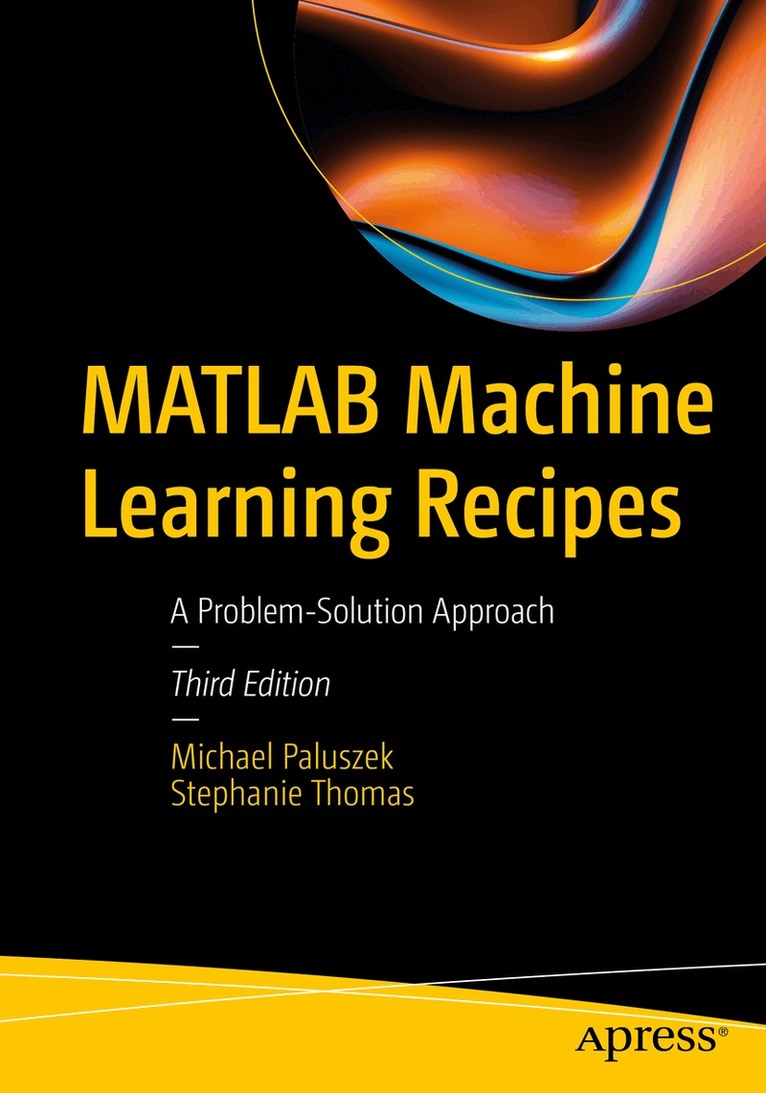
    MATLAB Machine Learning Recipes

    A Problem-Solution Approach

    AvMichael Paluszek,Stephanie Thomas

    Häftad, Engelska, 2024

    566 kr

    Beställningsvara. Skickas inom 3-6 vardagar. Fri frakt över 249 kr.

    Beskrivning

    Harness the power of MATLAB to resolve a wide range of machine learning challenges. This new and updated third edition provides examples of technologies critical to machine learning. Each example solves a real-world problem, and all code provided is executable. You can easily look up a particular problem and follow the steps in the solution.This book has something for everyone interested in machine learning. It also has material that will allow those with an interest in other technology areas to see how machine learning and MATLAB can help them solve problems in their areas of expertise. The chapter on data representation and MATLAB graphics includes new data types and additional graphics. Chapters on fuzzy logic, simple neural nets, and autonomous driving have new examples added. And there is a new chapter on spacecraft attitude determination using neural nets. Authors Michael Paluszek and Stephanie Thomas show how all of these technologies allow you to build sophisticated applications to solve problems with pattern recognition, autonomous driving, expert systems, and much more.What You Will LearnWrite code for machine learning, adaptive control, and estimation using MATLABUse MATLAB graphics and visualization tools for machine learningBecome familiar with neural netsBuild expert systemsUnderstand adaptive controlGain knowledge of Kalman FiltersWho This Book Is ForSoftware engineers, control engineers, university faculty, undergraduate and graduate students, hobbyists.

    Produktinformation

    • Utgivningsdatum:2024-03-02
    • Mått:178 x 254 x 24 mm
    • Vikt:813 g
    • Format:Häftad
    • Språk:Engelska
    • Antal sidor:447
    • Upplaga:3
    • Förlag:APress
    • ISBN:9781484298459

    Utforska kategorier

    • Databaser inom Data och IT
    • Artificiell intelligens inom Data och IT

    Mer om författaren

    Michael Paluszek is President of Princeton Satellite Systems, Inc. (PSS) in Plainsboro, New Jersey. Mr. Paluszek founded PSS in 1992 to provide aerospace consulting services. He used MATLAB to develop the control system and simulations for the Indostar-1 geosynchronous communications satellite. This led to the launch of Princeton Satellite Systems’ first commercial MATLAB toolbox, the Spacecraft Control Toolbox, in 1995. Since then he has developed toolboxes and software packages for aircraft, submarines, robotics, and nuclear fusion propulsion, resulting in Princeton Satellite Systems’ current extensive product line. He is working with the Princeton Plasma Physics Laboratory on a compact nuclear fusion reactor for energy generation and space. Mr. Paluszek is a lecturer at the Massachusetts Institute of Technology.propulsion. He is also leading the development of new power electronics for fusion power systems and working on heat-engine-based auxiliary power systemsfor spacecraft. Prior to founding PSS, Mr. Paluszek was an engineer at GE Astro Space in East Windsor, NJ. At GE he designed the Global Geospace Science Polar despun platform control system and led the design of the GPS IIR attitude control system, the Inmarsat-3 attitude control systems, and the Mars Observer delta-V control system, leveraging MATLAB for control design. Mr. Paluszek also worked on the attitude determination system for the DMSP meteorological satellites. Mr. Paluszek flew communication satellites on over twelve satellite launches, including the GSTAR III recovery, the first transfer of a satellite to an operational orbit using electric thrusters. At Draper Laboratory Mr. Paluszek worked on the Space Shuttle, Space Station, and submarine naviga- tion. His Space Station work included designing Control Moment Gyro-based control systems for attitude control. Mr. Paluszek received his bachelor’s degree in Electrical Engineering, and master’s and engineer’s degrees in Aeronautics and Astronautics from the Massachusetts Institute of Technology. He is the author of numerous papers and has over a dozen U.S. Patents. Mr. Paluszek is the author of “MATLAB Recipes”, “MATLAB Machine Learning,” “Practical MATLAB Deep Learning, A Projects-Based Approach, Second Edition,” all published by Apress, and ”ADCS: Spacecraft Attitude Determination and Control Systems by Elsevier.” Stephanie Thomas is Vice President of Princeton Satellite Systems, Inc. in Plainsboro, New Jersey. She received her bachelor’s and master’s degrees in Aeronautics and Astronautics from the Massachusetts Institute of Technology in 1999 and 2001. Ms. Thomas was introduced to the PSS Spacecraft Control Toolbox for MATLAB during a summer internship in 1996 and has been using MATLAB for aerospace analysis ever since. In her nearly 20 years of MATLAB experience, she has developed many software tools including the Solar Sail Module for the Spacecraft Control Toolbox; a proximity satellite operations toolbox for the Air Force; collision monitoring Simulink blocks for the Prisma satellite mission; and launch vehicle analysis tools in MATLAB and Java, She has developed novel methods for space situation assessment such as a numeric approach to assessing the general rendezvous problem between any two satellites implemented in both MATLAB and C++. Ms. Thomas has contributed to PSS’ Attitude and Orbit Control textbook, featuring examples using the Spacecraft Control Toolbox, and written many software User’s Guides. She has conducted SCT training for engineers from diverse locales such as Australia, Canada, Brazil, and Thailand and has performed MATLAB consulting for NASA, the Air Force, and the European Space Agency. Ms. Thomas is the author of “MATLAB Recipes” and “MATLAB Machine Learning” and “Practical MATLAB Deep Learning Projects” and ‘Practical MATLAB Deep Learning Projects Version 2” published by Apress. In 2016, Ms. Thomas was named a NASA NIAC Fellow for the project “Fusion-Enabled Pluto Orbiter and Lander”. Stephanie is an Associate Fellow of the AIAA and a member of the AIAA Propulsion and Energy Group.

    Innehållsförteckning

    • Chapter 1. An Overview of Machine Learning.- Chapter 2. Data Representation.- Chapter 3. MATLAB Graphics.- Chapter 4. Kalman Filters.- Chapter 5. Adaptive Control.- Chapter 6. Neural Aircraft Control.- Chapter 7. Fuzzy Logic.- Chapter 8. Classification with Neural Nets.- Chapter 9. Simple Neural Nets.- Chapter 10. Data Classification. - Chapter 11. Neural Nets with Deep Learning.- Chapter 12. Multiple Hypothesis Testing.- Chapter 13.  Autonomous Driving with MHT.- Chapter 14. Case-Based Expert Systems.- Chapter 15. Spacecraft Attitude Determination Using Neural Nets. -Appendix A Brief History of Autonomous Learning.- Appendix B. Software for Autonomous Learning.