• Fri frakt över 249 kr
  • •
  • Snabba leveranser
  • •
  • Billiga böcker
Kundservice

Du är på sajten för privatpersoner.

Företag, bibliotek eller offentlig verksamhet?

Du handlar på classic.bokus.com, där alla dina funktioner finns intakta.
Till classic.bokus.com
Bokus logotyp. Gå till startsidan.
  • Erbjudanden
  • Nyheter
  • Student
  • Topplistor
  • Barn & ungdom
  • Bokus Play
  • E-böcker
  • Pocketböcker
  • Spel & pussel

Må bättre, för mindre! Upp till 50% rabatt på hälsoböcker

Sidfot

Mina sidor

    Hjälp

    • Kundservice
    • Vanliga frågor och svar
    • Frakt och leverans
    • Retur vid ångerrätt
    • Reklamera vara
    • Betalning
    • Köpvillkor
    • Allmänna villkor
    • Information om webbplatsens tillgänglighet

    Om Bokus

    • Om oss
    • Pressrum
    • För studenter
    • För företag
    • För bibliotek och offentlig verksamhet
    • För leverantörer
    • Hållbarhet

    Populärt

    • Aktuella erbjudanden
    • Presentkort
    • Studentlitteratur
    • Nya böcker
    • Topplistor
    • Signerade böcker
    • Engelska böcker

    Inspiration

    • Boktips
    • BookTok
    • Populära bokserier
    • Barnbokskaraktärer
    • Populära författare
    Logotyp för Bokus
    Följ oss på Facebook (extern länk)Följ oss på Instagram (extern länk)Följ oss på YouTube (extern länk)Följ oss på TikTok (extern länk)
    bokus @ CookiesAnpassa cookiesIntegritetspolicyKöpvillkor
    Till Citymail hemsida (extern länk)Till Budbee hemsida (extern länk)Till Postnord hemsida (extern länk)Till Schenker hemsida (extern länk)Till Early Bird hemsida (extern länk)Till Walleys hemsida (extern länk)
    1. Samhälle och politik
    2. Social välfärd och brottslighet

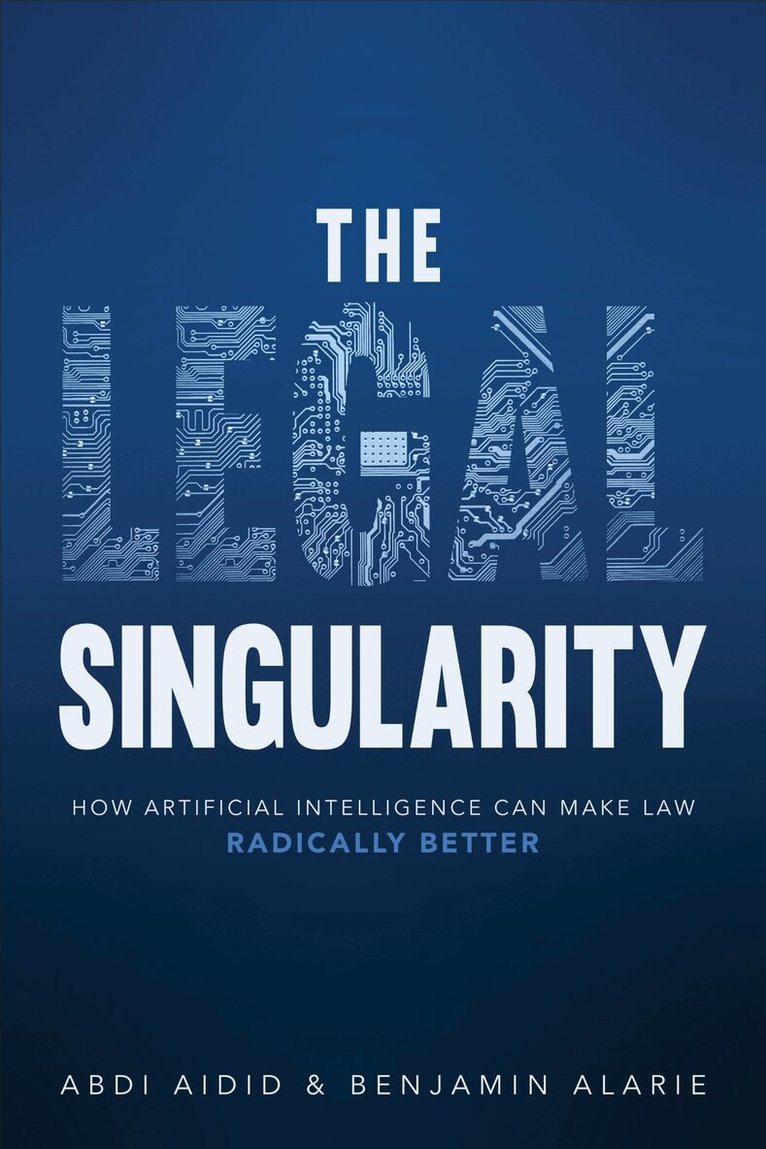
    Legal Singularity

    How Artificial Intelligence Can Make Law Radically Better

    AvAbdi Aidid,Benjamin Alarie

    E-bok
    Engelska, 2023

    474 kr

    Läs direkt i Bokus Reader – eller ladda ned till din enhet

    Fler format och utgåvor

    Inbunden

    417 kr

    E-bok

    474 kr

    Beskrivning

    Law today is incomplete, inaccessible, unclear, underdeveloped, and often perplexing to those whom it affects. In The Legal Singularity, Abdi Aidid and Benjamin Alarie argue that the proliferation of artificial intelligence–enabled technology – and specifically the advent of legal prediction – is on the verge of radically reconfiguring the law, our institutions, and our society for the better.

    Revealing the ways in which our legal institutions underperform and are expensive to administer, the book highlights the negative social consequences associated with our legal status quo. Given the infirmities of the current state of the law and our legal institutions, the silver lining is that there is ample room for improvement. With concerted action, technology can help us to ameliorate the problems of the law and improve our legal institutions. Inspired in part by the concept of the "technological singularity," The Legal Singularity presents a future state in which technology facilitates the functional "completeness" of law, where the law is at once extraordinarily more complex in its specification than it is today, and yet operationally, the law is vastly more knowable, fairer, and clearer for its subjects. Aidid and Alarie describe the changes that will culminate in the legal singularity and explore the implications for the law and its institutions.

    Produktinformation

    • Utgivningsdatum:2023-06-26
    • Språk:Engelska
    • Antal sidor:226
    • Filformat:EPUB
    • Kopieringsskydd:LCP
    • ISBN:9781487529437
    • Förlag:University of Toronto Press

    Utforska kategorier

    • Social välfärd och brottslighet inom Samhälle och politik
    • Brottslighet och kriminologi inom Samhälle och politik
    • Brottsutredning och kriminalteknik inom Samhälle och politik

    Mer om författaren

    Abdi Aidid is a graduate of Yale Law School and assistant professor of law at the University of Toronto.Benjamin Alarie holds the Osler Chair in Business Law in the Faculty of Law, University of Toronto and is an affiliated faculty member at the Vector Institute for Artificial Intelligence.

    Innehållsförteckning

    • 1. Introducing the Legal SingularityI. IntroductionII. What Is the Legal Singularity?a. The Technological Singularityb. The Economic Singularityc. The Legal SingularityIII. Hazards AheadIV. Our Story and ObjectivesV. Orienting OurselvesVI. Towards the Legal Singularity2. The Nature of Legal InformationI. IntroductionII. The Centrality of Information to Lawa. Law before Textb. Prediction and Law’s Information EnvironmentIII. Analogue, Digital, Computationala. The Analog Erab. The Digital EraIV. The New Information Environmenta. Impact of Digitalizationb. Access to Data and Access to Justicec. An Open Source Movement?3. Computational LawI. IntroductionII. Understanding Artificial IntelligenceIII. Applying AI to the Law: Computational Lawa. Should Law Be Computed?b. On "Computational Values"4. Complete LawI. IntroductionII. Incomplete Law and Its Problemsa. What Is Incomplete Law?b. In Search of Specificityc. Degradation of Legal CertaintyIII. How Computation Encourages CompletenessIV. Complete, as in No Gaps – Not Complete, as in Done5. Defending the Legal Singularity from Its CriticsI. IntroductionII. Is Computational Law Reductionist?a. Pasquale, Hildebrandt, and Law’s Unquantifiable Essenceb. Ideology, Social Context, and the Legal Singularityc. The Limits of Techno-CritiqueIII. Does the Legal Singularity Threaten the Rule of Law?6. Implications for the JudiciaryI. IntroductionII. The Pitfalls of the Modern Judiciarya. Biases and Human Weaknessesb. Courthouse Overcrowding and Delayed Justicec. The Implications of Court DesignIII. Computational Solutions in the Courtrooma. Human Expertsb. Legal Researchc. Document Draftingd. Expert Evidencee. Changes to Fact-Finding Proceduresf. Discoveryg. Predictive Technologyh. Case Managementi. Fair SettlementsIV. The Paradox of Judging in the Computational Eraa. Beyond Physical Courtrooms and Human Judgesi. Neural Lacesii. Online Courts and Dispute Resolutioniii. Alternative Dispute ResolutionV. Possible Roadblocks to Adoption VI. Looking Ahead: The Evolution of the Judiciary7. Towards Universal Legal LiteracyI. IntroductionII. The Legal Profession’s Problem Statea. Problem I: The Market for Legal Servicesi. The Unaffordability Problemii. Consequences of Unaffordabilityiii. Responses to the Unaffordability Problem by the Legal Professionb. Problem II: Excessive Legal ComplexityIII. The Solution: Universal Legal Literacya. Imagining Universal Legal Literacyb. Universal Legal Literacy in the Legal Singularity8. Implications for GovernmentsI. IntroductionII. Governments and TechnologyIII. Artificially Intelligent GovernmentsIV. Current Government Applications of AIV. Applications of AI in Service Provision and Regulationa. Tax Regulationb. Government Benefits Programsc. ImmigrationVI. Applications of AI in Legislationa. Drafting Legislationb. Normative Contributions and Second-Order Modelling9. Towards Ethical and Equitable Legal PredictionI. IntroductionII. The Problem Frameworka. Reflection and Amplification Problemsb. Techno-Epistemic Problems10. ConclusionAfterwordAcknowledgmentsIndex