• Fri frakt över 249 kr
  • •
  • Snabba leveranser
  • •
  • Billiga böcker
Kundservice

Du är på sajten för privatpersoner.

Företag, bibliotek eller offentlig verksamhet?

Du handlar på classic.bokus.com, där alla dina funktioner finns intakta.
Till classic.bokus.com
Bokus logotyp. Gå till startsidan.
  • Erbjudanden
  • Nyheter
  • Student
  • Topplistor
  • Barn & ungdom
  • Bokus Play
  • E-böcker
  • Pocketböcker
  • Spel & pussel

10% rabatt på allt med kod: NYSTART10 →

Sidfot

Mina sidor

    Hjälp

    • Kundservice
    • Vanliga frågor och svar
    • Frakt och leverans
    • Retur vid ångerrätt
    • Reklamera vara
    • Betalning
    • Köpvillkor
    • Allmänna villkor
    • Information om webbplatsens tillgänglighet

    Om Bokus

    • Om oss
    • Pressrum
    • För studenter
    • För företag
    • För bibliotek och offentlig verksamhet
    • För leverantörer
    • Hållbarhet

    Populärt

    • Aktuella erbjudanden
    • Presentkort
    • Studentlitteratur
    • Nya böcker
    • Topplistor
    • Signerade böcker
    • Engelska böcker

    Inspiration

    • Boktips
    • BookTok
    • Populära bokserier
    • Barnbokskaraktärer
    • Populära författare
    Logotyp för Bokus
    Följ oss på Facebook (extern länk)Följ oss på Instagram (extern länk)Följ oss på YouTube (extern länk)Följ oss på TikTok (extern länk)
    bokus @ CookiesAnpassa cookiesIntegritetspolicyKöpvillkor
    Till Citymail hemsida (extern länk)Till Budbee hemsida (extern länk)Till Postnord hemsida (extern länk)Till Schenker hemsida (extern länk)Till Early Bird hemsida (extern länk)Till Walleys hemsida (extern länk)
    1. Medicin
    2. Andra medicinska specialiteter
    3. Psykiatri

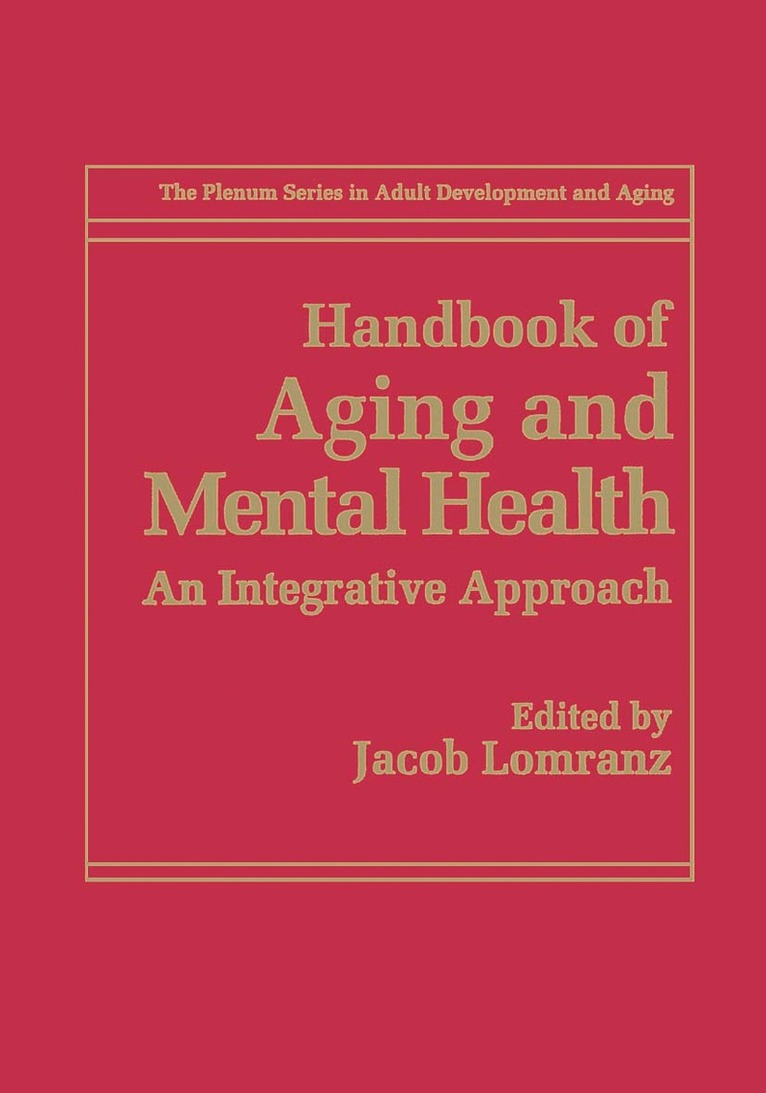
    Handbook of Aging and Mental Health

    An Integrative Approach

    AvJacob Lomranz

    Häftad, Engelska, 2013

    Del i serien Springer Series in Adult Development and Aging

    2 230 kr

    Beställningsvara. Skickas inom 10-15 vardagar. Fri frakt över 249 kr.

    Beskrivning

    De cibo quod superest nobis sufficit; oportet gratias agere. Some elders have accepted this proposition, although seldom with enthu- siasm. Gerontologists also have been burdened with the adage: "Leftovers are good enough for us, and we should be grateful for them." I remember how a clerk tried to palm off astale and cheap cigar to her octogenarian customer. He knew better and carne away with a far superior smoke. The clerk fumed, "What does he need a good cigar for? Who is he to be particular!" In this and in many other ways, elders often have labored under the sociocultural expectation that they should be well content with whatever scraps and shmattes happen to come their way. Gerontologists can identify with this situation. The systematic study of aging and the aged was a new enterprise at the midpoint of this century, but the concepts and methods were pretty much limited to those already on hand. What biological and sociobehavioral scientists had been doing for years was simply extended to the newly annexed territory. This as not only a convenient but also a cost-effective strategy.Data accumulated more rapidly by remaining within familiar frarnes of reference and relying on farniliar designs and mea- sures. The new gerontologists soon harvested a promising crop of descriptive findings. Within a decade after the establishment of the Gerontological Society of America (1947), it was possible to discern the outlines of a valuable new field of knowledge.

    Produktinformation

    • Utgivningsdatum:2013-06-16
    • Mått:178 x 254 x 30 mm
    • Vikt:1 040 g
    • Format:Häftad
    • Språk:Engelska
    • Serie:Springer Series in Adult Development and Aging
    • Antal sidor:539
    • Förlag:Springer-Verlag New York Inc.
    • ISBN:9781489901002

    Utforska kategorier

    • Psykiatri inom Medicin

    Innehållsförteckning

    • Introduction: Toward Theories in Mental Health and Aging.- I. Well-Being, Adjustment, and Growth Behaviors in Later Life.- 1. Declarative and Differential Aspects of Subjective Well-Being and Its Implications for Mental Health in Later Life.- 2. Control: Cognitive and Motivational Implications.- 3. Resilience in Adulthood and Later Life: Defining Features and Dynamic Processes.- II. Stress, Coping, and Mental Health.- 4. Toward a Developmentally Informed Theory of Mental Disorder in Older Adults.- 5. Conservation of Resources, Stress, and Aging: Why Do Some Slide and Some Spring?.- 6. War Trauma and the Aged: An Israeli Perspective.- 7. Toward a Temporal—Spatial Model of Cumulative Life Stress: Placing Late-Life Stress Effects in a Life-Course Perspective.- III. The Adult Developing Self.- 8. The Double Voice of the Third Age: Splitting the Speaking Self as an Adaptive Strategy in Later Life.- 9. Epistemology, Expectation, and Aging: A Developmental Analysis of the Gerontological Curriculum.- 10. An Image of Aging and the Concept of Aintegration: Coping and Mental Health Implications.- IV. Psychodynamics and Psychopathology in Later Life.- 11. Psychoanalysis, the Life Story, and Aging: Creating New Meanings within Narratives of Lived Experience.- 12. The Psychoimmune System in Later Life: The Problem of the Late-Onset Disorders.- 13. Uses of the Past in Adult Psychological Health: Objective, Historical, and Narrative Realities.- V. The Family in Later Life.- 14. Perspectives on the Family and Stress in Late Life.- 15. A Frame of Reference for Guiding Research Regarding the Relationship between Adult Attachment and Mental Health in Aging Families.- 16. Multigenerational Families and Mental Illness in Late Life.- 17. Cross-Cultural Perspective on Attitudes toward FamilyResponsibility and Well-Being in Later Years.- VI. Memory and Dementia.- 18. The Significance of Memory Complaints in Later Life: Methodological and Theoretical Considerations.- 19. Age-Related Cognitive Decline and the Dementia Threshold.- 20. Education and Dementia.- VII. Depression and Aging.- 21. Depression as a Pivotal Component in Secondary Aging: Opportunities for Research, Treatment, and Prevention.- 22. The Variability of Depression in Old Age: Narrative as an Integrative Construct.- 23. Aging and Behavioral Medicine: A Triaxial Model.- Epilogue: Future Perspectives.