• Fri frakt över 249 kr
  • •
  • Snabba leveranser
  • •
  • Billiga böcker
Kundservice

Du är på sajten för privatpersoner.

Företag, bibliotek eller offentlig verksamhet?

Du handlar på classic.bokus.com, där alla dina funktioner finns intakta.
Till classic.bokus.com
Bokus logotyp. Gå till startsidan.
  • Erbjudanden
  • Nyheter
  • Student
  • Topplistor
  • Barn & ungdom
  • Bokus Play
  • E-böcker
  • Pocketböcker
  • Spel & pussel

10% studentrabatt med kod TERM26

Sidfot

Mina sidor

    Hjälp

    • Kundservice
    • Vanliga frågor och svar
    • Frakt och leverans
    • Retur vid ångerrätt
    • Reklamera vara
    • Betalning
    • Köpvillkor
    • Allmänna villkor
    • Information om webbplatsens tillgänglighet

    Om Bokus

    • Om oss
    • Pressrum
    • För studenter
    • För företag
    • För bibliotek och offentlig verksamhet
    • För leverantörer
    • Hållbarhet

    Populärt

    • Aktuella erbjudanden
    • Presentkort
    • Studentlitteratur
    • Nya böcker
    • Topplistor
    • Signerade böcker
    • Engelska böcker

    Inspiration

    • Boktips
    • BookTok
    • Populära bokserier
    • Barnbokskaraktärer
    • Populära författare
    Logotyp för Bokus
    Följ oss på Facebook (extern länk)Följ oss på Instagram (extern länk)Följ oss på YouTube (extern länk)Följ oss på TikTok (extern länk)
    bokus @ CookiesAnpassa cookiesIntegritetspolicyKöpvillkor
    Till Citymail hemsida (extern länk)Till Budbee hemsida (extern länk)Till Postnord hemsida (extern länk)Till Schenker hemsida (extern länk)Till Early Bird hemsida (extern länk)Till Walleys hemsida (extern länk)
    1. Medicin
    2. Klinisk medicin och internmedicin
    3. Sjukdomar och rubbningar
    4. Onkologi

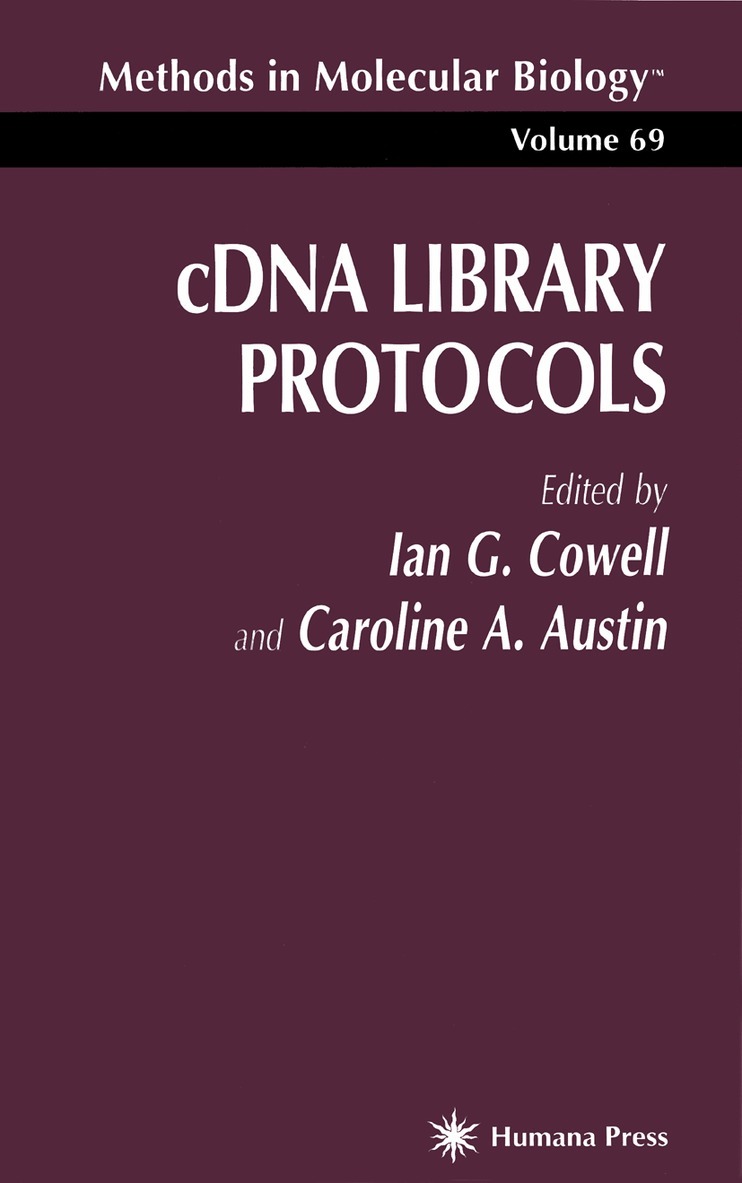
    cDNA Library Protocols

    AvIan G. Cowell,Caroline A. Austin

    Häftad, Engelska, 2013

    Del i serien Methods in Molecular Biology

    1 683 kr

    Beställningsvara. Skickas inom 10-15 vardagar. Fri frakt över 249 kr.

    Beskrivning

    The first libraries of complementary DNA (cDNA) clones were con­ structed in the mid-to-late 1970s using RNA-dependent DNA polymerase (reverse transcriptase) to convert poly A* mRNA into double-stranded cDNA suitable for insertion into prokaryotic vectors. Since then cDNA technology has become a fundamental tool for the molecular biologist and at the same time some very significant advances have occurred in the methods for con­ structing and screening cDNA libraries. It is not the aim of cDNA Library Protocols to give a comprehensive review of all cDNA library-based methodologies; instead we present a series of up-to-date protocols that together should give a good grounding of proce­ dures associated with the construction and use of cDNA libraries. In deciding what to include, we endeavored to combine up-to-date versions of some of the most widely used protocols with some very usefiil newer techniques. cDNA Library Protocols should therefore be especially useful to the investigator who is new to the use of cDNA libraries, but should also be of value to the more experienced worker. Chapters 1—5 concentrate on cDNA library construction and manipula­ tion, Chapters 6 and 7 describe means of cloning difficult-to-obtain ends of cDNAs, Chapters 8-18 give various approaches to the screening of cDNA libraries, and the remaining chapters present methods of analysis of cDNA clones including details of how to analyze cDNA sequence data and how to make use of the wealth of cDNA data emerging from the human genome project.

    Produktinformation

    • Utgivningsdatum:2013-08-18
    • Mått:152 x 229 x 18 mm
    • Vikt:486 g
    • Format:Häftad
    • Språk:Engelska
    • Serie:Methods in Molecular Biology
    • Antal sidor:321
    • Förlag:Humana Press Inc.
    • ISBN:9781489940506

    Utforska kategorier

    • Onkologi inom Medicin
    • Cellbiologi inom Naturvetenskap och teknik

    Recensioner i media

    This is a good overview of the essentials for preparing a cDNA library, for both the novice and the expert...the book is a true laboratory manual for the experimental scientist. It Should represent a useful and up-to-date addition for any lab that, for whatever reason, needs to generate its own libraries.-Hoffman-LaRoche, Inc. "...their fine layout and ease of use suggest that the lab copy won't stay on the bookshelf for long."-SGM Quarterly

    Innehållsförteckning

    • cDNA Library Construction from Small Amounts of RNA Using Paramagnetic Beads and PCR.- Increasing the Average Abundance of Low-Abundance cDNAs by Ordered Subdivision of cDNA Populations.- Isolation of Messenger RNA from Plant Tissues.- cDNA Library Construction for the Lambda ZAP®-Based Vectors.- Clone Excision Methods for the Lambda ZAP®-Based Vectors.- Using Rapid Amplification of cDNA Ends (RACE) to Obtain Full-Length cDNAs.- Inverse PCR Approach to Cloning cDNA Ends.- Cloning Gene Family Members Using the Polymerase Chain Reaction with Degenerate Oligonucleotide Primers.- Subtractive Hybridization for the Isolation of Differentially Expressed Genes Using Magnetic Beads.- Preparation of Competent Cells for High-Efficiency Plasmid Transformation of Escherichia coli.- The Tetramethylammonium Chloride (TMAC) Method for Screening cDNA Libraries with Highly Degenerate Oligonucleotide Probes Obtained by Reverse Translation of Amino Acid Sequences.- Screening cDNA Libraries by Hybridization with Double-Stranded DNA Probes and Oligonucleotides.- Immunological Screening of ?-Phage cDNA Expression Libraries.- Cloning Sequence-Specific DNA-Binding Factors from cDNA Expression Libraries Using Oligonucleotide Binding Site Probes.- Protein Interaction Cloning by Far-Western Screening of ?-Phage cDNA Expression Libraries.- Yeast Two-Hybrid Library Screening.- Signal Sequence Trap.- Isolation of Genetic Suppressor Elements (GSEs) from Random Fragment cDNA Libraries in Retroviral Vectors.- Expression and Preparation of Fusion Proteins from Recombinant ?gt1.1 Phages.- Computer Analysis of Cloned Sequences.- The TIGR Human cDNA Database.- Searching the dbEST Database.- Reference cDNA Library Facilities Available from European Sources.