• Fri frakt över 249 kr
  • •
  • Snabba leveranser
  • •
  • Billiga böcker
Kundservice

Du är på sajten för privatpersoner.

Företag, bibliotek eller offentlig verksamhet?

Du handlar på classic.bokus.com, där alla dina funktioner finns intakta.
Till classic.bokus.com
Bokus logotyp. Gå till startsidan.
  • Erbjudanden
  • Nyheter
  • Student
  • Topplistor
  • Barn & ungdom
  • Bokus Play
  • E-böcker
  • Pocketböcker
  • Spel & pussel

Må bättre, för mindre! Upp till 50% rabatt på hälsoböcker

Sidfot

Mina sidor

    Hjälp

    • Kundservice
    • Vanliga frågor och svar
    • Frakt och leverans
    • Retur vid ångerrätt
    • Reklamera vara
    • Betalning
    • Köpvillkor
    • Allmänna villkor
    • Information om webbplatsens tillgänglighet

    Om Bokus

    • Om oss
    • Pressrum
    • För studenter
    • För företag
    • För bibliotek och offentlig verksamhet
    • För leverantörer
    • Hållbarhet

    Populärt

    • Aktuella erbjudanden
    • Presentkort
    • Studentlitteratur
    • Nya böcker
    • Topplistor
    • Signerade böcker
    • Engelska böcker

    Inspiration

    • Boktips
    • BookTok
    • Populära bokserier
    • Barnbokskaraktärer
    • Populära författare
    Logotyp för Bokus
    Följ oss på Facebook (extern länk)Följ oss på Instagram (extern länk)Följ oss på YouTube (extern länk)Följ oss på TikTok (extern länk)
    bokus @ CookiesAnpassa cookiesIntegritetspolicyKöpvillkor
    Till Citymail hemsida (extern länk)Till Budbee hemsida (extern länk)Till Postnord hemsida (extern länk)Till Schenker hemsida (extern länk)Till Early Bird hemsida (extern länk)Till Walleys hemsida (extern länk)
    1. Historia och arkeologi
    2. Arkeologi

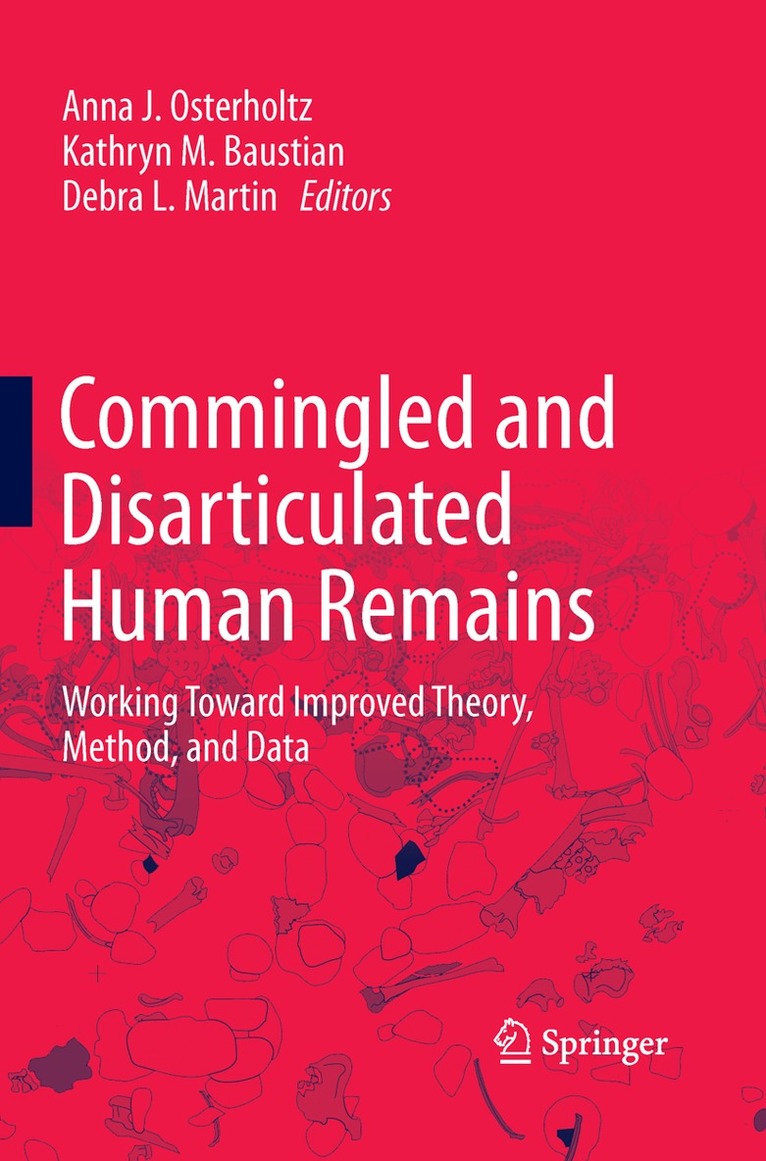
    Commingled and Disarticulated Human Remains

    Working Toward Improved Theory, Method, and Data

    AvAnna J. Osterholtz,Kathryn M. Baustian

    Häftad, Engelska, 2015

    1 119 kr

    Beställningsvara. Skickas inom 10-15 vardagar. Fri frakt över 249 kr.

    Beskrivning

    ​Commingled and Disarticulated Human Remains:Working Toward Improved Theory, Method, and Data brings together research that provides innovative methodologies for the analysis of commingled human remains. It has temporal and spatial breadth, with case studies coming from pre-state to historic periods, as well as from both the New and Old World. Highlights of this volume include: standardizes methods and presents best practices in the field using a case study approach demonstrates how data gathered from commingled human remains can be incorporated into the overall interpretation of a site explores best way to formulate population size, using commingled remains Field archaeologists, bioarchaeologists, academic anthropologists, forensic anthropologists, zoo archaeologists, and students of anthropology and archaeology will find this to be an invaluable resource.

    Produktinformation

    • Utgivningsdatum:2015-08-26
    • Mått:155 x 235 x 17 mm
    • Vikt:464 g
    • Format:Häftad
    • Språk:Engelska
    • Antal sidor:285
    • Förlag:Springer-Verlag New York Inc.
    • ISBN:9781489988188

    Utforska kategorier

    • Arkeologi inom Historia och arkeologi
    • Antropologi inom Samhälle och politik

    Mer om författaren

    Anna Osterholtz is a PhD Candidate in the Department of Anthropology at the University of Nevada, Las Vegas.  Her bioarchaeological research interests include the health consequences of trade, migration and interaction and the social role of violence.  She has worked extensively with commingled and fragmentary collections from around the world. Kathryn Baustian is a PhD Candidate in the Department of Anthropology at the University of Nevada, Las Vegas. Her research interests include bioarchaeological investigations focused on ancient social organization and the biological effects of culture change. She is also interested in forensic anthropology and the interpretation of violence in ancient and modern settings.Debra L. Martin is Lincy Professor of Anthropology in the Department of Anthropology at the University of Nevada, Las Vegas.  Her interests include bioarchaeological approaches to understanding social processes that produce and reproduce poor health and violence within culturally defined and marginalized subgroups.

    Recensioner i media

    "Overall, this volume is a major contribution in this area.....It will be an added resource to all those who work with human and animal remains in both archaeological and forensic contexts" (Bernadette M. Manifold, PaleoAnthropology, 2014)"I recommend the volume by Osterholtz and coworkers to practitioners in bioarchaeology and forensic anthropology.....the volume has much to offer in terms of ideas for dealing with commingling, and I am happy to recommend this book for all bioarchaeologists and forensic anthropologists" (John E. Byrd, American Journal of Physical Anthropology, Vol. 155, 2014)

    Innehållsförteckning

    • Chapter 1- IntroductionChapter 2- Making Sense of Social Behavior from Disturbed and Commingled Skeletons: A Case Study from Çatalhöyük, TurkeyChapter 3- Commingled Human Skeletal Assemblages: Integrative Techniques in Determination of the MNI/MNEChapter 4- Bioarchaeological Spatial Analysis of the Walker-Noe Crematory (15GD56)Chapter 5- Into the Kettle:  The Analysis of Commingled Remains from Southern OntarioChapter 6- Crow Creek Bone Bed Commingling: The Relationship between Bone Mineral Density and Minimum Number of Individuals and Its Effect on Paleodemographic AnalysesChapter 7- Extreme Processing at Mancos and Sacred Ridge: The Value of Comparative Studies Chapter 8- Disarticulated and Disturbed, Processed and Eaten?  Cautionary Notes from the La Plata Assemblage   (AD 1000-1150)Chapter 9- Partible, Permeable, and Relational Bodies in a Maya Mass GraveChapter 10- Unmingling Commingled Museum Collections: A Photographic MethodChapter 11- Primary and secondary burials with commingled remains from archaeological contexts in Cyprus, Greece, and TurkeyChapter 12- Commingled Bone Assemblages: Insights from Zooarchaeology and Taphonomy of a Bonebed at Karain B Cave, SW TurkeyChapter 13- Normal Goat or Diseased Human? Disciplinary Boundaries and Methodological Traps in the Analysis of Fragmentary Remains at Franchthi Cave, GreeceChapter 14-Taking Analyses of Commingled Remains into the Future:  Challenges and Prospects