• Fri frakt över 249 kr
  • •
  • Snabba leveranser
  • •
  • Billiga böcker
Kundservice

Du är på sajten för privatpersoner.

Företag, bibliotek eller offentlig verksamhet?

Du handlar på classic.bokus.com, där alla dina funktioner finns intakta.
Till classic.bokus.com
Bokus logotyp. Gå till startsidan.
  • Erbjudanden
  • Nyheter
  • Student
  • Topplistor
  • Barn & ungdom
  • Bokus Play
  • E-böcker
  • Pocketböcker
  • Spel & pussel

10% rabatt på allt med kod: NYSTART10 →

Sidfot

Mina sidor

    Hjälp

    • Kundservice
    • Vanliga frågor och svar
    • Frakt och leverans
    • Retur vid ångerrätt
    • Reklamera vara
    • Betalning
    • Köpvillkor
    • Allmänna villkor
    • Information om webbplatsens tillgänglighet

    Om Bokus

    • Om oss
    • Pressrum
    • För studenter
    • För företag
    • För bibliotek och offentlig verksamhet
    • För leverantörer
    • Hållbarhet

    Populärt

    • Aktuella erbjudanden
    • Presentkort
    • Studentlitteratur
    • Nya böcker
    • Topplistor
    • Signerade böcker
    • Engelska böcker

    Inspiration

    • Boktips
    • BookTok
    • Populära bokserier
    • Barnbokskaraktärer
    • Populära författare
    Logotyp för Bokus
    Följ oss på Facebook (extern länk)Följ oss på Instagram (extern länk)Följ oss på YouTube (extern länk)Följ oss på TikTok (extern länk)
    bokus @ CookiesAnpassa cookiesIntegritetspolicyKöpvillkor
    Till Citymail hemsida (extern länk)Till Budbee hemsida (extern länk)Till Postnord hemsida (extern länk)Till Schenker hemsida (extern länk)Till Early Bird hemsida (extern länk)Till Walleys hemsida (extern länk)
    1. Ekonomi och Ledarskap
    2. Nationalekonomi
    3. Mikroekonomi

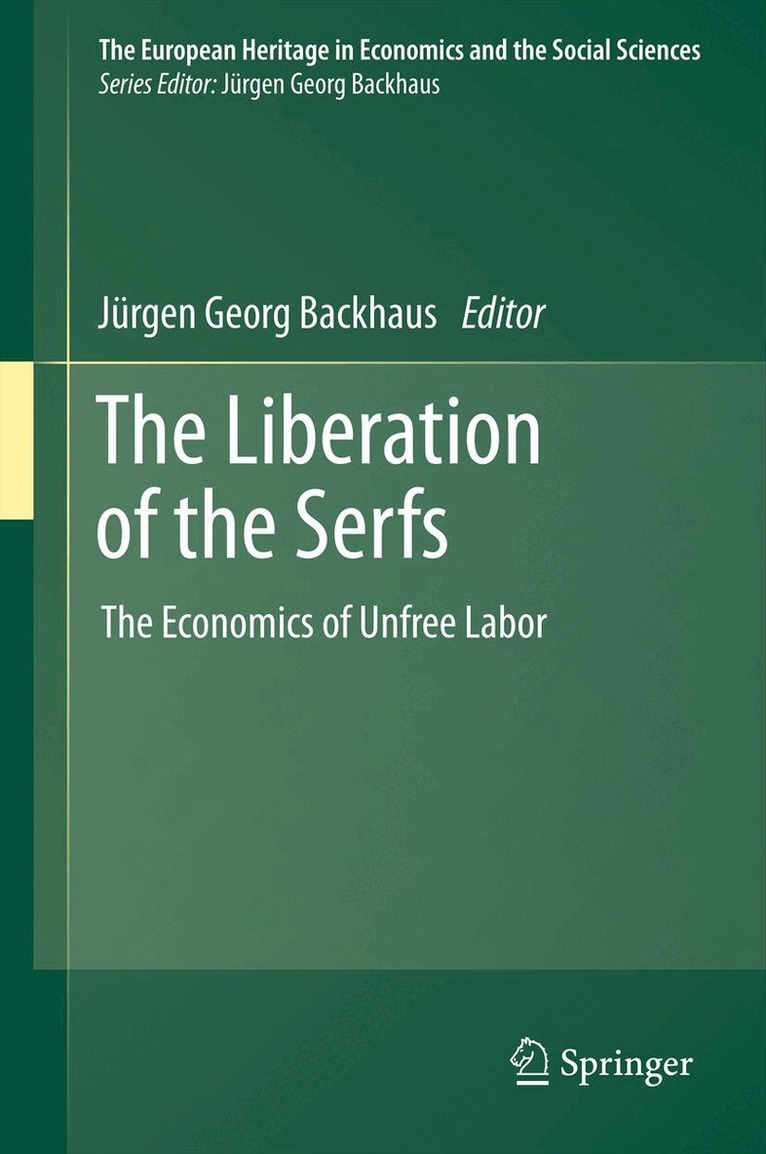
    Liberation of the Serfs

    The Economics of Unfree Labor

    AvJürgen Backhaus

    Häftad, Engelska, 2014

    Del 14 i serien European Heritage in Economics and the Social Sciences

    1 119 kr

    Beställningsvara. Skickas inom 10-15 vardagar. Fri frakt över 249 kr.

    Beskrivning

    In Europe, the liberation of the serfs was a project initiated in 1806 with a scheduled completion date of 1810. It was obvious to those who planned the project that the liberation of the serfs involved a complete overhaul of agriculture as it was then known as Europe moved from feudalism to capitalism. For this reason, Prussia was careful in implementing the reform, and did not rush, after seeing the Kingdom of Westphalia perishing under its crushing debt accumulated in part from Napoleon’s failed Russian campaign. The basic hypothesis of this book is that slave labor can never be efficient and will therefore disappear by itself. However, this process of disappearance can take many years. For instance, two generations after the importation of slaves to North America had ended, the states still fought over the issue, and this despite the fact that Ely Whitney had invented the Cotton Gin in 1793 and already then made slavery in cotton production literally superfluous.  While there have been several books on the economics of American slavery, few studies have examined this issue in an international context.  The contributions in this book address the economics of unfree labor in places like Prussia, Westphalia, Austria, Argentina and the British Empire.  The issue of slavery is still a hotly debated and widely studied issue, making this book of interest to academics in history, economics and African Studies alike.

    Produktinformation

    • Utgivningsdatum:2014-07-17
    • Mått:155 x 235 x 6 mm
    • Vikt:143 g
    • Format:Häftad
    • Språk:Engelska
    • Serie:European Heritage in Economics and the Social Sciences
    • Antal sidor:76
    • Upplaga:2012
    • Förlag:Springer-Verlag New York Inc.
    • ISBN:9781489992697

    Utforska kategorier

    • Mikroekonomi inom Ekonomi och Ledarskap
    • Slaveri inom Historia och arkeologi

    Innehållsförteckning

    • 1.Introduction Jürgen G. Backhaus.- 2.Sold SoldiersJürgen G. Backhaus.- 3.The Brandenburg TriangleGerhard Scheuerer.- 4.Some Short Thoughts on “The Economics of Slavery”Thomas Straubhaar.- 5.Emancipation of the peasantry in Lower AustriaGünther Chaloupek.- 6.Liberation of the Serfs – The End of Forced Labour?Hans A. Frambach.- 7.More Than Just a Production Factor: The View of Labour in the Works of the Norwegian Economist Torkel Aschehoug (1822—1909) Mathilde Fasting and Sylvi Endresen.- 8.Forced Labor under the Gulag Regime (1918-1990)Nicholas W. Balabkins.