• Fri frakt över 249 kr
  • •
  • Snabba leveranser
  • •
  • Billiga böcker
Kundservice

Du är på sajten för privatpersoner.

Företag, bibliotek eller offentlig verksamhet?

Du handlar på classic.bokus.com, där alla dina funktioner finns intakta.
Till classic.bokus.com
Bokus logotyp. Gå till startsidan.
  • Erbjudanden
  • Nyheter
  • Student
  • Topplistor
  • Barn & ungdom
  • Bokus Play
  • E-böcker
  • Pocketböcker
  • Spel & pussel

10% studentrabatt med kod TERM26

Sidfot

Mina sidor

    Hjälp

    • Kundservice
    • Vanliga frågor och svar
    • Frakt och leverans
    • Retur vid ångerrätt
    • Reklamera vara
    • Betalning
    • Köpvillkor
    • Allmänna villkor
    • Information om webbplatsens tillgänglighet

    Om Bokus

    • Om oss
    • Pressrum
    • För studenter
    • För företag
    • För bibliotek och offentlig verksamhet
    • För leverantörer
    • Hållbarhet

    Populärt

    • Aktuella erbjudanden
    • Presentkort
    • Studentlitteratur
    • Nya böcker
    • Topplistor
    • Signerade böcker
    • Engelska böcker

    Inspiration

    • Boktips
    • BookTok
    • Populära bokserier
    • Barnbokskaraktärer
    • Populära författare
    Logotyp för Bokus
    Följ oss på Facebook (extern länk)Följ oss på Instagram (extern länk)Följ oss på YouTube (extern länk)Följ oss på TikTok (extern länk)
    bokus @ CookiesAnpassa cookiesIntegritetspolicyKöpvillkor
    Till Citymail hemsida (extern länk)Till Budbee hemsida (extern länk)Till Postnord hemsida (extern länk)Till Schenker hemsida (extern länk)Till Early Bird hemsida (extern länk)Till Walleys hemsida (extern länk)
    1. Psykologi och pedagogik
    2. Pedagogik
    3. Pedagogisk psykologi

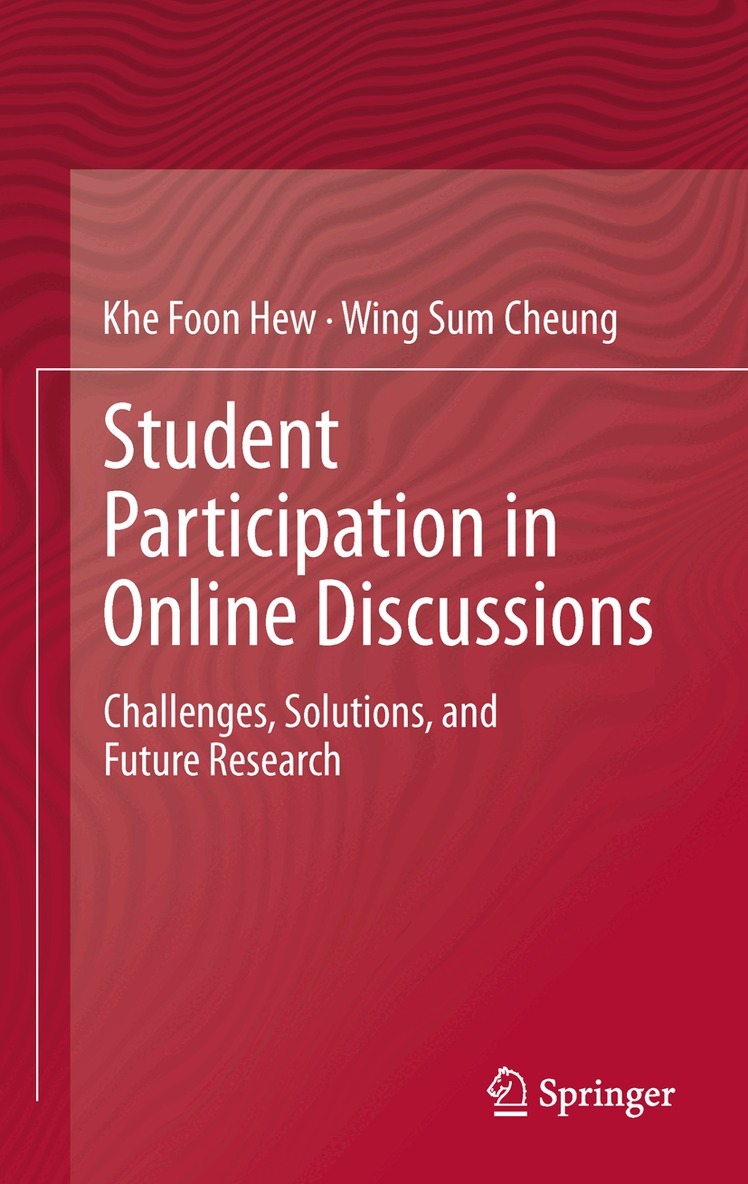
    Student Participation in Online Discussions

    Challenges, Solutions, and Future Research

    AvKhe Foon Hew,Wing Sum Cheung

    Häftad, Engelska, 2014

    1 061 kr

    Beställningsvara. Skickas inom 10-15 vardagar. Fri frakt över 249 kr.

    Fler format och utgåvor

    Inbunden

    1 061 kr

    Beskrivning

    The increasingly prevalent use of online- or blended-learning in schools universities has resulted in asynchronous online discussion forum becoming an increasingly common means to facilitate dialogue between instructors and students, as well as students and students beyond the boundaries of their physical classrooms.   This proposed academic book contributes to the literature on asynchronous online discussions in the following three main ways: First, it reviews previous research studies in order to identify the factors leading to limited student contribution. Limited student contribution is defined as students making few or no postings, students exhibiting surface-level thinking or students demonstrating low-level knowledge construction in online discussions. It then identifies the various empirically-based guidelines to address the factors.  Second, three potential guideline dilemmas that educators may encounter: (a) use of grades, (b) use of number of posting guideline, and (c) instructor-facilitation are introduced. These are guidelines where previous empirical research shows mixed results when they are implemented. Acknowledging the dilemmas is essential for educators and researchers to make informed decisions about the discussion guidelines they are considering implementing.  Third, nine exploratory case studies related to student-facilitation and audio-based discussion are reported on and examined. Using students as facilitators may be an alternative solution to educators who wish to avoid the instructor-facilitation guideline dilemma. Using audio discussion would be useful for participants with poor typing skills or those who prefer talking to typing.  The proposed book is distinctive in comparison to current competitor titles because all the findings and guidelines are empirically-based. Furthermore, the nine expanded case studies provided specifically address the issue of student/peer facilitation and audio-based discussion. Student/peerfacilitation and audio discussion are two areas that hitherto received comparatively lesser attention compared to instructor facilitation and text-based discussion. ​

    Produktinformation

    • Utgivningsdatum:2014-07-17
    • Mått:155 x 235 x 9 mm
    • Vikt:248 g
    • Format:Häftad
    • Språk:Engelska
    • Antal sidor:142
    • Upplaga:2012
    • Förlag:Springer-Verlag New York Inc.
    • ISBN:9781489994141

    Utforska kategorier

    • Pedagogisk psykologi inom Psykologi och pedagogik
    • Människa – datorinteraktion inom Data och IT
    • Material och digital teknik i undervisningen inom Psykologi och pedagogik

    Mer om författaren

    Dr. Cheung Wing Sum is an Associate Professor in the Learning Sciences and Technologies Academic Group at teh Nanyang Technological University, Singapore. . He is also the MAIDT Program Coordinator of LST. He was educated at Northern Illinois University where he rreceived undergraaduate degrees in  Management and Computer Science, an MS in Computer Science and an EdD in Curriculum & Supervision. His research areas of interest include: Asynchronous Online Discussion, E-Learning, Instructional Design, and Multimedia Design.Dr Khe Foon Hew earned his doctorate in Instructional Systems Technology from Indiana University, Bloomington. He is currently with the Learning Sciences and Technologies academic group at the National Institute of Education, Nanyang Technological University, Singapore. Dr. Hew's areas of research interest include: Online facilitation strategies; Student interaction & cognition in computer-supported environments; Online communities of practice; and  Integrating Technologies in teaching and learning contexts.

    Innehållsförteckning

    • .-1 Introduction to asynchronous online discussion.-2 Literature Review.-3 Challenges: Students making few or no postings, Students exhibiting surface-level critical thinking, Students showing low-level knowledge construction.-4 Potential Solutions: Use of Grades, Use of number of posting guideline, Instructor facilitation, Student/Peer facilitation.-5 Case Studies on student facilitation: What motivates students to participate? -6 Case Studies on student facilitation: How to sustain participants' online discussions? -7 case Studies on student facilitation: How to foster high levels of knowledge construction?-8 Exploring audio based online discussion.-9 Conclusions.      ​