• Fri frakt över 249 kr
  • •
  • Snabba leveranser
  • •
  • Billiga böcker
Kundservice

Du är på sajten för privatpersoner.

Företag, bibliotek eller offentlig verksamhet?

Du handlar på classic.bokus.com, där alla dina funktioner finns intakta.
Till classic.bokus.com
Bokus logotyp. Gå till startsidan.
  • Erbjudanden
  • Nyheter
  • Student
  • Topplistor
  • Barn & ungdom
  • Bokus Play
  • E-böcker
  • Pocketböcker
  • Spel & pussel

Må bättre, för mindre! Upp till 50% rabatt på hälsoböcker

Sidfot

Mina sidor

    Hjälp

    • Kundservice
    • Vanliga frågor och svar
    • Frakt och leverans
    • Retur vid ångerrätt
    • Reklamera vara
    • Betalning
    • Köpvillkor
    • Allmänna villkor
    • Information om webbplatsens tillgänglighet

    Om Bokus

    • Om oss
    • Pressrum
    • För studenter
    • För företag
    • För bibliotek och offentlig verksamhet
    • För leverantörer
    • Hållbarhet

    Populärt

    • Aktuella erbjudanden
    • Presentkort
    • Studentlitteratur
    • Nya böcker
    • Topplistor
    • Signerade böcker
    • Engelska böcker

    Inspiration

    • Boktips
    • BookTok
    • Populära bokserier
    • Barnbokskaraktärer
    • Populära författare
    Logotyp för Bokus
    Följ oss på Facebook (extern länk)Följ oss på Instagram (extern länk)Följ oss på YouTube (extern länk)Följ oss på TikTok (extern länk)
    bokus @ CookiesAnpassa cookiesIntegritetspolicyKöpvillkor
    Till Citymail hemsida (extern länk)Till Budbee hemsida (extern länk)Till Postnord hemsida (extern länk)Till Schenker hemsida (extern länk)Till Early Bird hemsida (extern länk)Till Walleys hemsida (extern länk)
    1. Naturvetenskap och teknik
    2. Geovetenskap
    3. Miljövetenskap och miljöpolitik

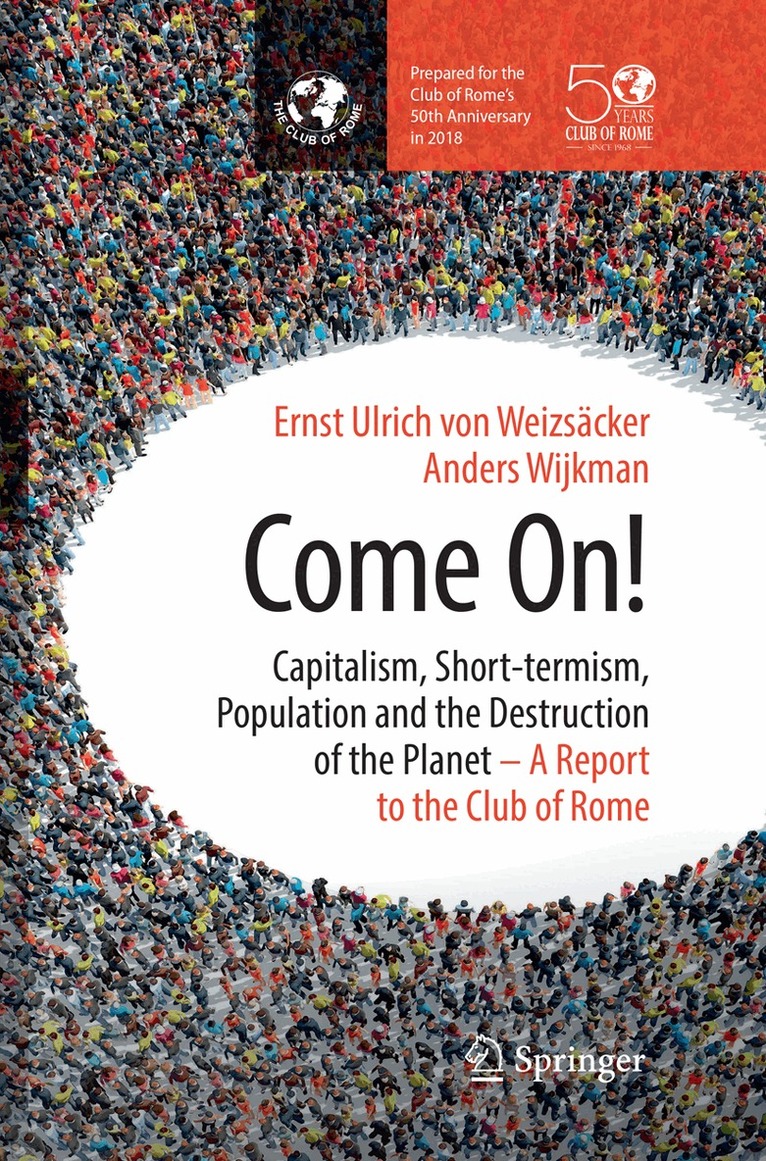
    Come On!

    Capitalism, Short-termism, Population and the Destruction of the Planet

    AvErnst Ulrich von Weizsäcker,Anders Wijkman

    Häftad, Engelska, 2018

    304 kr

    Beställningsvara. Skickas inom 10-15 vardagar. Fri frakt över 249 kr.

    Fler format och utgåvor

    Inbunden

    353 kr

    Beskrivning

    Current worldwide trends are not sustainable. The Club of Rome’s warnings published in the book Limits to Growth are still valid. Remedies that are acceptable for the great majority tend to make things worse. We seem to be in a philosophical crisis.  Pope Francis says it clearly: our common home is in deadly danger. Analyzing the philosophical crisis, the book comes to the conclusion that the world may need a “new enlightenment”; one that is not based solely on doctrine, but instead addresses a balance between humans and nature, as well as a balance between markets and the state, and the short versus long term. To do this we need to leave behind working in ”silos” in favor of a more systemic approach that will require us to rethink the organization of science and education.However, we have to act now; the world cannot wait until 7.6 billion people have struggled to reach a new enlightenment. This book is full of optimistic case studies and policy proposals that will lead us back to a trajectory of sustainability. But it is also necessary to address the taboo topic of population increase. Countries with a stable population fare immensely better than those with continued increase.  Finally, we are presenting an optimistic book from the Club of Rome.

    Produktinformation

    • Utgivningsdatum:2018-06-23
    • Mått:155 x 235 x 20 mm
    • Vikt:372 g
    • Format:Häftad
    • Språk:Engelska
    • Antal sidor:220
    • Förlag:Springer-Verlag New York Inc.
    • ISBN:9781493984800

    Utforska kategorier

    • Miljövetenskap och miljöpolitik inom Naturvetenskap och teknik
    • Geografi inom Naturvetenskap och teknik

    Mer om författaren

    Ernst von Weizsäcker,  Emmendingen, Germany Anders Wijkman,  Stockholm, Sweden

    Recensioner i media

    “The new book is essential reading for all of us. … The book offers many positive, practical examples, success stories and opportunities. Many areas of action concern policies at EU level and are of direct relevance to the current policy debate, for example, a move towards a circular economy can help overcome mineral scarcity, significantly lower carbon emissions and increase the number of jobs or regenerative agriculture can stop soil erosion, enhance yields and build carbon in the soil.” (Rod Janssen, energyindemand.com, April, 2018)

    Innehållsförteckning

    • Preface.- Acknowledgments.- Executive Summary.- Part One - C’mon! Don’t tell me the current trends are sustainable! .- 1.1 Introduction: The World in Disarray.- 1.2 Limits to Growth - how relevant was its message?- 1.3 Planetary Boundaries.- 1.4 The Anthropocene .- 1.5 The Climate Challenge.- 1.6 Other disasters ahead.- 1.7 Unsustainable population growth – and urbanization.- 1.8 Unsustainable agriculture and food system.- 1.9 Trade versus environment.- 1.10 The 2030 Agenda – the devil is in implementation.- 1.11 Do we like disruptions? The case of the digital revolution.- 1.12 From Empty World to Full World .- Part Two - C’mon! Don’t stick to outdated philosophies!.- 2.1 Laudato Sí: The Pope raises His voice.- 2.2 Change the Story, Change the Future.- 2.3 1991: „The First Global Revolution“ .- 2.4 Capitalism got arrogant .- 2.5 The failure of the market doctrine .- 2.6 Philosophical errors of the market doctrine.- 2.7 Reductionist philosophy is shallow and inadequate.- 2.8 Gaps between Theory, Education and Social Reality.- 2.9 Tolerance and long-term perspectives.- 2.10 We may need a New Enlightenment.- Part Three Come On! Join us on an exciting journey towards a sustainable world! .- 3.1 A regenerative economy.- 3.2 Development Alternatives.- 3.3 The Blue Economy.- 3.4 Decentralized energy.- 3.5 Some agricultural success stories.- 3.6 Regenerative urbanization: Ecopolis.- 3.7 Climate: Some good news, but bigger challenges.- 3.8 Circular economy requires a new economic logic.- 3.9 Five-fold resource productivity.- 3.10 Healthy disruption.- 3.11 Reform of the financial sector.- 3.12 Reform of the economic set-up.- 3.13 Benign investment.- 3.14 Measuring well-being rather than GDP.- 3.15 Civil Society, Social Capital and Collective Leadership.- 3.16 Global Governance.- 3.17 National level action: China and Bhutan.- 3.18 Education for a sustainable civilization.- Conclusion: We invite readers to ‘come on’.- Index.- Blurbs.