• Fri frakt över 249 kr
  • •
  • Snabba leveranser
  • •
  • Billiga böcker
Kundservice

Du är på sajten för privatpersoner.

Företag, bibliotek eller offentlig verksamhet?

Du handlar på classic.bokus.com, där alla dina funktioner finns intakta.
Till classic.bokus.com
Bokus logotyp. Gå till startsidan.
  • Erbjudanden
  • Nyheter
  • Student
  • Topplistor
  • Barn & ungdom
  • Bokus Play
  • E-böcker
  • Pocketböcker
  • Spel & pussel

10% rabatt på allt med kod: NYSTART10 →

Sidfot

Mina sidor

    Hjälp

    • Kundservice
    • Vanliga frågor och svar
    • Frakt och leverans
    • Retur vid ångerrätt
    • Reklamera vara
    • Betalning
    • Köpvillkor
    • Allmänna villkor
    • Information om webbplatsens tillgänglighet

    Om Bokus

    • Om oss
    • Pressrum
    • För studenter
    • För företag
    • För bibliotek och offentlig verksamhet
    • För leverantörer
    • Hållbarhet

    Populärt

    • Aktuella erbjudanden
    • Presentkort
    • Studentlitteratur
    • Nya böcker
    • Topplistor
    • Signerade böcker
    • Engelska böcker

    Inspiration

    • Boktips
    • BookTok
    • Populära bokserier
    • Barnbokskaraktärer
    • Populära författare
    Logotyp för Bokus
    Följ oss på Facebook (extern länk)Följ oss på Instagram (extern länk)Följ oss på YouTube (extern länk)Följ oss på TikTok (extern länk)
    bokus @ CookiesAnpassa cookiesIntegritetspolicyKöpvillkor
    Till Citymail hemsida (extern länk)Till Budbee hemsida (extern länk)Till Postnord hemsida (extern länk)Till Schenker hemsida (extern länk)Till Early Bird hemsida (extern länk)Till Walleys hemsida (extern länk)
    1. Djur och Natur
    2. Naturböcker
    3. Nationalparker och naturreservat

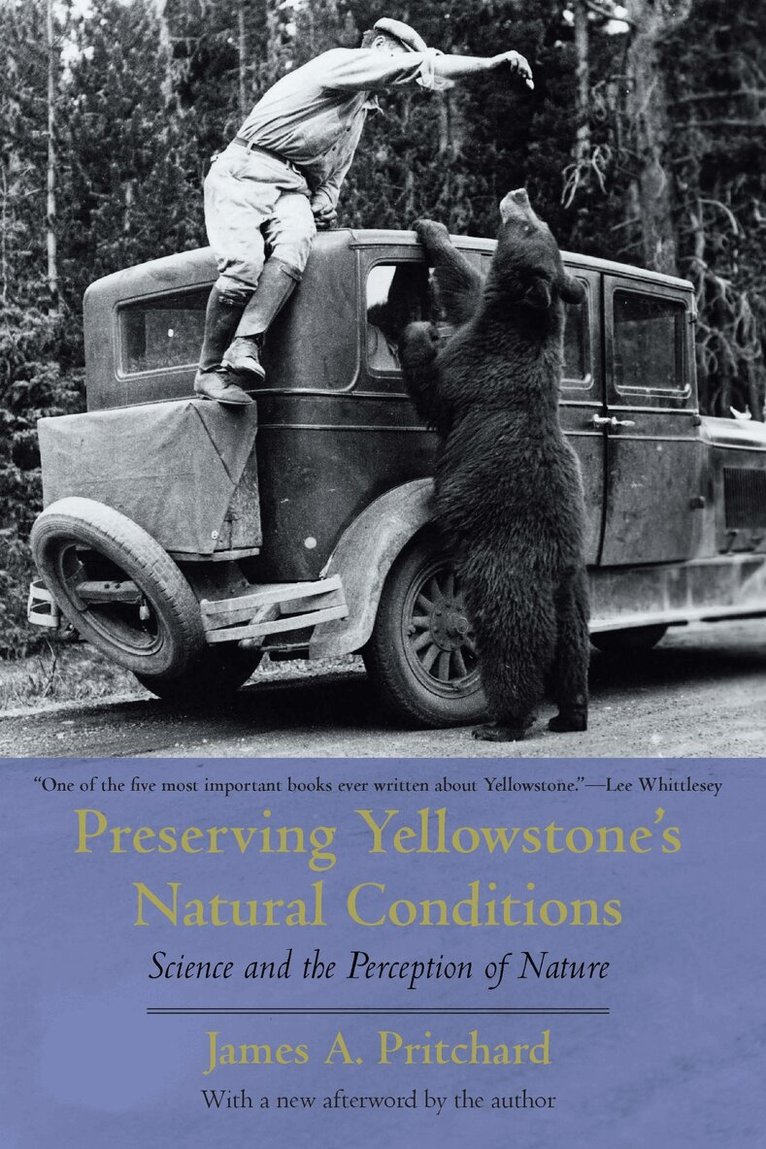
    Preserving Yellowstone's Natural Conditions

    Science and the Perception of Nature

    AvJames A. Pritchard

    Häftad, Engelska, 2022

    215 kr

    Skickas . Fri frakt över 249 kr.

    Beskrivning

    Preserving Yellowstone’s Natural Conditions describes in fascinating detail the historical origins and development of wildlife management in Yellowstone National Park, alongside shifting understandings of nature in science and culture. James A. Pritchard traces the idea of “natural conditions” through time, from the introduction of this concept by early ecologists in the 1930s. He tells several overlooked stories of Yellowstone wildlife, including a sensational scientific hunt for bears with bow and arrow, and the episode of the predator pelicans, which facilitated a fundamental shift toward protection of all wildlife in Yellowstone, and for the National Park Service as a whole. A prolonged debate regarding the elk herd on Yellowstone’s northern range is addressed, along with the origins of the notion of natural regulation, and the reasons for ending direct reductions of elk. This story emphasizes how ecological science came to Yellowstone and to the National Park Service, subsequently developing over a period of decades.In the new afterword to this book Pritchard summarizes recent developments in wildlife science and management-such as the “ecology of fear” and trophic cascades-and discusses historical continuities in the role of the park as a wildlife refuge and the inestimable values of the park for wildlife conservation.

    Produktinformation

    • Utgivningsdatum:2022-10-01
    • Mått:152 x 229 x 28 mm
    • Vikt:670 g
    • Format:Häftad
    • Språk:Engelska
    • Antal sidor:434
    • Upplaga:2
    • Förlag:University of Nebraska Press
    • ISBN:9781496233059

    Utforska kategorier

    • Nationalparker och naturreservat inom Djur och Natur

    Mer om författaren

    James A. Pritchard is an affiliate faculty member in the Department of Ecology at Montana State University and an adjunct associate professor emeritus at Iowa State University. He is the coauthor of A Field Guide to the Butterflies of the Greater Yellowstone Ecosystem and A Green and Permanent Land: Ecology and Agriculture in the Twentieth Century.

    Recensioner i media

    “This is one of the five most important books ever written about Yellowstone, and perhaps the most important one about ecological management of the park.”-Lee Whittlesey, retired historian for Yellowstone National Park “James Pritchard’s book is a milestone in Yellowstone historical research. It is also essential reading for anyone who wants to understand how we got the magnificent park that we enjoy, celebrate, and constantly argue over today. For the sake of Yellowstone and your own clear thinking, don’t deny yourself this vital and challenging perspective.”-Paul Schullery, author of Searching for Yellowstone and Past and Future Yellowstones “A model of thoughtful, responsible storytelling; attentive to nuance, careful in its claims, judicious in its judgments. It’s a refreshing antidote to the tsunami of poorly informed, ideologically driven analyses all too common today.”-Paul Hirt, professor emeritus, School of Historical, Philosophical, and Religious Studies, Arizona State University “This is a complicated story, dispassionately told and meticulously documented.”-Choice “A must-read for anyone interested in Yellowstone. It articulates the history, traces the evolution, and, by extension, anticipates the future of resource management in the park. It perfectly captures the messy world of science, policy, and public expectations that Yellowstone shoulders.”-Tom Olliff, ecologist for the National Park Service and former chief of resources at Yellowstone National Park “Having stood the test of time, Pritchard has updated his groundbreaking chronicle of nature preservation policy in Yellowstone with an insightful epilogue that brings the book forward into the new era of climate change, hyper-visitation, digital technology, state-managed wolves, migration corridors, and landscape-scale conservation.”-Robert B. Keiter, author of To Conserve Unimpaired: The Evolution of the National Park Idea “Yellowstone, the first national park in world history, is synonymous with charismatic wild animals and wild landscapes. Here is where, over the past century and a half, people have developed cultural attitudes toward wildness and tried to mitigate the damage that our species has done to the natural order. And the best guide to that learning is historian James Pritchard. No one has matched his richly detailed, comprehensive understanding of the meaning of Yellowstone and of the ways Americans have tried to protect it. This updated edition adds valuable new material on the changes of the past two decades. Highly recommended for historians, ecologists, park employees, and general readers.”-Donald Worster, author of A Passion for Nature: The Life of John Muir “Perhaps the single most important book describing how the National Park Service developed its policy on preservation and what are ‘natural’ conditions. With so much to read I rarely read anything twice, but this one I did and I am considering a third.”-Douglas W. Smith, senior wildlife biologist for Yellowstone National Park “As Yellowstone National Park celebrates its 150th birthday and park wildlife faces increasing pressure on all fronts, the reissue of James Pritchard’s engaging history, with a new, comprehensive afterword, could not be more timely. As Pritchard demonstrates so well, we ‘cannot understand the management of our parks or hope for enlightened park management if we fail to see our parks in a historical context.’”-Diane Smith, author of Yellowstone and the Smithsonian: Centers of Wildlife Conservation“The historical tension between active management and natural regulation was brilliantly laid out in the 1999 edition. Here, Pritchard fast-forwards to the present day and asks us to consider wicked new challenges-delisting, climate change, skyrocketing visitation-facing America’s first national park.”-Cathy Whitlock, Regents Professor Emerita, Montana State University

    Innehållsförteckning

    • List of IllustrationsAcknowledgmentsIntroduction1. A Preservationist Yellowstone, 1872–19152. Conservationist Thought and Yellowstone, 1916–19303. The Wildlife Division and the Ecology of Intervention4. Managing the Natural During the Postwar Era5. A Natural Yellowstone, 1963–19746. A Greater Yellowstone, 1975–1995EpilogueAfterwordNotesSourcesIndex