• Fri frakt över 249 kr
  • •
  • Snabba leveranser
  • •
  • Billiga böcker
Kundservice

Du är på sajten för privatpersoner.

Företag, bibliotek eller offentlig verksamhet?

Du handlar på classic.bokus.com, där alla dina funktioner finns intakta.
Till classic.bokus.com
Bokus logotyp. Gå till startsidan.
  • Erbjudanden
  • Nyheter
  • Student
  • Topplistor
  • Barn & ungdom
  • Bokus Play
  • E-böcker
  • Pocketböcker
  • Spel & pussel

10% rabatt på allt med kod: NYSTART10 →

Sidfot

Mina sidor

    Hjälp

    • Kundservice
    • Vanliga frågor och svar
    • Frakt och leverans
    • Retur vid ångerrätt
    • Reklamera vara
    • Betalning
    • Köpvillkor
    • Allmänna villkor
    • Information om webbplatsens tillgänglighet

    Om Bokus

    • Om oss
    • Pressrum
    • För studenter
    • För företag
    • För bibliotek och offentlig verksamhet
    • För leverantörer
    • Hållbarhet

    Populärt

    • Aktuella erbjudanden
    • Presentkort
    • Studentlitteratur
    • Nya böcker
    • Topplistor
    • Signerade böcker
    • Engelska böcker

    Inspiration

    • Boktips
    • BookTok
    • Populära bokserier
    • Barnbokskaraktärer
    • Populära författare
    Logotyp för Bokus
    Följ oss på Facebook (extern länk)Följ oss på Instagram (extern länk)Följ oss på YouTube (extern länk)Följ oss på TikTok (extern länk)
    bokus @ CookiesAnpassa cookiesIntegritetspolicyKöpvillkor
    Till Citymail hemsida (extern länk)Till Budbee hemsida (extern länk)Till Postnord hemsida (extern länk)Till Schenker hemsida (extern länk)Till Early Bird hemsida (extern länk)Till Walleys hemsida (extern länk)
    1. Kultur
    2. Scenkonst och film
    3. Film

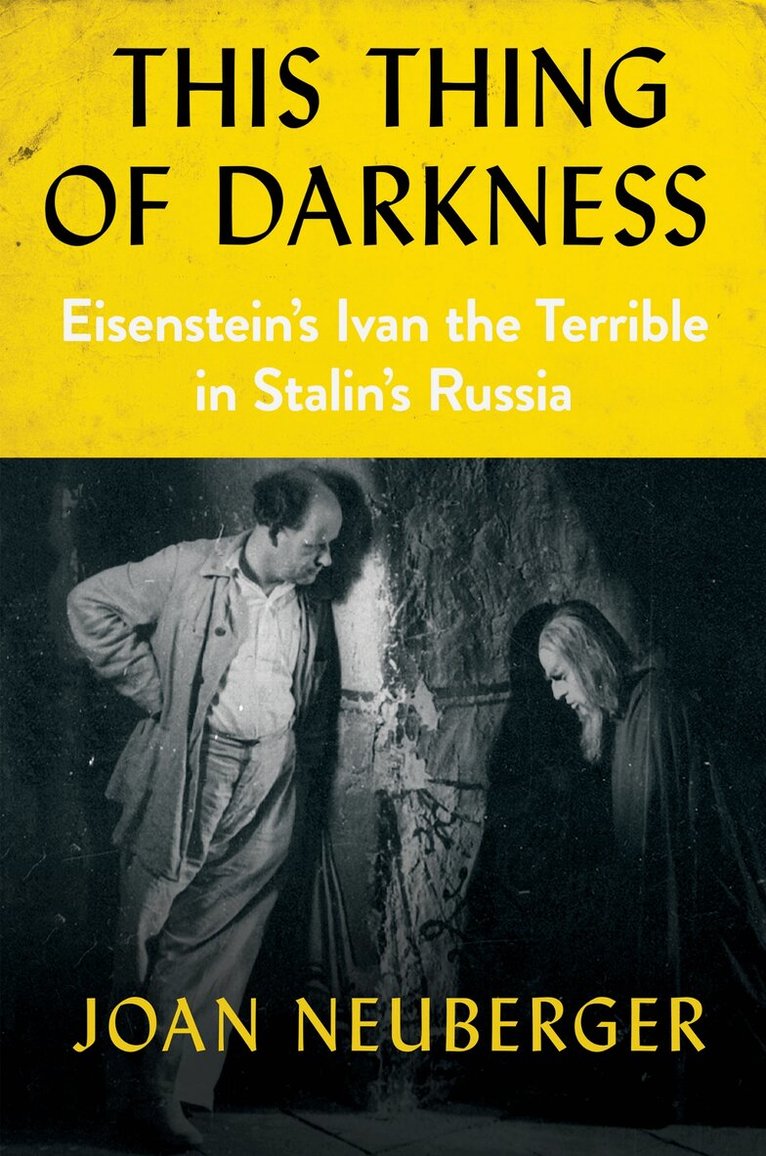
    This Thing of Darkness

    Eisenstein's Ivan the Terrible in Stalin's Russia

    AvJoan Neuberger

    Inbunden, Engelska, 2019

    1 692 kr

    Beställningsvara. Skickas inom 5-8 vardagar. Fri frakt över 249 kr.

    Fler format och utgåvor

    Häftad

    405 kr

    Beskrivning

    Sergei Eisenstein's unfinished masterpiece, Ivan the Terrible, was no ordinary movie. Commissioned by Joseph Stalin in 1941 to justify state terror in the sixteenth century and in the twentieth, the film's politics, style, and epic scope aroused controversy even before it was released. In This Thing of Darkness, Joan Neuberger offers a sweeping account of the conception, making, and reception of Ivan the Terrible that weaves together Eisenstein's expansive thinking and experimental practice with a groundbreaking new view of artistic production under Stalin. Drawing on Eisenstein's unpublished production notebooks, diaries, and manuscripts, Neuberger's riveting narrative chronicles Eisenstein's personal, creative, and political challenges and reveals the ways cinematic invention, artistic theory, political critique, and historical and psychological analysis went hand in hand in this famously complex film.Neuberger's bold arguments and daring insights into every aspect of Eisenstein's work during this period, together with her ability to lucidly connect his wide-ranging late theory with his work on Ivan, show the director exploiting the institutions of Soviet artistic production not only to expose the cruelties of Stalin and his circle but to challenge the fundamental principles of Soviet ideology itself. Ivan the Terrible, she argues, shows us one of the world's greatest filmmakers and one of the twentieth century's greatest artists observing the world around him and experimenting with every element of film art to explore the psychology of political ambition, uncover the history of recurring cycles of violence and lay bare the tragedy of absolute power.

    Produktinformation

    • Utgivningsdatum:2019-03-15
    • Mått:152 x 229 x undefined mm
    • Vikt:907 g
    • Format:Inbunden
    • Språk:Engelska
    • Antal sidor:424
    • Förlag:Cornell University Press
    • ISBN:9781501732768
    • Utmärkelser:Short-listed for Pushkin House Russian Book Prize 2020 (United States)

    Utforska kategorier

    • Film inom Kultur

    Mer om författaren

    Joan Neuberger is Earl E. Sheffield Regents Professor of History Emerita in the History Department at the University of Texas at Austin. She has written extensively in print and online about Eisenstein, film, and modern Russian cultural history.

    Recensioner i media

    A superbly informed, comprehensive reading of the films that may fairly be said to be the first fully to unpack and contextualize this still controversial masterpiece.(Cinéaste) Joan Neuberger has given us a wonderful book. Anyone interested in Eisenstein, in Soviet film, in the ways Soviet artists and the institutions around them interacted, or in what happened to Soviet art during World War II will want to read this lively, well-researched, thought-provoking monograph a couple of times over—and then will be sure to keep it somewhere readily at hand, for easy access while teaching classes on film or Eisenstein or Russian history.(Russian Review) This fine monograph under review is an excellent addition to both Eizenshtein studies and to studies of Stalin-era Soviet films.(Slavonic and East European Review) Impressive in its profound scholarship and brilliant insight into Eisenstein's filmic and historical achievement, Joan Neuberger's This Thing of Darkness provides the most wide-ranging account to date of Eisenstein's classic and controversial film.... This book provides a scintillating new perspective not only of this film and director, but more broadly of how art was produced within the political culture of Stalin's Soviet Union.(Citation from the 2020 Wayne S. Vucinich Book Prize Committee) "A beautifully written microhistory of Sergei Eisenstein's unfinished cinematic trilogy, Ivan the Terrible. By means of a wide variety of sources, from Eisenstein's diaries and notes to archival materials, Neuberger ties in international and national politics to her analysis of the characters, content, and production of the film. Her brilliant analysis admirably demonstrates what happens to aesthetic theory and practice in the hands of a genius at an existential political moment."(Citation from the American Historical Association's 2020 George L. Mosse Prize Committee) Joan Neuberger's beautifully written and meticulously researched book tells the story of this film with a focus both on Eisenstein's creative process and his quixotic attempt to reconcile the official historiography and the aesthetic of socialist realism with his aspiration to make a film that critiqued Stalinism using the cinematic language of modernism.(Journal of Modern History) While one hopes that this meticulously-researched, empirically-rich, and theoretically-informed study will indeed inspire a greater appreciation of the complexities of Eisenstein's film, the volume will surely become essential reading for anyone interested in early Soviet cinema or Eisenstein's oeuvre. Interdisciplinary in its scope and combining 'historical, political, cinematic, and cultural approaches,' the volume has much to offer to historians, as well as film and culture scholars.(Slavic Review) Neuberger's book on Ivan the Terrible is a welcome addition to Russian film studies. She collates readings of archival sources with novel interpretations of published ones to create a text that offers a thorough explication of the complexity, nuance, and depth of Eisenstein's lifelong development of his montage theory and its final culmination in Ivan the Terrible.(American Historical Review) Joan Neuberger's dazzling, absorbing history of Eisenstein's film explores the artistic truths the director presented. This Thing of Darkness reveals Neuberger's wide interests, incisive thinking, creative approaches, and brilliant approaches to film analysis.(Studies in Russian and Soviet Cinema)

    Innehållsförteckning

    • List of IllustrationsAcknowledgmentsTransliteration, Translations, and CitationsList of AbbreviationsIntroduction1. The Potholed Path: Ivan in Production2. Shifts in Time: Ivan as History3. Power Personified: Ivan as Biography4. Power Projected: Ivan as Fugue5. How to Do It: Ivan as Polyphonic Montage6. The Official Reception: Ivan as Triumph and NightmareConclusionNotesBibliographyIndex