• Fri frakt över 249 kr
  • •
  • Snabba leveranser
  • •
  • Billiga böcker
Kundservice

Du är på sajten för privatpersoner.

Företag, bibliotek eller offentlig verksamhet?

Du handlar på classic.bokus.com, där alla dina funktioner finns intakta.
Till classic.bokus.com
Bokus logotyp. Gå till startsidan.
  • Erbjudanden
  • Student
  • Topplistor
  • Barn & ungdom
  • Bokus Play
  • E-böcker
  • Ljudböcker
  • Pocketböcker
  • Spel och pussel

Pocketfynda! Hundratals böcker för 49 kr/st →

Sidfot

Mina sidor

    Hjälp

    • Kundservice
    • Vanliga frågor och svar
    • Frakt och leverans
    • Retur vid ångerrätt
    • Reklamera vara
    • Betalning
    • Köpvillkor
    • Allmänna villkor
    • Information om webbplatsens tillgänglighet

    Om Bokus

    • Om oss
    • Pressrum
    • För studenter
    • För företag
    • För bibliotek och offentlig verksamhet
    • För leverantörer
    • Hållbarhet

    Populärt

    • Aktuella erbjudanden
    • Presentkort
    • Studentlitteratur
    • Nya böcker
    • Topplistor
    • Signerade böcker
    • Engelska böcker

    Inspiration

    • Boktips
    • BookTok
    • Barnbokskaraktärer
    • Populära författare
    Logotyp för Bokus
    Följ oss på Facebook (extern länk)Följ oss på Instagram (extern länk)Följ oss på YouTube (extern länk)Följ oss på TikTok (extern länk)
    bokus @ CookiesAnpassa cookiesIntegritetspolicyKöpvillkor
    Till Citymail hemsida (extern länk)Till Budbee hemsida (extern länk)Till Postnord hemsida (extern länk)Till Schenker hemsida (extern länk)Till Early Bird hemsida (extern länk)Till Walleys hemsida (extern länk)
    1. Samhälle och politik
    2. Sociologi och antropologi
    3. Sociologi

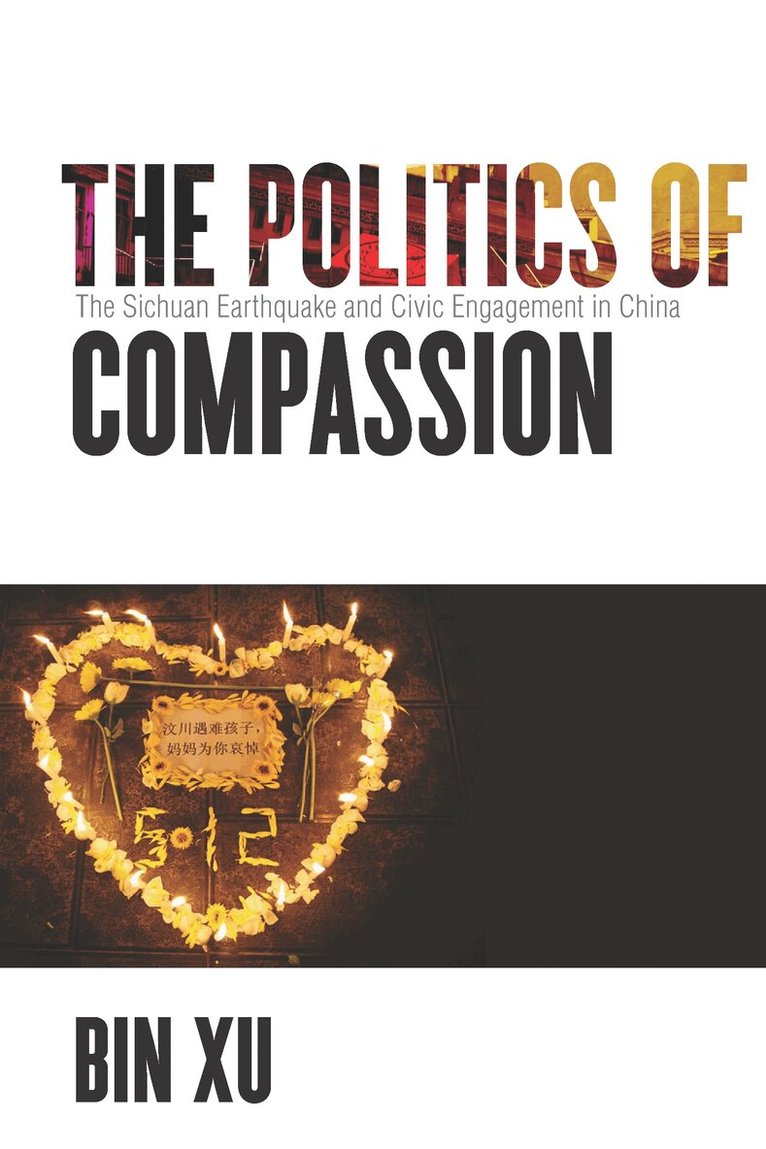
    Politics of Compassion

    The Sichuan Earthquake and Civic Engagement in China

    AvBin Xu

    Häftad, Engelska, 2017

    293 kr

    Beställningsvara. Skickas inom 5-8 vardagar. Fri frakt över 249 kr.

    Fler format och utgåvor

    Inbunden

    1 206 kr

    E-bok

    353 kr

    Beskrivning

    The 2008 Sichuan earthquake killed 87,000 people and left 5 million homeless. In response to the devastation, an unprecedented wave of volunteers and civic associations streamed into Sichuan to offer help. The Politics of Compassion examines how civically engaged citizens acted on the ground, how they understood the meaning of their actions, and how the political climate shaped their actions and understandings. Using extensive data from interviews, observations, and textual materials, Bin Xu shows that the large-scale civic engagement was not just a natural outpouring of compassion, but also a complex social process, both enabled and constrained by the authoritarian political context. While volunteers expressed their sympathy toward the affected people's suffering, many avoided explicitly talking about the causes of the suffering—particularly in the case of the collapse of thousands of schools. Xu shows that this silence and apathy is explained by a general inability to discuss politically sensitive issues while living in a repressive state. This book is a powerful account of how the widespread death and suffering caused by the earthquake illuminates the moral-political dilemma faced by Chinese citizens and provides a window into the world of civic engagement in contemporary China.

    Produktinformation

    • Utgivningsdatum:2017-08-22
    • Mått:152 x 229 x 18 mm
    • Vikt:340 g
    • Format:Häftad
    • Språk:Engelska
    • Antal sidor:256
    • Förlag:Stanford University Press
    • ISBN:9781503603363

    Utforska kategorier

    • Sociologi inom Samhälle och politik

    Mer om författaren

    Bin Xu is Assistant Professor of Sociology at Emory University.

    Recensioner i media

    "Bin Xu's analytic insights into "the politics of compassion" are acute, but his account never erases the personal and human. The result is riveting, provocative, and ultimately heart breaking."—Deborah Davis, Yale University "A riveting account of the aftermath of the Sichuan earthquake. All of the different types of actors, both within the state and in society, that constitute "civil society" in China are here brought to life and depicted in their complex interactions and negotiations. The Politics of Compassion should be required reading for all students of contemporary Chinese society and politics, as well as on state-society relations in general."—David A. Palmer, The University of Hong Kong "In a field heavily influenced by institutional and organizational analysis, Bin Xu's book foregrounds action, meaning, and context in the formation of Chinese civil society. Analyzing the practices of civic engagement following the Sichuan earthquake in 2008, Xu tells a rich and moving story of both apathy and moral sentiments, powerlessness and agency. The result is a refreshing, cultural-sociological perspective on the politics of compassion and civil society in China."—Guobin Yang, University of Pennsylvania "The Politics of Compassion does a masterful job telling the story of the Sichuan disaster and its aftermath in ways that draw readers into the specific details of a particular time and place while allowing us to see the broader political pattern as one that is repeated time and again in every corner of the planet.[It] is a must-read for anyone interested in Chinese civil society. Scholars of social policy, nonprofit management, disaster recovery, and state–society relations more generally will also find it to be an engaging, uplifting, disturbing, and highly provocative book to add to their shelves and their intellectual libraries."—Mary Alice Haddad, China Review International "Xu presents a powerful new concept to account for the extraordinary activism after the Sichuan earthquate, offering an in-depth analysis of activists' circumstances, actions, motivations, and justifications. This is an important book for all China scholars working on social movements and civil society, and may also offer new insights to anyone interested in disaster-related social and political changes." Huan Guo, Journal of Chinese Political Science "This book provides an original, much-needed, bottom-up perspective on the political and sociocultural aspects of the aftermath of the enormous tragedy of the 2008 Sichuan earthquake in China. Drawing upon extensive in-depth fieldwork conducted in Sichuan and elsewhere, the author goes beyond the conventional narrative of a compassionate post-disaster "civil society" to reveal the complex ways in which the underlying political and social contexts shape the action and meanings of various self-organized, grassroots civic engagements under authoritarianism....[T]his book is an illuminating yet sobering read for scholars interested in issues of civil society and social movement in China."—C. Chen, CHOICE "Xu's Politics of Compassion makes an important contribution to our understanding of civic engagement and civil society in contemporary China. It is an exemplary ethnography of citizens' involvement and participation within a larger political context."—Myungji Yang, American Journal of Sociology "The Politics of Compassionis an important contribution to a deeper theoretical and empirical understanding of civil society in an authoritarian state....[Xu's] attention to the cultural aspect of civic engagement provides great insight regarding how compassion is a sociopolitical act shaped by both structural relations between the civil society and the state, and by the meanings and goals people give to their actions. Therefore, the book is a valuable read for scholars seeking to understand civil society and volunteerism in China, as well as those working on social movements and disaster response."—Shijing Zhang, Pacific Affairs "Provocatively investigating volunteerism and civil engagement, Xu's book, with rich, timely first-hand data of the volunteers and disaster victims, will be of great value to students and researchers interested in Chinese state–society relations, and the moral–political contestations which deeply influence the political, economic and social activities of ordinary Chinese citizens."—Qiaoyun Zhang, NewBooks.Asia

    Innehållsförteckning

    • Contents and AbstractsIntroduction chapter abstractThe Introduction presents an overview of the topics, significance, and theoretical framework of the book.1Consensus Crisis chapter abstractThis chapter explores the massive wave of volunteer work in the aftermath of the Sichuan earthquake and examines how the volunteers themselves understood the meaning of their volunteering. The earthquake forced both the state and civic associations to solve pressing issues related to the emergency response instead of confronting each other. This created a "consensus crisis" where, in the face of crisis, different parties reached a consensus on goals and priorities. This in turn enabled civic associations to exercise the capacity they had built up in preceding decades. While all the participants expressed their compassion for the victims and their solidarity with fellow volunteers, the meaning they attached to their actions were multivocal and diverse. Most of the meanings, however, did not reflect classical Western notions of civil society, such as liberty and equality, but instead drew on nationalistic sentiment, religion, and a discourse of individualism.2Mourning for the Ordinary chapter abstractThis chapter examines how public intellectuals and liberal media proposed a national mourning observance and why the proposal became a reality in the wake of the Sichuan earthquake, whereas there had been no national mourning for victims of previous disasters. The mourning for the victims of the Sichuan earthquake was historically unprecedented because, unlike past instances of national mourning, which had been restricted to the deaths of state leaders and soldiers, it was a mourning for ordinary citizens. This was a result of the development of the Chinese public sphere in recent decades, in both its institutional capacity and its moral ideas about ordinary people's value. This development was catalyzed by the Chinese state's concern with its image after a series of political crises in the year of the Olympics.3Civic Engagement in the Recovery Period chapter abstractThis chapter analyzes the civic engagement in the recovery period. During this time, the consensus crisis dissolved when the state-business alliance came to dominate the recovery plans and the state, out of political considerations, restricted civic associations' activities. The post-earthquake civic engagement did not lead to significant long-term changes in the structural relations between the state and civil society. Changes in the political context, however, shaped how the volunteers understood and talked about their engagement, particularly when they faced an ethical-political dilemma about the school collapse issue. Most of them became apathetic and avoided the school collapse issue because of their inability to change the social and political factors that had led to shoddy construction, the normalization of the disaster as an acceptable pathology, and a reluctance to talk about it due to national pride.4Forgetting, Remembering, and Activism chapter abstractThis chapter examines how a "tiny public" of dissidents and intellectuals countered the state's forced remembering and forgetting by collecting the student victims' names and producing commemorative objects. Participants in the commemorative activism clearly articulated the meanings of their actions, which were similar to the classical normative ideas of civil society, such as individual liberty and the value of ordinary people's lives. Their engagement can be explained by their life experience and their prior involvement in the tiny public's activities. They significantly changed the memory of the earthquake in the world outside China, but their influence on memory within China was limited.Conclusion chapter abstractThe Conclusion presents a comparative case, the 2010 Yushu earthquake, to recapitulate the major arguments of the book and discusses the book's contributions to understanding civic engagement and civil society in China.