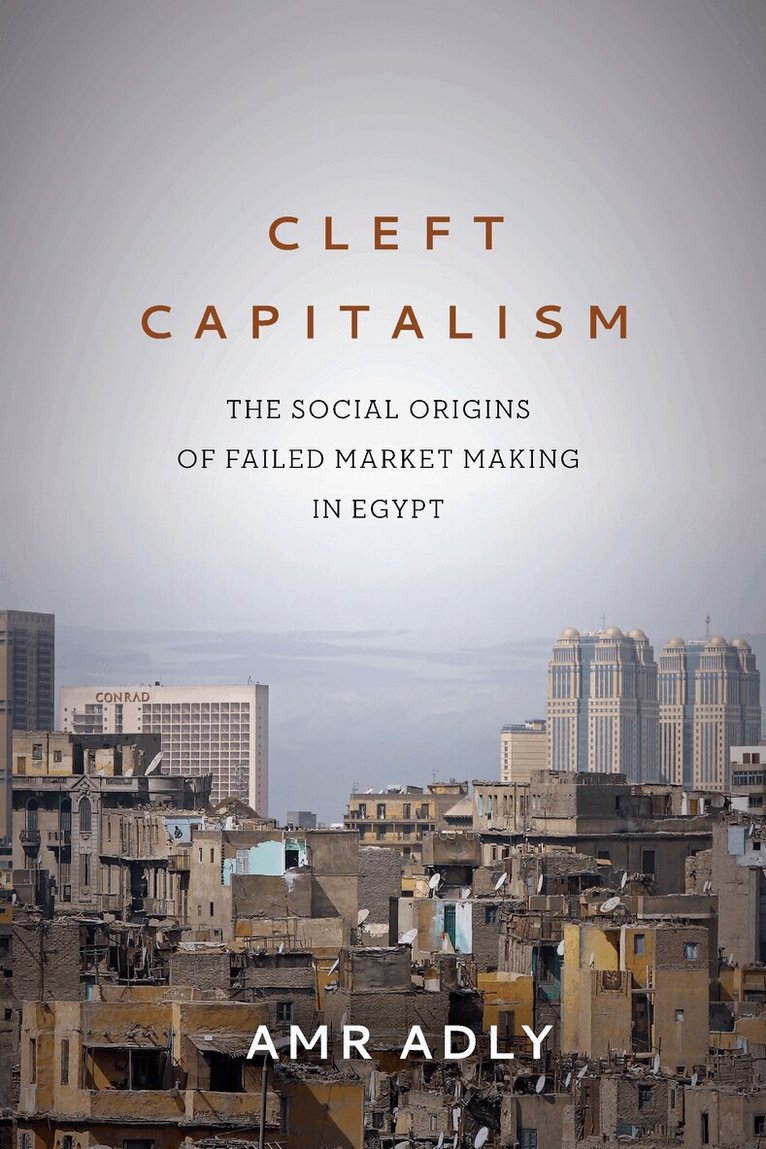
Inbunden, Engelska, 2020
Cleft Capitalism
The Social Origins of Failed Market Making in Egypt
Av Amr Adly
Del i serien Stanford Studies in Middle Eastern and Islamic Societies and Cultures
1500 kr
Beställningsvara. Skickas inom 7-10 vardagar. Fri frakt över 249 kr.
Beskrivning
Produktinformation
- Utgivningsdatum: 2020-06-09
- Mått: 152 x 229 x 28 mm
- Vikt: 658 g
- Format: Inbunden
- Språk: Engelska
- Serie: Stanford Studies in Middle Eastern and Islamic Societies and Cultures
- Antal sidor: 336
- Förlag: Stanford University Press
- ISBN: 9781503608917
Utforska kategorier
Mer om författaren
Amr Adly is Assistant Professor of Political Science at the American University in Cairo and the author of State Reform and Development in the Middle East: The Cases of Turkey and Egypt (2012).
Recensioner i media
"Cleft Capitalism is a highly original analysis of what Amr Adly calls Egypt's 'successful transition to failed capitalism.' Based on extensive and sound research, it represents an important rethinking of the trajectory of Egypt's political economy since 1974 and a bold challenge to Washington Consensus economic policy orthodoxy."—Joel Beinin, Stanford University "Amr Adly elaborates a novel explanation for underperforming economies of the Global South. Richly detailed, theoretically insightful, Cleft Capitalism is essential reading for anyone interested in the Egyptian, Middle Eastern, and other political economies."—Robert Springborg, Naval Postgraduate School "Cleft Capitalism offers a lucid, rich, and new understanding of the course of Egyptian economic development. With his sophisticated understanding of Egyptian politics and society and refined economic analysis, Amr Adly not only helps us understand Egypt better, but offers a model of how to approach the contentious terrain of economic change in the developing world."—Nathan J. Brown, George Washington University "Adly puts forth compelling arguments and descriptions of Egypt's failed market making....Cleft Capitalism offers new theoretical insights and valuable empirical analysis of the course of Egypt's political economy and the causes of its economic predicaments since 1974."—Housam Darwisheh, The Developing Economies "[Cleft Capitalism] is more than an exemplary analysis of the situation of political economy in Egypt. It is also a significant contribution to wider debates on the possibilities and limits of market-based development in the Global South....an essential read to students, researchers, and policy-makers interested in the political economy of Egypt, the limits and potentials of structural adjustment policies, and the insights of economic sociology to the study of political economy."—Hesham Shafik, Jadaliyya "Cleft Capitalism is an ambitious book that aims to make broad academic contributions far beyond its specific focus on the contemporary social and political economy of Egypt....[It succeeds] both as an overview of the Egyptian economy and as a critique of the institutional economics orthodoxy. It is one of the best books that I have read about both subjects in recent years, and I recommend it highly."—Mahmoud A. El-Gamal, Middle East Journal "[Adly's] novel argument diverges from dominant political economy accounts, which focus on corruption and crony capitalism or the lack of formal property rights and the rule of law. For Adly, the answer lies in the 'missing middle' of small and medium enterprises, which have served an important role in capitalist development by scaling up to become important job creators in more successful developing economies, such as in South Korea. Adly traces the roots of the problem to historically specific institutional arrangements that emerged earlier in the 20th century and during the period of state-led development under Nasser and were consolidated under Sadat and Mubarak's tenures. Adly's book is grounded on impressive qualitative and quantitative data collection and analysis and makes important contributions to the study of failed development in Egypt, with comparative implications for other developing countries in and beyond the Middle East and North Africa."—Committee for the Roger Owen Book Award, sponsored by the Middle East Studies Association
Betyg & recensioner
0 recensioner
Inga recensioner tillgängliga.