• Fri frakt över 249 kr
  • •
  • Snabba leveranser
  • •
  • Billiga böcker
Kundservice

Du är på sajten för privatpersoner.

Företag, bibliotek eller offentlig verksamhet?

Du handlar på classic.bokus.com, där alla dina funktioner finns intakta.
Till classic.bokus.com
Bokus logotyp. Gå till startsidan.
  • Erbjudanden
  • Student
  • Topplistor
  • Barn & ungdom
  • Bokus Play
  • E-böcker
  • Ljudböcker
  • Pocketböcker
  • Spel & pussel

10% rabatt på allt med kod NYSTART10 →

Sidfot

Mina sidor

    Hjälp

    • Kundservice
    • Vanliga frågor och svar
    • Frakt och leverans
    • Retur vid ångerrätt
    • Reklamera vara
    • Betalning
    • Köpvillkor
    • Allmänna villkor
    • Information om webbplatsens tillgänglighet

    Om Bokus

    • Om oss
    • Pressrum
    • För studenter
    • För företag
    • För bibliotek och offentlig verksamhet
    • För leverantörer
    • Hållbarhet

    Populärt

    • Aktuella erbjudanden
    • Presentkort
    • Studentlitteratur
    • Nya böcker
    • Topplistor
    • Signerade böcker
    • Engelska böcker

    Inspiration

    • Boktips
    • BookTok
    • Populära bokserier
    • Barnbokskaraktärer
    • Populära författare
    Logotyp för Bokus
    Följ oss på Facebook (extern länk)Följ oss på Instagram (extern länk)Följ oss på YouTube (extern länk)Följ oss på TikTok (extern länk)
    bokus @ CookiesAnpassa cookiesIntegritetspolicyKöpvillkor
    Till Citymail hemsida (extern länk)Till Budbee hemsida (extern länk)Till Postnord hemsida (extern länk)Till Schenker hemsida (extern länk)Till Early Bird hemsida (extern länk)Till Walleys hemsida (extern länk)
    1. Psykologi och pedagogik
    2. Pedagogik
    3. Pedagogisk metodik

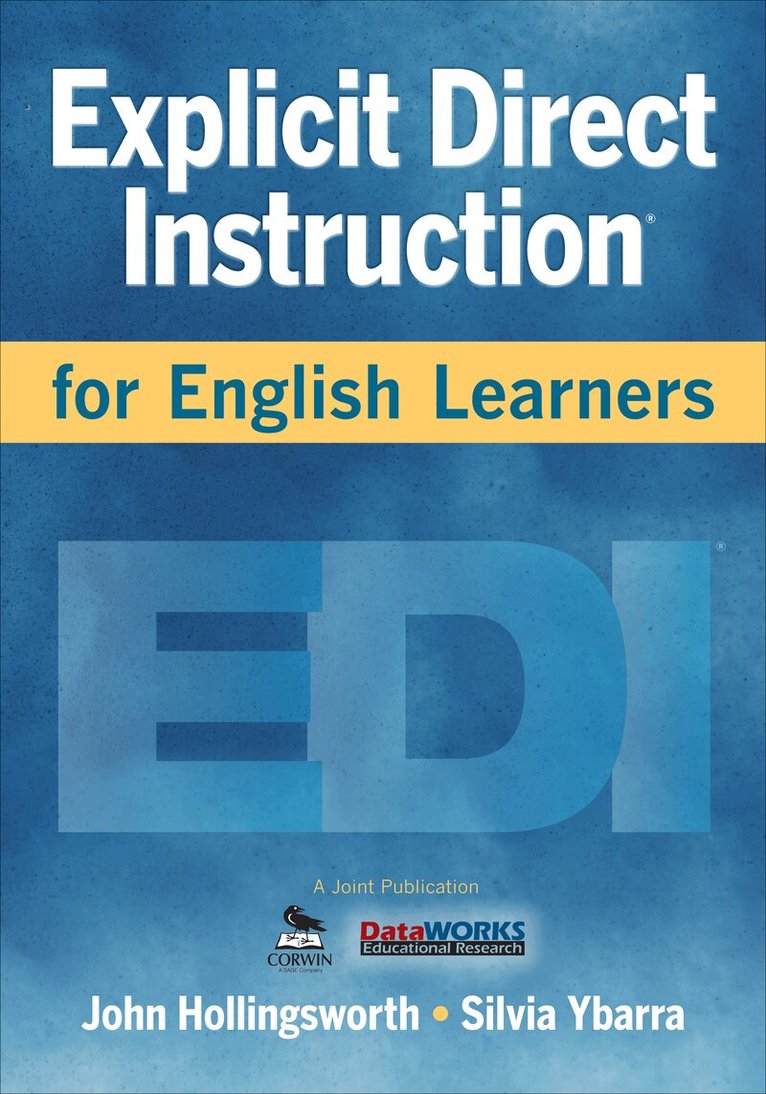
    Explicit Direct Instruction (EDI)

    The Power of the Well-Crafted, Well-Taught Lesson

    AvJohn R. Hollingsworth,Silvia E. Ybarra

    Häftad, Engelska, 2017

    Del i serien Corwin Teaching Essentials

    393 kr

    Beställningsvara. Skickas inom 5-8 vardagar. Fri frakt över 249 kr.

    Beskrivning

    A proven approach to better teaching and learning.

    Explicit Direct Instruction (EDI), an approach based on the premise that all children can learn, helps teachers deliver well-designed, well-taught lessons that significantly improve achievement for all learners. Authors Hollingsworth and Ybarra have refined and extended their highly successful methods in this second edition of their bestselling book.

    Written in an easy-to-read, entertaining style, this resource provides K-12 teachers with concrete strategies, detailed sample lessons, and scenarios that illustrate what EDI techniques look like in inclusive and diverse classrooms. With chapters covering the individual components of EDI, such as checking for understanding and activating prior knowledge, this updated edition refines the methods so that they are even more effective and easier to implement. Readers will find:  

    • Strategies for continuous, systematized student engagement 
    • Expanded corrective feedback strategies
    • Clear alignment to the latest content standards
    • A new, field-tested strategy for skill development and guided practice
    • Expanded information about differentiation and scaffolding 

    Combining educational theory, brain research, and data analysis, this is a fine-tuned, step-by-step guide to a highly effective teaching method.

    "Before EDI, our school was a ship adrift at sea with everyone rowing in different directions. EDI has provided us with a framework for instruction and a common language that allowed us to all row in the same direction. 
    Benjamin Luis, Principal
    Liberty Middle School, Lemoore, CA


    “EDI makes students accountable. They see now that school is a place to work and learn and play, and they love it. Because even though it is hard, they are doing well.”
    Trudy Cox, School Instructional Coach
    St. Mary Star of the Sea Catholic School, Carnarvon, Western Australia


    Produktinformation

    • Utgivningsdatum:2017-12-05
    • Mått:213 x 277 x 15 mm
    • Vikt:699 g
    • Format:Häftad
    • Språk:Engelska
    • Serie:Corwin Teaching Essentials
    • Antal sidor:248
    • Upplaga:2
    • Förlag:SAGE Publications
    • ISBN:9781506337517

    Utforska kategorier

    • Pedagogisk metodik inom Psykologi och pedagogik

    Mer om författaren

    John Hollingsworth is president of DataWORKS Educational Research, a company originally created to use real data to improve student achievement. Although DataWORKS started by analyzing learning outcomes (test scores), it soon refocused towards analyzing learning inputs (classroom instructional practices).  DataWORKS now focuses mainly on providing staff development to schools on classroom instruction.  John is an active researcher and presenter and has published numerous articles in educational publications.  He spends much of his time on the road training teachers. Dr. Silvia Ybarra, Ed.D., began her career in education as a physics and chemistry teacher at Roosevelt High School in Fresno, California.  Next, Silvia became principal of Wilson Middle School in Exeter, California, which under her leadership became a prestigious Distinguished School.  Silvia was then named assistant superintendent of Coalinga-Huron School District. Her focus progressed from helping one classroom to helping one school to helping an entire district.  Silvia is the head researcher at DataWORKS.

    Recensioner i media

    "I flagged page after page. I had been a classroom teacher for ten years and was unaware of many of the EDI strategies.

    Innehållsförteckning

    • Preface to the Second Edition: What’s New in EDIAcknowledgmentsAbout the AuthorsChapter 1. Students Say, “I Can Do It!”The Day I Saw the Breakthrough in Classroom InstructionWhere Our Research Began: Student AchievementWhere Our Research Led: Classroom InstructionChapter 2. Are Some Approaches Better Than Others? What Is Effective Instruction?Why Are Children Sent to School? Talent Discovery Versus Talent DevelopmentThe Teaching/Learning Dilemma: Speed Up or Slow DownCriteria for an Instructional ApproachTwo Philosophies About EducationHigh-Stakes TestingWhat to Do?EDI Is Not LecturingEDI Is Not ScriptedResearch Supports Direct InstructionWhen to Use Group WorkChapter 3. Good Instruction Is Always Good Instruction: An Explicit Direct Instruction OverviewWhat Is Explicit Direct Instruction?Explicit Direct Instruction Lesson DesignExplicit Direct Instruction Lesson DeliveryHow to Use EDI in Your ClassroomChapter 4. Creating Engaged Students: Use Engagement Norms!Student Engagement Is Created When You Ask Your Students to Do SomethingHistory of Student Engagement NormsStudent Engagement Norm 1: Pronounce With MeStudent Engagement Norm 2: Track With MeStudent Engagement Norm 3: Read With MeStudent Engagement Norm 4: Gesture With MeStudent Engagement Norm 5: Pair-ShareStudent Engagement Norm 6: Attention SignalStudent Engagement Norm 7: WhiteboardsStudent Engagement Norm 8: Use Complete Sentences (Public Voice, Academic Vocabulary)Training Students in the Engagement NormsSummaryChapter 5. Is Everyone Learning? Checking for UnderstandingWhat Is Checking for Understanding?TAPPLE—Checking for Understanding the EDI Way!Teach FirstAsk a Specific QuestionPair-SharePick a Non-VolunteerListen Carefully to the ResponseEffective FeedbackSummaryChapter 6. Everyone Learns: Corrective Feedback and WhiteboardsListen Carefully to the ResponseEffective FeedbackWhiteboards, the Best Way to CFU!SummaryChapter 7. Establishing What Is Going to Be Taught: Learning ObjectivePart I: Well-Designed Learning ObjectivesPart II: Writing Standards-Based Learning ObjectivesPart III: The Learning Objective Must Be Presented to the StudentsSummaryChapter 8. Connecting to What Students Already Know: Activating Prior KnowledgePart I: What Does It Mean to Activate Prior Knowledge?Part II: How to Activate Prior KnowledgeSummaryChapter 9. These Are the Big Ideas: Concept DevelopmentPart I: Concept Development DesignPart II: Concept Development DeliverySummaryChapter 10. I’ll Work a Problem First: Rule of Two— Skill Development and Guided PracticeSkill Development (Teacher)Guided Practice (Students)How to Design Skill Development and Guided PracticeHow to Teach Skill Development/Guided PracticeSummaryChapter 11. This Is Important to Learn: RelevanceRelevanceWhen Do You Teach Lesson Relevance?How Do You Provide Lesson Relevance?How to Design Lesson RelevanceHow to Teach Lesson RelevanceSummaryChapter 12. Making One Final Check: Closing the LessonClosing the LessonHow to Provide Lesson ClosureWhen Closure Is Complete, Initiate Independent PracticeChapter 13. Planning for Success: Differentiation and ScaffoldingDifferentiating and Scaffolding to Increase Student SuccessIn-Class Interventions and Out-of-Class InterventionsResponse to Intervention (RTI) and EDISummaryChapter 14. Having Students Work by Themselves: Independent Practice and Periodic ReviewStarting With the End in Mind: The Independent Practice Must Match the LessonPeriodic ReviewSummaryChapter 15. Creating Well-Crafted Lessons: Putting It All TogetherCreating EDI Lessons From a TextbookCreating Your Own EDI LessonsDataWORKS Enters the Classroom to TeachChapter 16. Looking at All the Components: Analyzing a Sample LessonUse educeri.com for EDI LessonsEDI Lesson LayoutSummaryResources: What the Research SaysReferencesIndex