• Fri frakt över 249 kr
  • •
  • Snabba leveranser
  • •
  • Billiga böcker
Kundservice

Du är på sajten för privatpersoner.

Företag, bibliotek eller offentlig verksamhet?

Du handlar på classic.bokus.com, där alla dina funktioner finns intakta.
Till classic.bokus.com
Bokus logotyp. Gå till startsidan.
  • Erbjudanden
  • Student
  • Topplistor
  • Barn & ungdom
  • Bokus Play
  • E-böcker
  • Ljudböcker
  • Pocketböcker
  • Spel och pussel

Pocketfynda! Hundratals böcker för 49 kr/st →

Sidfot

Mina sidor

    Hjälp

    • Kundservice
    • Vanliga frågor och svar
    • Frakt och leverans
    • Retur vid ångerrätt
    • Reklamera vara
    • Betalning
    • Köpvillkor
    • Allmänna villkor
    • Information om webbplatsens tillgänglighet

    Om Bokus

    • Om oss
    • Pressrum
    • För studenter
    • För företag
    • För bibliotek och offentlig verksamhet
    • För leverantörer
    • Hållbarhet

    Populärt

    • Aktuella erbjudanden
    • Presentkort
    • Studentlitteratur
    • Nya böcker
    • Topplistor
    • Signerade böcker
    • Engelska böcker

    Inspiration

    • Boktips
    • BookTok
    • Barnbokskaraktärer
    • Populära författare
    Logotyp för Bokus
    Följ oss på Facebook (extern länk)Följ oss på Instagram (extern länk)Följ oss på YouTube (extern länk)Följ oss på TikTok (extern länk)
    bokus @ CookiesAnpassa cookiesIntegritetspolicyKöpvillkor
    Till Citymail hemsida (extern länk)Till Budbee hemsida (extern länk)Till Postnord hemsida (extern länk)Till Schenker hemsida (extern länk)Till Early Bird hemsida (extern länk)Till Walleys hemsida (extern länk)
    1. Samhälle och politik
    2. Sociologi och antropologi

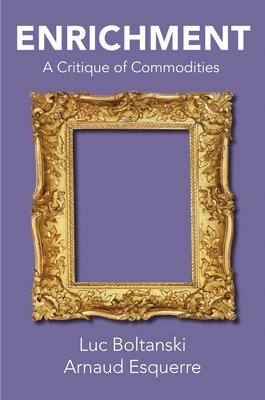
    Enrichment

    A Critique of Commodities

    AvLuc Boltanski,Arnaud Esquerre

    Inbunden, Engelska, 2020

    252 kr

    Beställningsvara. Skickas inom 5-8 vardagar. Fri frakt över 249 kr.

    Beskrivning

    This book offers a major new account of modern capitalism and of the ways in which value and wealth are created today. Boltanski and Esquerre argue that capitalism in the West has recently undergone a fundamental transformation characterized by de-industrialization, on the one hand, and, on the other, by the increased exploitation of certain resources that, while not entirely new, have taken on unprecedented importance.  It is this new form of exploitation that has given rise to what they call the ‘enrichment economy’.  The enrichment economy is based less on the production of new objects and more on the enrichment of things and places that already exist.  It has grown out of a combination of many different activities and phenomena, all of which involve, in their varying ways, the exploitation of the past. The enrichment economy draws upon the trade in things that are intended above all for the wealthy, thus providing a supplementary source of enrichment for the wealthy people who deal in these things and exacerbating income inequality. As opportunities to profit from the exploitation of industrial labour began to diminish, capitalism shifted its focus to expand the range of things that could be exploited.  This gave rise to a plurality of different forms for making things valuable – valuing objects in terms of their properties is only one such form.  The form that plays a central role in the enrichment economy is what the authors call the ‘collection form’, which values objects based on the gap they fill in a collection. This valuation process relies on the creation of narratives which enrich commodities. This wide-ranging and highly original work makes a major contribution to our understanding of contemporary societies and of how capitalism is changing today.  It will be of great value to students and scholars in sociology, political economy and cultural studies, as well as to anyone interested in the social and economic transformations shaping our world.

    Produktinformation

    • Utgivningsdatum:2020-04-09
    • Mått:163 x 231 x 43 mm
    • Vikt:862 g
    • Format:Inbunden
    • Språk:Engelska
    • Antal sidor:600
    • Förlag:John Wiley and Sons Ltd
    • ISBN:9781509528721
    • Översättare:Catherine Porter

    Utforska kategorier

    • Sociologi och antropologi inom Samhälle och politik

    Mer om författaren

    Luc Boltanski is Professor of Sociology at the EHESS, Paris and he is the author of many books, including The New Spirit of Capitalism (with Eve Chiapello).Arnaud Esquerre is a researcher at Centre National de la Recherche Scientifique (CNRS) and Director of the Institute for Interdisciplinary Research on Social Issues (Paris).

    Recensioner i media

    “Boltanski and Esquerre propose a grammar of things and their value that sheds new light on the transformations of contemporary capitalism. An original and powerful work which will undoubtedly stimulate much debate.”Clément Lefranc, Sciences humaines “A seminal book.”European Journal of Sociology“arresting and impressive”Journal of Classical Sociology "Expansion of industry blocked, capitalism in France—and not only there—seeks shelter in the production by select artisans and artists of 'authentic' goods for the winners of globalization. Enrichment is a brilliant and deeply disturbing study of this grim involution, by which a nation’s history and identity become its last resource, and new forms of labor market inclusion and exclusion disarm traditional criticism of exploitation. This book is a foundation stone in a sociology of dystopia for our times." Charles Sabel, Columbia Law School “Uplifting, fun, accessible to all, Enrichment is the most scholarly and relevant analysis to finally make sense of the current 'madness' of the art market. It fascinates speculators, disconcerts art lovers, and arouses public distrust. But the observation is obvious to all: in our post-industrial societies, heritage, luxury goods and even contemporary art are the only source of wealth that we have. They are now part of the main foundations of our economy." Catherine Millet, founder and editor of Art Press

    Innehållsförteckning

    • AcknowledgmentsTranslator’s notePreface by Charles SabelIntroductionPART I. Destruction and Creation of WealthChapter 1. The Age of the Enrichment EconomyThe deindustrialization of Western EuropeOld and new sites of prosperityThe omnipresence of enriched objectsThe rise of luxuryHeritage creationThe development of tourism The expansion of cultural activitiesThe art tradeArles: from railroad shops to contemporary art exhibitsAn economic reorientation toward the wealthyChapter 2. Toward EnrichmentThe characteristics of an enrichment economyDormant resources in the enrichment economyChanges in French cultural policyA new perspective in economic analysisA shift to different scalesFrom ornamental patrimony to heritage creationLocal mutations in global capitalismPartisans of thingsPart II. Prices and Forms of ValuationChapter 3. Commerce in ThingsThe commodity conditionOn the circulation of thingsChanging handsThe process of determinationPrice and metaprice Critiquing the priceValue as justification for a pricePrice as an element in the construction of realityChapter 4. Forms of ValuationStructure and transformation group of forms of valuationAnalytic and narrative presentations of thingsThe problem of valuation by means of imagesOn the reproduction of thingsInstitutions and forms of valuationStructuralism and capitalismCompetition from a systematic viewpointCapitalism and markets The role of the capacity to reflectThe structure of the forms of valuationPart III. Commodity StructuresChapter 5. The Standard FormThe model for the standard formThe standard form and industrial productionPrototypes and specimensThe proliferation of things without personsThe internal tensions of the standard formThe unease created by the standard formChapter 6. Standardization and DifferentiationThe historical dimension of the forms of valuationFrom trade in things to the circulation of commoditiesThe effect of standardization on the constitution of forms of valuationMaterial economies, immaterial economiesChapter 7. The Collection FormThe modernity of the collection formSystematic collection as an arrangement for valuationCollectors’ items Price and value of collectors’ itemsThe fields of collectiblesThe structure of the collection formChapter 8. Collection and EnrichmentThe usefulness of useless thingsCollecting in thrall to marketingOn the use of the collection form by luxury firmsFrom lumber to luxury goods: the transformation of the Pinault group into KeringCapturing the wealth of the wealthiestValues and prices of luxury product brandsStandard products with a “collector effect” and collectors’ itemsThe collection form and contemporary art The contradiction of the enrichment economyChapter 9. The Trend FormTrend, sign, and distinctionThe structure of the trend formThe economic constraints of the trend formFrom the trend form to the collection formChapter 10. The Asset FormCharacteristics of the asset formOn the liquidity of things as assetsThe commercial potential of assetsPart IV. Who Profits from the PastChapter 11. Profit in a Commercial SocietyCompetition and differentiationSurplus work value and profitSurplus market value and profitDisplacing commodities or displacing buyersProfiting from the wealthy in the capitalist cosmosChapter 12. The Enrichment Economy in PracticeAn enriched village: Laguiole in AubracThe transformation of habitats through heritage creationNew “traditional festivals” in the villageHeritage creation around foodA landscape to contemplateCutlery valorized by the collection formThe “artisanal” manufacture of a knife in LaguioleA collectible knifeMuseification as a means of commercializationThe problem of the origin of materialsDistinguishing Laguiole’s knives from those made elsewhere“A name, a brand, a village”How the residents lost the ability to dispose freely of the name of their villageA geographic indication to “highlight the treasures of the territories”Chapter 13. The Shape of the Enrichment SocietyThe organization of things and personsWho can profit from an enrichment economy?“Losers” and “servants”The return of “rentiers”Chapter 14. Creators in the Enrichment Society The economic condition of culture workersSelf-promotion by creatorsThe constraint of self-exploitationThe circumstances behind the crystallization of social classesTroubled critiquesConclusion. Action and StructuresThe enrichment economy and a critique of capitalismOn pragmatic structuralismAnnexe BibliographyNotes