• Fri frakt över 249 kr
  • •
  • Snabba leveranser
  • •
  • Billiga böcker
Kundservice

Du är på sajten för privatpersoner.

Företag, bibliotek eller offentlig verksamhet?

Du handlar på classic.bokus.com, där alla dina funktioner finns intakta.
Till classic.bokus.com
Bokus logotyp. Gå till startsidan.
  • Erbjudanden
  • Nyheter
  • Student
  • Topplistor
  • Barn & ungdom
  • Bokus Play
  • E-böcker
  • Pocketböcker
  • Spel & pussel

10% rabatt på allt med kod NYSTART10 →

Sidfot

Mina sidor

    Hjälp

    • Kundservice
    • Vanliga frågor och svar
    • Frakt och leverans
    • Retur vid ångerrätt
    • Reklamera vara
    • Betalning
    • Köpvillkor
    • Allmänna villkor
    • Information om webbplatsens tillgänglighet

    Om Bokus

    • Om oss
    • Pressrum
    • För studenter
    • För företag
    • För bibliotek och offentlig verksamhet
    • För leverantörer
    • Hållbarhet

    Populärt

    • Aktuella erbjudanden
    • Presentkort
    • Studentlitteratur
    • Nya böcker
    • Topplistor
    • Signerade böcker
    • Engelska böcker

    Inspiration

    • Boktips
    • BookTok
    • Populära bokserier
    • Barnbokskaraktärer
    • Populära författare
    Logotyp för Bokus
    Följ oss på Facebook (extern länk)Följ oss på Instagram (extern länk)Följ oss på YouTube (extern länk)Följ oss på TikTok (extern länk)
    bokus @ CookiesAnpassa cookiesIntegritetspolicyKöpvillkor
    Till Citymail hemsida (extern länk)Till Budbee hemsida (extern länk)Till Postnord hemsida (extern länk)Till Schenker hemsida (extern länk)Till Early Bird hemsida (extern länk)Till Walleys hemsida (extern länk)
    1. Samhälle och politik
    2. Politik och statsskick

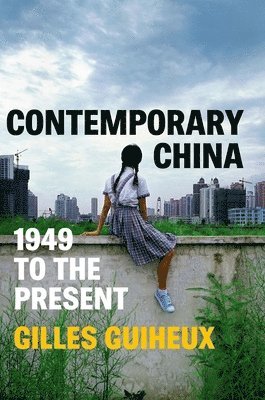
    Contemporary China

    1949 to the Present

    AvGilles Guiheux

    Inbunden, Engelska, 2023

    244 kr

    Beställningsvara. Skickas inom 5-8 vardagar. Fri frakt över 249 kr.

    Fler format och utgåvor

    E-bok

    408 kr

    Beskrivning

    With a population of nearly 1.5 billion and the world’s second largest economy, China is a major player in the world today, and yet many in the West know very little about contemporary China. This book provides a clear, authoritative and up-to-date history of China since 1949, drawing on extensive research to describe and explain the key developments and to dispel the many myths and misconceptions surrounding this twenty-first-century superpower.In contrast to many commentators who overstate the novelty of the Communist regime, Guiheux emphasizes instead its complex political heritage, highlighting the many continuities it shares with the reformers and revolutionaries of the early twentieth century. At the same time, the ability of China’s authoritarian regime to transform the economy and society is key to understanding its breakneck trajectory of modernization – an ability that, as Guiheux explains, far outweighed the importance and effectiveness of Mao’s utopian vision. Guiheux also aims to ‘de-exoticize’ China. While not on the path of a Western-style modernity, China has experienced the same phenomena that have characterized every historical process of modernization: industrialization, urbanization, bureaucratization and globalization.This expertly researched history of the People’s Republic of China will be essential reading for all students and scholars of Chinese history and politics, and for anyone interested in contemporary China.

    Produktinformation

    • Utgivningsdatum:2023-05-19
    • Mått:163 x 231 x 41 mm
    • Vikt:771 g
    • Format:Inbunden
    • Språk:Engelska
    • Antal sidor:432
    • Förlag:Polity Press
    • ISBN:9781509552498
    • Översättare:Andrew Brown

    Utforska kategorier

    • Politik och statsskick inom Samhälle och politik

    Mer om författaren

    Gilles Guiheux is a historian and sociologist at Université Paris Cité.

    Recensioner i media

    ‘A comprehensive and well-balanced account of today’s China and how it evolved, from the political system to culture, from history to twenty-first-century society, set in the context of the long-term national development of the country whose evolution will affect the whole world.’Jonathan Fenby, author of The Penguin History of Modern China‘Moving beyond tired frames that stress China’s uniqueness and incommensurability, Guiheux skilfully situates the history of the PRC in broadly comparative terms. Particularly effective is the balance struck between a chronological account and the thematically specific analyses of politics, society, culture and economy. A wonderful achievement of synthesis and insight with much to offer to both specialist and lay reader alike.’Arunabh Ghosh, Harvard University‘To many, China is a complicated, threatening and opaque nation. Gilles Guiheux aims to “‘de-exoticize’ China and analyse its transformations in the light of other human societies”, and he succeeds. By the book’s final page, the mysterious and alien become transparent and familiar, serving the reader well as the West strategizes a constructive path forward with the most populous superpower.’Chris Fenton, Former President of DMG Entertainment Motion Picture Group (China)

    Innehållsförteckning

    • Acknowledgments Introduction Chapter One. The establishment of a new regime (1949-1957)Building a new stateThe achievement of unity The administration of the territoriesThe strategy of the New Democracy (1949-1953) The New Institutions (1954)Society is brought into lineThe marriage law (May 1950)Agrarian reformThe campaign for the repression of counter-revolutionaries (February 1951)The Three-anti Campaign (December 1951) and the Five-anti Campaign (April 1952) against the bourgeoisieBringing intellectuals to heelForging links with the socialist campThe Sino-Soviet allianceThe Korean WarAn orthodox economic policyThe Eighth Party Congress (1956)Conclusion Chapter Two. Maoism and its excesses (1958-1976)The origins of the Great Leap ForwardThe successive stages of the Great Leap ForwardThe Great Famine (1959-1961)Natural causesHuman errorsPolitical responsibilitiesPragmatism and political divisions (1960-1965)Mao’s adjustment program and political withdrawalThe Socialist Education Movement (1962-1965)The Maoization of the People’s Liberation Army and preparation for warThe Cultural Revolution (1966-1969)The beginnings (October 1965-July 1966)The mobilization of the Red Guards (August 1966-January 1967)Militarization in the face of revolutionary seizures of power (January to      August 1967)The return to order (1967-1969): bringing the Red Guards to heel and the      Ninth CongressResponsibilities and consequencesThe end of Maoism and the crises of succession (1969-1976)The Lin Biao era (1969-1971)The elimination of Lin Biao in September 1971The end of Maoism (1972-1976)Conclusion Chapter Three. Giving priority to economic modernization (1976-1992)The Hua Guofeng transition (September 1976-December 1978)The struggle between two tendencies: neo-Maoists against pragmatistsA veteran to embody renewalThe first reforms (1979-1986)Deng Xiaoping comes to powerThe rehabilitation of the lawThe acceleration of reforms (1984-1986)The failure of Zhao Ziyang and the crisis of the regime (1986-1989)The aborted political reformThe reimposition of dictatorshipConclusion Chapter Four. Building a new model (since 1992)The Jiang Zemin decade: authoritarian, conservative and pragmatic leadership (1989-2002)An engineer in powerThe rise of nationalismJiang Zemin’s consolidation of powerJiang Zemin’s initiativesThe Hu Jintao - Wen Jiabao Era (2002-2012): a lost decade?Populist leadersCrises in Tibet and Sichuan in 2008Two ‘campaigns of mass distraction’The fifth generation of leaders in power (since 2012)The change of political personnelXi Jinping, a ‘prince’ in powerInternal authoritarianismExpansionism abroadConclusion Chapter Five. Forms of government: from arbitrary rule to the aborted attempt at institutionalizationThe Communist Party: organization, ideology, adaptationParty organizationParty membersIdeologyFive generations of leadersThe state apparatus: a democratic façadeExecutive powerThe elected assembliesA ‘state of laws without rule of law’The army in the political systemThe Party-State and society: control, participation, resistanceA triple system of repression, confinement and surveillanceSocial coalitions supporting the regimeOpponents without oppositionPublic space and civil societyConclusion Chapter Six. The creation of wealth: from planned economy to the marketThe socialist cycleThe place of inheritanceThe socialist planned economyThe Great Leap Forward (1958-1960)Assessment of the Maoist periodThe reform cycleThe decollectivization of the countrysideBusiness reform1984-1988: take-off1989-1993, the end of the reformsThe move towards a market economy (1993-2003)The Hu Jintao-Wen Jiabao administration: a new activismThe economic policy of Xi Jinping and Li KeqiangAn assessment of the structural transformationsThe Chinese market economyThe diversification of economic actorsThe transformation of the economic role of the stateRestructuring the administration of the economyThe weaknesses of the stateThe internationalization of the economyChina and international tradeConclusion  Chapter Seven. Society on the move: mobility and inequalityMaoist China: From movement to immobilization (1949-1978)The establishment of the hukou systemLabelling of the populationA nomenklatura: a privileged castePolitical mobilitySociety on the move again (since 1979)The winnersThe old working class and the new urban povertyThe new working class: migrant workersThe debate about inequality A diverse social spaceA political project: the construction of the middle classesThe hypothesis of the social divideLatin Americanization as a possible scenarioMeasuring inequalitiesConclusion Chapter Eight. The towns versus the countrysideThe broken promises of the peasant revolutionMaoism sacrifices the peasantsBuilding a working classThe non-development of citiesThe urban miracle: urbanization without revolutionUrban growth: a political choiceImproving housing conditionsNew urban governanceNew rural issuesThe ‘three nong’Collective action in the countrysideNew rural policiesConclusion Chapter Nine. Populations: the modernization of societyCounting the population, controlling the demographicsThe demographic transitionThe pragmatism of Maoist population policiesThe one-child policyThe harmful consequences of the one-child policyProtecting the population: social policiesThe Maoist period: protection for those who workThe state’s withdrawal after 1978The reconstruction of a welfare systemThe private and intimate sphereThe familyForms of sexuality: a liberation?Homosexuality is now toleratedPersistent gender inequalitiesThe individualization of societyThe choice of spouse: a freely chosen alliance between two familiesSelf-interestThe reconfiguration of the religious sceneConclusion Chapter Ten. Education and cultureEducation and scienceEducation (1949-1976): priority given to the early yearsThe massification, marketization and internationalization of higher education since 1979Persistent problems: selectivity, inequalityThe professionalization and internationalization of scientific activity since 1979Culture and creationCulture at the service of the political project (1949-1979)A decade of experiments (1979-1989)Culture opens up to the market Cultural policies: the case of museumsConclusion Epilogue MapTitle-holders of the main positions in the government of the People’s Republic of China (1949-2018)ChronologyBibliographyIndex